Why the US Government Suspended Claude Fable 5 and Mythos 5
Three days live, then dark, inside the export-control directive that pulled two frontier models
- AI Digest
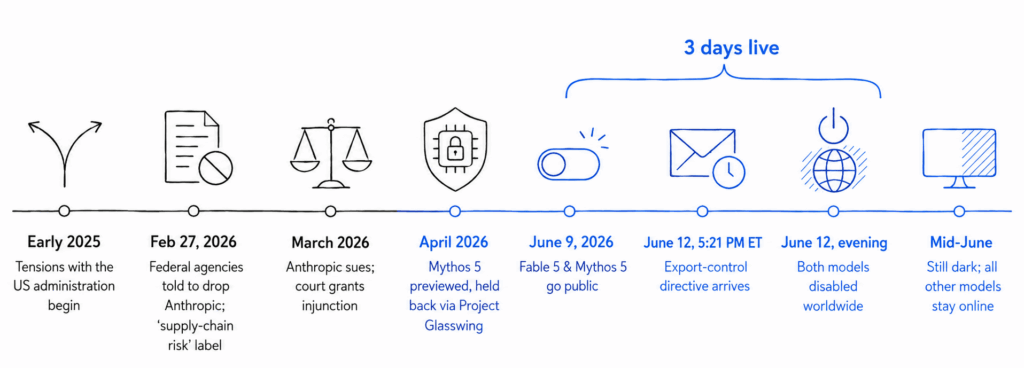
A frontier AI model was on the market for three days. Then the US government took it off.
On the evening of June 12, 2026, Anthropic disabled access to Claude Fable 5 and Claude Mythos 5 for every customer worldwide. Anthropic took this step to comply with an export-control directive from the US government, issued under national security authorities. The models had been public for three days, and every other Anthropic model stayed online. Here is the timeline, the stated trigger, and the dispute now unfolding in the open.
What the directive ordered
By Anthropic’s own account, the order arrived at 5:21 PM ET on June 12. It instructed the company to suspend all access to Fable 5 and Mythos 5 “by any foreign national, whether inside or outside the United States”, a scope that explicitly included Anthropic’s own foreign-national employees.
There is a nuance the shorthand online tends to flatten. On paper, the directive applied specifically to access by non-US nationals. Because Anthropic operates globally and cannot cleanly segregate access at that granularity overnight, the practical effect was a total shutdown, and the company disabled both models for all users to guarantee compliance.
The practical result was a worldwide shutdown, even though the directive’s text named foreign nationals specifically. The letter, Anthropic says, gave no specific detail about the underlying national security concern.
The stated trigger: a narrow jailbreak
Anthropic’s reading is that the government believes it became aware of a method of jailbreaking Fable 5, bypassing the safeguards meant to block high-risk cyber tasks.
The reported technique, by Anthropic’s description, amounts to asking the model to read a specific codebase and fix the software flaws it finds. The company reviewed a demonstration and concluded it surfaced a small number of previously known, minor vulnerabilities, the kind, it argues, that other publicly available models (it names OpenAI’s GPT-5.5) can find without any bypass, and that defenders use routinely to keep systems safe.
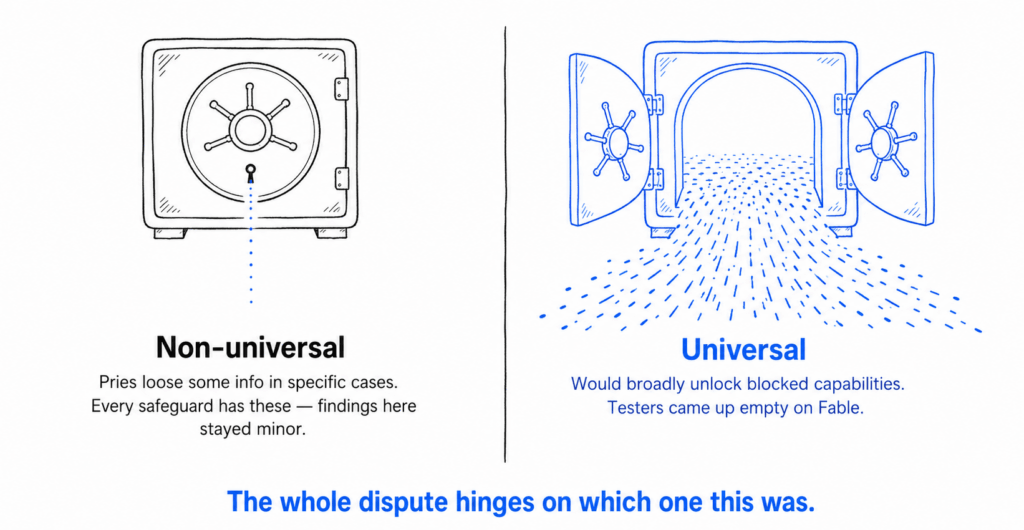
This distinction between narrow and universal jailbreaks sits at the centre of the disagreement:
- A non-universal jailbreak pries loose some information in specific circumstances. Anthropic says every safeguard in the industry is vulnerable to these, and that everything disclosed to it stayed benign or amounted to minor findings with no Mythos-specific uplift.
- A universal jailbreak would broadly unlock the model’s blocked capabilities. Anthropic says every tester so far, across thousands of hours of red-teaming with the US government, the UK AI Safety Institute and outside groups, has come up empty on Fable.
What Fable and Mythos are
Mythos 5 is Anthropic’s most powerful model, its frontier tier. When the company first previewed it in April, it held the model back from general release on the grounds that it was too capable at hacking to ship safely. Access instead went to a small set of organisations through Project Glasswing, reportedly more than forty companies, including Microsoft, Apple, AWS, Cisco, Nvidia, Broadcom and the Linux Foundation, who used it to find and patch security weaknesses. Mozilla alone reported resolving hundreds of vulnerabilities with the preview model’s help.
Fable 5 is the same underlying model wrapped in extra safeguards designed to block cybersecurity and other high-risk uses. It was the first time Anthropic released a model of that capability tier to the public, and the safeguards were the reason it could. The company says those guardrails tested as substantially stronger than any previously deployed model’s, strong enough that some users complained they were overly broad. To support ongoing jailbreak research, Fable also carried a 30-day data-retention requirement, a policy Anthropic acknowledges carries real commercial cost.
The distinction between model capability and model safety is often misunderstood. We explored a similar gap between technical reality and public perception in What Are Deepfakes — and Why the Problem Surrounding Them Is Often Misunderstood? →
Anthropic is complying, and openly disagreeing
The company’s posture is unusual: full compliance alongside public dissent.
Anthropic removed access as ordered. At the same time, it stated plainly that it disagrees a narrow potential jailbreak should justify recalling a model deployed to hundreds of millions of people, and warned that applying that standard across the industry would effectively halt all new frontier-model releases. Its broader principle is that governments should be able to block unsafe deployments through a process that is transparent, fair, clear and grounded in technical facts. This action, the company argues, fell short of those tests. It apologised to customers, called the situation a misunderstanding, and said it is working to restore access.
The backdrop: a year-long standoff
This grew out of a longer conflict. Anthropic and the current US administration have been at odds, with tensions rising, since early 2025.
On February 27, 2026, President Trump directed federal agencies to stop using Anthropic’s technology, and Defense Secretary Pete Hegseth designated the company a “supply chain risk”, a label historically reserved for firms tied to foreign adversaries. The trigger was a collapse in negotiations over military use: Anthropic had drawn red lines against domestic mass surveillance and fully autonomous weapons, while the Pentagon wanted unrestricted access for any lawful purpose. Anthropic sued in March; a San Francisco federal judge granted a preliminary injunction against enforcing a Claude ban, while an appeals court later declined to stay the separate supply-chain-risk action. The export-control directive on Fable and Mythos continues that same sequence.
The Anthropic dispute highlights a broader challenge: technology adoption is rarely limited by technology alone. We explored the organizational side of AI transformation in AI and Humans Together: How to Transform the Organization? →
How the industry read it
Reaction split along predictable lines, with a few surprises.
Security practitioners zeroed in on the precedent: a capability defenders use every day was treated as the basis for pulling a commercial product. Developers who had built on Fable 5 concentrated on reliability, and many took the episode as a live argument for open-weight or self-hosted models that stay under their own control. Some observers, more cynically, read it as pre-IPO publicity. And historians noted the rhyme: in the 1990s the US classified strong encryption as a controlled munition, a stance that eventually unwound.
Where it stands now
As of mid-June, Fable 5 and Mythos 5 remain dark. Every other Anthropic model (Opus, Sonnet, Haiku) stays available, and across Claude’s products, sessions that would have used the suspended models now fall back to the user’s default or to Opus 4.8. Anthropic says it is working to restore access and has promised further detail.
The episode raises a question larger than one company: how, and on what evidence, a government can reach into a deployed AI product and switch it off.
Where this leaves your roadmap
The AI landscape can shift in a single afternoon, and a model that’s central to your plans one day can be gone the next. If your roadmap leans on a single model or provider, that exposure is worth a clear-eyed look. In a free 30-minute consultation, Omnit gives you a straight professional read on where AI fits and where it puts you at risk. It is a focused technical conversation built around your own situation.
Sources
- Anthropic. (2026). Official statement on the export-control directive. Anthropic. Read article →
- CNBC. (2026). Background on the Anthropic–Pentagon dispute. CNBC. Read article →
- CNBC. (2026). News report on Anthropic’s worldwide service suspension. CNBC. Read article →
- 9to5Mac. (2026). Reporting on Project Glasswing and the model background. 9to5Mac. Read article →
- Snyk. (2026). Security perspective on the Anthropic shutdown and its implications. Snyk. Read article →
- The Conversation. (2026). Analysis of the Anthropic shutdown and the broader AI regulation context. The Conversation. Read article →

Csaba Fekszi
Csaba Fekszi is an IT expert with more than two decades of experience in data engineering, system architecture, and AI-driven process optimization. His work focuses on designing scalable solutions that deliver measurable business value.
Related posts

The shift from capability to control — and what it means for enterprise AI strategy




Are you sure AI is the right next step?
We help uncover the real opportunities, limitations, and realistic next steps.