
From Open to Owned
Will AI Repeat the Internet's Story
- AI Digest
A Hungarian mid-market CFO recently asked us a question we keep hearing in different forms: “If we wait two years before starting with AI, will we still have a real choice, or will it already be too late to decide?”
It’s the right question. And it’s exactly what European companies should have asked themselves about the internet back in 1998.
The web's quiet handover
Thirty years ago, the open internet was supposed to flatten power. Open protocols, free information, equal access. By 2010, most of that promise had been quietly handed over to a handful of platforms.
The shift happened in three steps:
- Decentralized protocols got wrapped in closed platforms.
- User choice narrowed into algorithmic feeds.
- The product stopped being information and became data about you.
The infrastructure didn’t fail. It got captured. And the companies that captured it now sit atop the most valuable resource in the digital economy: behavioral data.
Why this matters for the AI conversation
At Omnit, we’ve spent more than 15 years working within the data and integration layers of mid-sized and large enterprises, long before “AI” became a board-level agenda item. From that vantage point, the parallels between 1998 and 2026 are uncomfortable to ignore.
The early-stage signals are familiar:
- An open ecosystem with low entry barriers.
- Strong rhetoric about democratizing the technology.
- Adoption faster than any infrastructure shift in living memory.
The late-stage signals are already visible:
- A small group of labs controls the frontier models.
- Training advantage depends on data moats that almost no one else can replicate.
- Regulation is, as usual, a step or two behind the market.
We’ve seen this script before. We know how Act Two plays out if no one rewrites it.
The difference that should make European leaders uneasy
There is one place where the analogy breaks, and not in our favor.
The internet reshaped how we access information. AI reshapes how we form judgments about it.
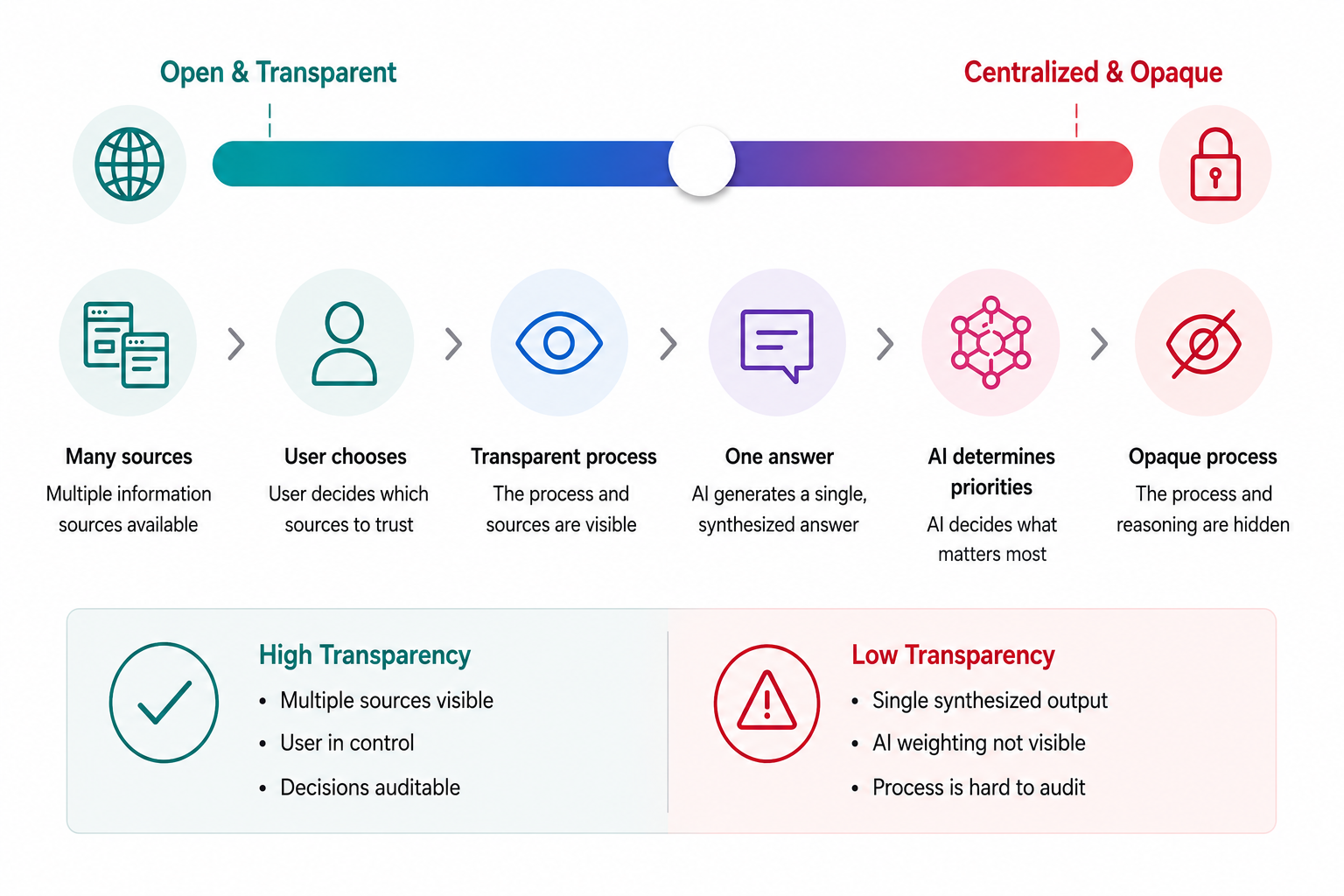
A search engine hands you ten links and lets you choose. A language model hands you one answer in confident prose, with the sources blurred into the background. Multiplied across millions of daily decisions inside a company, pricing, hiring, risk assessment, and customer response, that quietly shifts something deeper than productivity. It shifts the locus of judgment.
We explored the enterprise governance implications of uncontrolled AI adoption in more detail in Shadow AI at Work →
This is where most AI pilots inside European mid-market firms get stuck. Not on the model. On the question: whose judgment is this, really, and can we defend it?
What we see when we look inside real projects
A pattern from our recent work, anonymized, but representative: A Central European financial services firm with around 400 employees. Weekly management reporting was eating up two to three days of work for four people. Numbers from different systems didn’t reconcile. Department heads were defending contradictory figures before the executive board.
Their assumption: we need an AI layer on top.
Our visual operational diagnosis showed that the AI layer wasn’t the problem. Three core data flows were broken at the integration level. Master data was duplicated across four systems with no single source of truth. Pasting a language model on top would have produced confident answers built on incoherent inputs, exactly the failure mode that erodes executive trust in AI for years afterward.
We fixed the data plumbing first. Reporting cycle: from two days to three hours. Manual reconciliation hours per week: from roughly 40 down to 5. Only then did an AI-assisted layer make sense, and it worked.
The lesson generalizes: in three out of four mid-market cases we see, the bottleneck labeled “AI readiness” is really a data- and integration-readiness problem dressed up in newer language. That’s not a marketing slogan. It’s what fifteen years of looking at enterprise systems from the inside tends to reveal.
We covered the relationship between enterprise data foundations and successful AI adoption in more detail in AI Search: Turning Organizational Knowledge into Confident Decisions →
The risks, named plainly
Strip the jargon, and the worries about an unmanaged AI rollout are straightforward:
- Concentration. A handful of labs decide what counts as a reasonable answer.
- Opacity. Even the builders can’t fully explain a given output.
- Bias at scale. Skew in training data becomes skew in millions of decisions.
- Eroded autonomy. When the assistant is faster than your own thinking, your own thinking quietly atrophies.
For an individual user, these are inconveniences. For a regulated mid-sized firm, there are governance, audit, and liability problems with real numbers attached.
Three lessons from the last cycle
If we’re willing to learn from how the open web got captured, the syllabus is short:
- Technology alone doesn’t deliver freedom. Open protocols got closed. Open models can be too.
- A regulatory vacuum doesn’t stay neutral. It gets filled by whoever moves fastest — usually the largest incumbent.
- Founding intentions don’t survive economic pressure unless they’re built into the architecture. Mission statements aren’t load-bearing. Governance and data ownership are.
None of this is hypothetical. The internet ran the rehearsal. AI is the live performance, on a much larger stage, with the audience already in the room.
So what should a European mid-market firm do
The interesting question is, should we use AI? It’s how we maintain ownership of our data, our judgment, and our operational logic as we use them.
In practice, that means three things, in this order:
- Get the data and integration layer honest first. Most failed AI pilots fail here, not at the model.
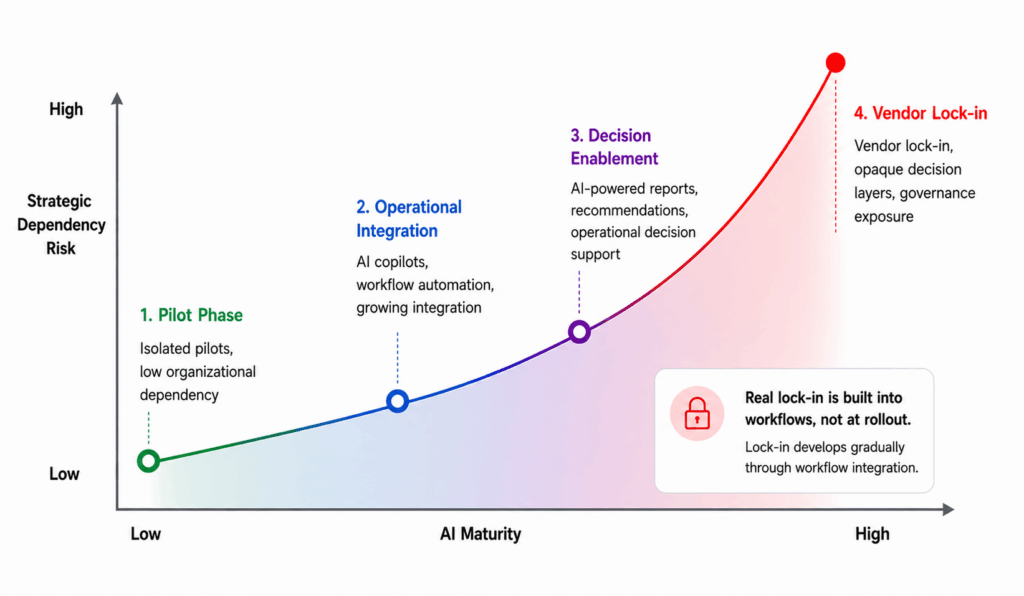
- Treat AI tooling decisions the way you’d treat any other strategic supplier dependency. With exit options, not just onboarding plans.
- Keep human judgment in the loop where it matters legally and reputationally. Especially in regulated industries.
AI is roughly where the web was around 1998, past the toy phase, before the lock-in. The architecture chosen now, in research labs, in policy rooms, and in the procurement decisions most users never see, will define what this technology actually does to power, work, and judgment over the next decade.
There are two roads. On one, we repeat the web’s mistakes faster and at higher resolution. On the other hand, we use the lesson from the last cycle, pay for it, and build something less captureable from the start.
The choice isn’t being made in five years. It’s being made in the contracts, defaults, and standards being written this quarter, including in your own company.
If this resonates with where your company is right now
If you’re trying to understand whether AI actually makes sense for your organization — or whether the real bottleneck sits somewhere deeper in your data, processes, or systems — it’s usually worth starting with a structured assessment rather than disconnected pilots.
A few common starting points we use with mid-market and enterprise clients:
- AI Compass Audit — maps your company’s AI potential, operational workflows, and system environment to identify where AI initiatives realistically make business sense and what the right next steps should be.
- AI Factory initiatives — support enterprise AI adoption through assessments, governance frameworks, intelligent automation, AI agents, document processing, and full AI implementation projects.
- Data Solutions services — focus on data preparation, integration, governance, reporting, migration, and scalable data foundations for enterprise environments.
The goal is not another theoretical strategy deck, but a practical decision framework that business, technology, and compliance leaders can actually use.
Not sure where to start? A short introductory conversation is often enough to clarify the right next step.
Sources
- Brookings Institution. (2025). From open internet to open intelligence: Why AI’s market structure matters more than ever. Brookings. Read article →
- Explosion AI. (2024). History of the web, future of AI. Explosion AI Blog. Read article →
- Scale Capital. (2024). AI will change the world more than the internet ever did. Scale Capital. Read article →
- The AI Guru. (2024). AI & the internet: History repeats itself. Medium. Read article →
- Wired. (2024). Fact-checking AI. Wired. Read article →

Lajos Fehér
Lajos Fehér is an IT expert with nearly 30 years of experience in database development, particularly Oracle-based systems, as well as in data migration projects and the design of systems requiring high availability and scalability. In recent years, his work has expanded to include AI-based solutions, with a focus on building systems that deliver measurable business value.
Related posts



Turning Organizational Knowledge into Confident Decisions

How your employees are already using ChatGPT without you — and why it's a board-level risk

Are you sure AI is the right next step?
We help uncover the real opportunities, limitations, and realistic next steps.