
Why Claude Is Suddenly the AI Conversation Everyone Is Having
The shift from capability to control — and what it means for enterprise AI strategy
- AI Digest
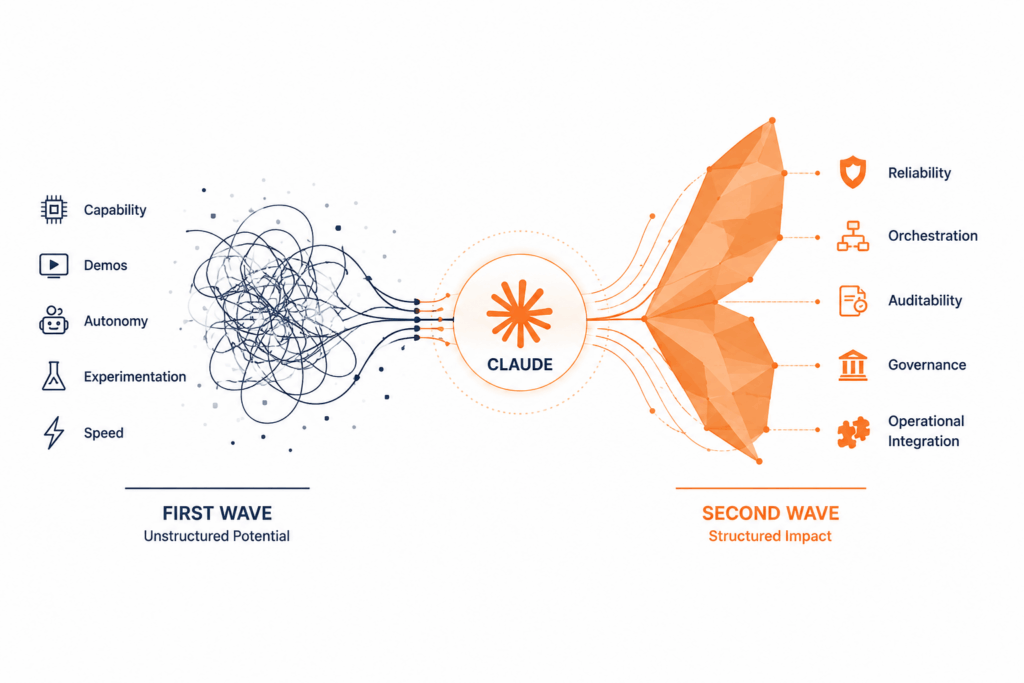
The AI market is reorganizing itself. Not because a new powerful model arrived — they arrive every few months now — but because the priorities are changing.
- From capability to reliability.
- From demos to operational integration.
- From autonomy to orchestrated control.
In recent weeks, Anthropic and its Claude model family have moved from “credible alternative” to the center of serious enterprise discussion. This isn’t hype. It’s the market maturing — and Claude happens to fit what the second wave needs.
This article isn’t a ranking. It doesn’t try to settle who is “best.” It looks at something more useful: what Claude offers, why now, and what its rise tells us about where enterprise AI is heading.
If you want a broader overview of how modern AI systems evolved to this point, we covered that in more depth in our piece on Artificial Intelligence Explained →
The quiet lab that was built for a different question
Anthropic was founded around a different question than most of its peers. While the first AI wave focused on demonstrating capability — what can the model do? — Anthropic’s focus has been narrower and, until recently, less photogenic:
- How does the model stay predictable?
- How do you reduce unwanted behavior?
- How do you make it auditable?
This led to Constitutional AI: an approach in which the model’s behavior is shaped by a set of explicit principles, made as an architectural decision. For years, this looked like a niche bet on safety. Today, it looks like a strategic position — because the people now buying AI seriously are exactly the people who need those answers.
Claude 3 and what changed in the conversation
The current attention isn’t abstract. It traces back to a concrete release: the Claude 3 model family, with three variants serving different use cases.
- Opus is the high-end variant, optimized for complex reasoning and coding.
- Sonnet sits in the middle, balancing performance and cost.
- Haiku is fast and economical, built for lighter tasks.
What matters here is how developers and enterprises responded. Opus benchmarks and, more importantly, hands-on developer feedback pushed Claude into a different category in the discussion. Not “an alternative to try,” but “a serious option to standardize on for specific workloads.”
In enterprise terms, this changes the conversation entirely. You are no longer choosing “an AI model.” You are choosing capacity tiers matched to task profiles — which makes model selection an architectural decision, not a procurement one.
What Claude is good at
Long-context handling
Structured reasoning
Reasoning and code
In the developer community, Claude has become competitive in complex reasoning and programming tasks, and in some specific use cases, leading. The interesting part: most of the noise around this comes from practitioners, not from Anthropic’s marketing team.
Where Claude sits in the competitive landscape
Claude’s rise isn’t only about Claude. It reflects that the AI market has split into several parallel strategies, and customers now have to choose which one best matches their situation.
OpenAI is moving toward rapid product iteration and a broad ecosystem play — many products, fast cycles, wide consumer reach. Google is positioning around platform and product integration — embedding AI into the surfaces enterprises already use. Anthropic is building an entirely different narrative: control, reliability, and auditability.
The question for buyers is, which architecture do I want underneath my operations?
We explored the operational side of enterprise AI adoption in more detail in our article on The Key Steps to a Successful AI Implementation →
Claude is a controlled multi-agent architecture
One of the most important — and least visible — things about Claude is how it works under the hood.
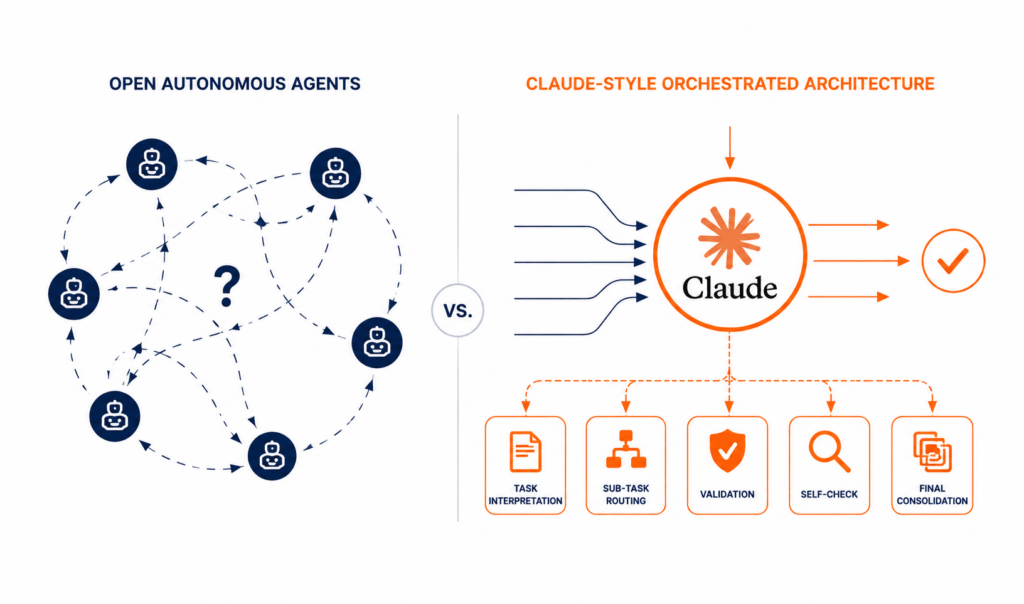
There is a meaningful distinction worth drawing. On one side: open, autonomous AI agents that take initiative and act. On the other hand, structured, orchestrated systems where the model handles different internal roles in a controlled sequence. Claude leans firmly toward the second.
Modern models, including Claude, increasingly don’t operate in a simple prompt-in/answer-out pattern. Underneath a single response, several steps may be running:
- Interpreting the task.
- Breaking it into sub-tasks.
- Running checks or self-reflection.
- Consolidating the final answer.
From the outside, this looks like one output. Internally, it is a controlled, quasi-multi-agent logic—the result: more stable reasoning, lower error rates, and more auditable behavior.
For an enterprise, this is operational risk management.
Why now
The first wave of AI was about capability — proving these systems could do interesting things. The second wave is about reliability: can they do those things consistently, in production, at scale, without breaking?
This shift becomes obvious the moment an organization moves from pilot to deployment. The questions change:
- Will it produce the same answer twice?
- Can we explain its decisions to a regulator?
- Does it integrate with what we already run?
- What happens when it fails?
Claude is positioned well for exactly these questions.
Not because it is dramatically more capable than its peers — the gap on capability is narrowing across the board — but because the architectural choices Anthropic made early are the choices second-wave buyers now want.
AI as strategic infrastructure
Beyond product strategy, there is a wider pattern. AI is no longer treated as a product category. It is becoming strategic infrastructure — and that changes who weighs in on the decision.
In both the US and Europe, the focus is sharpening on AI governance, national security implications, supplier control, and dual-use concerns. In this environment, security-first model development isn’t a brand value. It’s a competitive advantage. Anthropic’s positioning here is not accidental.
Part of Claude’s current visibility is a signal: AI has become a question of trust, not just performance.
What this all signals
Claude’s rise isn’t really about one company winning a benchmark race. It’s a sign that the market is maturing. The emphasis is shifting:
- From capability to control.
- From creativity to reliability.
- From autonomy to orchestration.
- From demos to operational integration.
- This is the second-generation phase of enterprise AI.
What this means for your organization
If your company is asking these questions seriously — not “should we use AI” but “which AI architecture fits our operating reality?” — the answer rarely lives in a benchmark sheet. It lives in a structured assessment of where AI can create real value in your specific operations, with which guardrails, on what timeline.
That’s where we typically start with clients. A focused, time-boxed look at where the genuine opportunities are — and, equally important, where they aren’t yet. If the conversation in this article matches a question you’re already having internally, a 30-minute consultation is the lightest way to begin.
If you want a more structured starting point, our AI Compass Audit is a 4-week, fixed-price engagement that ends with a clear answer to:
- Which AI initiative to start with?
- What success looks like?
- What the real risks are?
Sources
- DigiDop. (2024). Claude vs ChatGPT. Read article →
- Salapa, G. (2024). What Claude does when the conversation never ends: Emergent behavior when an AI is given freedom. Medium. Read article →
- TechDogs. (2024). Why everyone is suddenly talking about Claude. Read article →
- UX Planet. (2024). Why Claude is better than ChatGPT. UX Planet. Read article →

Csaba Fekszi
Csaba Fekszi is an IT expert with more than two decades of experience in data engineering, system architecture, and AI-driven process optimization. His work focuses on designing scalable solutions that deliver measurable business value.
Related posts




Are you sure AI is the right next step?
We help uncover the real opportunities, limitations, and realistic next steps.