
The End of Cloud-First
Why 93% of Enterprises Are Bringing AI Workloads Home
- AI Digest
In February 2026, Cloudian published a number that should make every CFO and CIO pause: 93% of enterprises have already moved at least some AI workloads back from public cloud, are doing it right now, or are actively evaluating it. Not piloting. Not theorizing. Doing. The pattern is no longer fringe; it is the new default question in every serious infrastructure conversation.
The industry is no longer asking whether the cloud is better than on-premise. It is asking a much sharper question: which workloads belong where, and what is it actually costing us to keep getting that answer wrong?
The signal: a cloud-first decade meets its reality check
For ten years, the default architectural answer was simple: move it to the cloud. New project? Cloud. Refresh cycle on an old server? Cloud. AI experiment? Definitely cloud. Questioning that default was, in many organizations, a career-limiting move.
Then the bills started arriving. And the bills for AI started arriving.
The Cloudian Enterprise AI Infrastructure Survey 2026 surveyed 203 enterprise IT decision-makers. The headline 93% figure is striking, but the underlying numbers tell the real story: 79% have already moved AI workloads back, 73% plan to shift further toward on-premises or hybrid over the next two years, and 86% expect their AI budgets to grow in 2026, with 40% projecting increases of 25% or more.
Money is still flowing into AI, just toward different infrastructure than before.
A separate Barclays CIO Survey put a complementary number on the table: 83% of CIOs plan to repatriate at least one workload from public cloud, the highest figure ever recorded in that survey. And in Cloudian’s own data, 40% of respondents reported overspending their planned cloud AI budget.
“Enterprises aren’t abandoning the cloud, they’re getting smarter about where AI workloads belong.”
Jon Toor, CMO, Cloudian
That framing matters. What looks like an exodus in the headlines is, on the ground, a correction.
Why AI is the forcing function
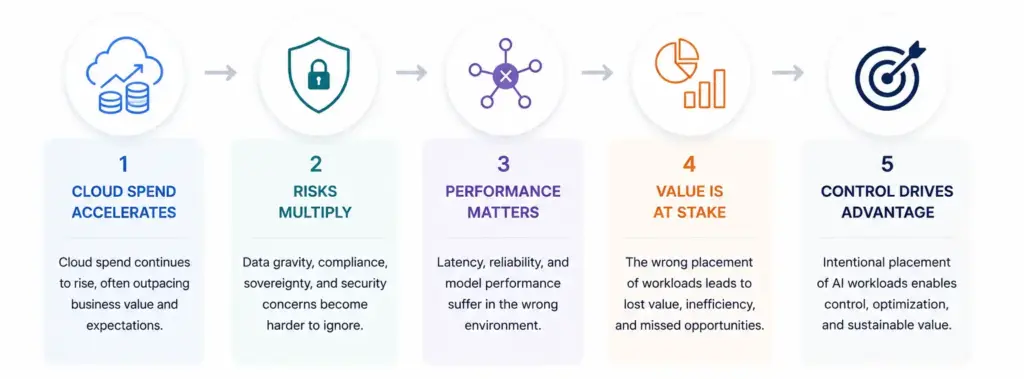
Cost frustration with cloud has been around for years. Enterprises have grumbled about egress fees, opaque pricing, and steady-state workloads that quietly bleed money. What changed in the last 18 months is that AI made those frustrations impossible to ignore.
Three things happen when you put serious AI workloads in a public cloud:
- Cost predictability breaks. GPU rentals are expensive and volatile. Egress fees on training data are unforgiving. A successful pilot that runs 24/7 in production is a fundamentally different financial animal than the same pilot running a few hours a week.
- Latency limits show up. In Cloudian’s survey, 55% of respondents said public cloud cannot consistently meet AI inference latency requirements. For real-time use cases, fraud detection, quality control on production lines, and customer-facing assistants, that is a hard ceiling, not a tuning problem.
- Sovereignty stops being theoretical. 52% need to keep AI training data on-premise for security or compliance reasons. DORA is live in the EU. The GDPR / US CLOUD Act conflict is no longer an abstract legal debate; it shows up in audits.
Deloitte’s analysis puts a number on the cost side: above a certain token volume, on-premises AI delivers 50% or more in savings over three years compared with continuing to run the same workload in the public cloud.
The break-even point varies with workload, but for AI on dedicated GPUs running near full utilization, the on-prem case pays back within months.
Three companies that did the math out loud
GEICO: ten years up, now coming back
Warren Buffett’s GEICO began migrating to the public cloud in 2013. Ten years and 600+ applications later, the result was uncomfortable: cloud costs ran 2.5x the original projection, reliability declined, and the company found itself spending over $300 million annually on cloud services.
GEICO is now rebuilding on an OpenStack-based private cloud and Kubernetes. Internal projections target 50% lower compute cost per core and 60% lower storage cost per gigabyte. Rebecca Weekly, who runs the infrastructure overhaul, was blunt about the lesson:
“All of a sudden that ‘OpEx model’ is looking like a CapEx model.”
Rebecca Weekly, VP of Platform and Infrastructure Engineering, GEICO
Dropbox: the original repatriation, before the term existed
Between 2013 and 2016, Dropbox moved roughly 90% of customer data off AWS to its own custom-built infrastructure, codenamed Magic Pocket. The result, documented in engineering post-mortems and in public financial reporting: approximately $75 million in savings over two years, and gross margins that climbed from 33% to 67%.
Dropbox did this before AI made repatriation a board-level topic. The economics were already there for any data-heavy workload running at a steady state. AI just made those same economics visible to everyone else.
37signals: cloud exit on the record
“Cloud can be a good choice in certain circumstances, but the industry pulled a fast one convincing everyone it’s the only way.”
David Heinemeier Hansson, CTO, 37signals
A correction, with cloud spending still rising
The temptation, reading headlines like “86% of CIOs are leaving the cloud,” is to flip the dogma. Cloud bad. On-prem good. That would be just as wrong as the original cloud-first reflex.
Only 8–9% of enterprises plan to exit the cloud entirely. The other 90%+ are doing something more specific: selective placement. Cloud for the workloads where elasticity is the value (variable demand, global distribution, early-stage experimentation). On-premises or private cloud for the workloads where predictability, control, and unit economics matter more (production AI inference, regulated data, steady-state databases, integration backbones).
Gartner still forecasts more than $700 billion in global cloud spending. Cloud keeps growing, but its use is becoming more deliberate. The new question every infrastructure decision now answers has shifted from “cloud or on-prem?” to “what is this workload actually doing, and where does it earn its keep?”
A practical decision framework
Before you commission a repatriation project or sign the next three-year reserved instance, it is worth running every significant workload through five questions. None of them is technical. All of them are economic.
- Is the demand predictable or variable? Stable, 24/7 workloads (production AI inference, master data, ERP, integration platforms) quickly lose the cloud cost argument. Bursty, seasonal, or experimental workloads keep it.
- How data-heavy is it? Egress fees and storage-tier creep disproportionately punish data-heavy workloads. If the workload reads or moves large volumes regularly, on-premises math gets compelling fast.
- What is the real latency requirement? If a use case requires a sub-50ms response, the cloud often stops being a viable option altogether.
- What is the regulatory exposure? Under DORA, the EU Data Act, and equivalent regimes, “the vendor said so” is no longer an audit answer. You need documented control.
- What does the true TCO model look like, including staff, power, hardware lifecycle, and migration cost? Repatriation comes with its own costs. The failure mode is treating it as a procurement exercise instead of an architecture project.
Running every workload through these questions takes the default off the table and forces a real answer.
This kind of operational clarity is also what separates scalable AI initiatives from stalled pilots, something we explored in Common Pitfalls to Avoid in an AI Pilot →
The Takeaway
The 93% figure says more about cloud-first as a thinking shortcut than about cloud itself.
For the last decade, infrastructure decisions were made by reflex: cloud, unless proven otherwise. For the next decade, the burden of proof flips. Each significant workload, and especially every AI workload, has to earn its place. Cloud where elasticity is worth the premium. On-premises or private cloud, where predictability, control, and unit economics matter more.
The companies that get this right are the ones with a clear, workload-by-workload answer to a single question: “Why does this workload live here?”
If you cannot answer that for your AI workloads today, you are part of the 93%.
Where to start
If your organization is now asking whether some workloads, AI or otherwise, belong somewhere other than where they ended up, a procurement decision is rarely the right first move. The better first step is understanding what you actually run, where the operational bottlenecks are, how your data flows, and which direction can create measurable business value.
At Omnit, we help organizations assess and build both AI and data-driven capabilities in a structured way. Through our AI Factory approach, we support companies from opportunity identification and validation to pilot implementation and scalable deployment. On the data side, our Data Solutions services help organizations organize, integrate, and activate their data landscape to support reliable operations and better decision-making.
Whether the challenge is infrastructure, AI adoption, fragmented systems, or disconnected data, the goal is the same: creating a practical development direction you can actually execute.
Sources
- Cloudian. (2026, March 3). 93% of enterprises are repatriating AI workloads or evaluating a move away from public cloud. Read article →
- Cloudian. (2026, April 2). Cloud data repatriation survey. Read article →
- Data Canopy. (n.d.). Back to private cloud. Read article →
- Fortuna, A. (2026, March 9). Cloud repatriation. Read article →
- HBS. (2025, November 26). Cloud repatriation trends: Cost, AI, and the push towards hybrid. Read article →
- HyScaler. (2026, January 6). Cloud repatriation: The strategic shift in IT. Read article →
- Linthicum, D. (2024, December 20). Cost-conscious cloud repatriation strategies. InfoWorld. Read article →
- MRC Productivity. (2026, April). What’s driving cloud repatriation in 2026? Read article →
- Reed, P., & Tatam, R. (2025, January 9). Cloud repatriation. Puppet. Read article →
- StorageNewsletter. (2026, March 11). Enterprise survey finds 93% are repatriating AI workloads or evaluating a move away from public cloud. Read article →
- Targett, E. (2024, October 17). Warren Buffett’s GEICO repatriates work from the cloud, continues ambitious infrastructure overhaul. The Stack. Read article →
- Toor, J. (2024, November 9). Cloud repatriation. Cloudian. Read article →

Csaba Fekszi
Csaba Fekszi is an IT expert with more than two decades of experience in data engineering, system architecture, and AI-driven process optimization. His work focuses on designing scalable solutions that deliver measurable business value.
Related posts




Turning Ambition into Real, Scalable Results

How your employees are already using ChatGPT without you — and why it's a board-level risk
Are you sure AI is the right next step?
We help uncover the real opportunities, limitations, and realistic next steps.