
Geopatriation and the New Cloud Reality
What Hungarian enterprises need to know for 2026
- AI Digest
By 2030, more than 75% of enterprises outside the United States will have a digital sovereignty strategy, supported by a sovereign cloud strategy. This Gartner prediction signals a structural shift in how enterprise IT will be procured for the rest of the decade. The trend now sits at number nine on Gartner’s 2026 Top 10 Strategic Technology Trends, and Gartner gave it a name: GEOPATRIATION.
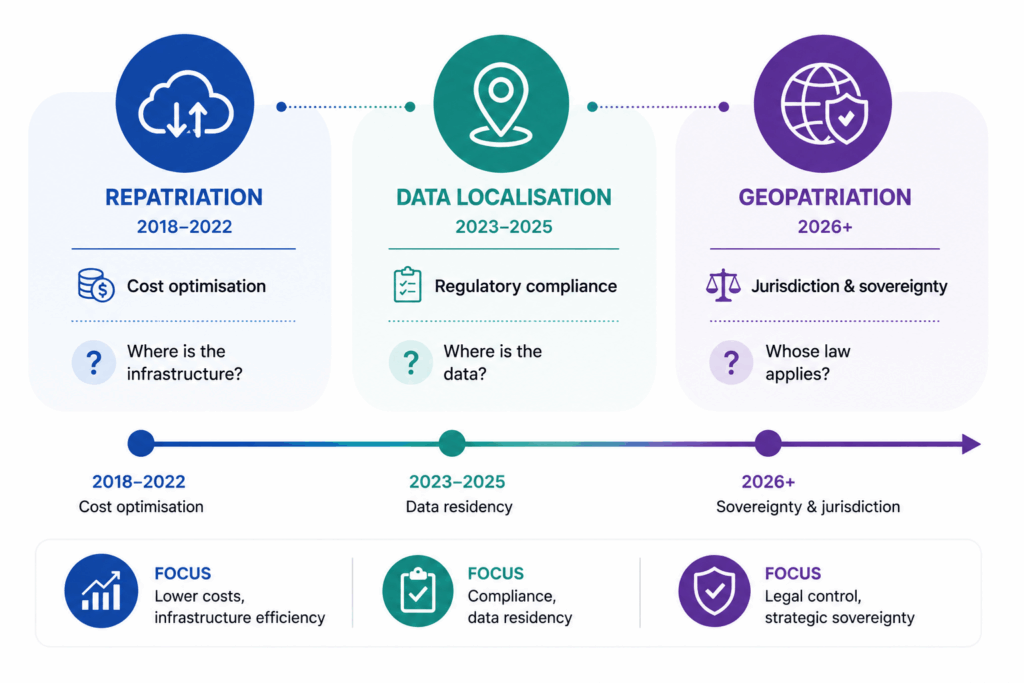
The earlier wave of repatriation was a cost story: hyperscaler bills outgrew workloads, and companies pulled some systems back in-house. Geopatriation runs on different fuel. It is jurisdictional. The decision now hinges on a single question: under which country’s law does this workload actually run?
The problem: GDPR and the US CLOUD Act cannot both be satisfied
For a Hungarian CIO, the legal picture in 2026 looks roughly like this. GDPR has been live for eight years. The EU Data Act started applying on 12 September 2025, and Chapter VII of that regulation explicitly requires cloud providers to protect non-personal data held in the EU from unlawful access requests by non-EU governments. Foreign government requests can only be honoured if there is an international agreement, and even then only with judicial authorisation.
On the other side of the Atlantic, the US CLOUD Act says something incompatible: a US-headquartered cloud provider can be compelled to hand over data to US authorities regardless of where that data is physically stored. Frankfurt data centre, Warsaw region, Budapest availability zone, none of that matters. If the provider is American, US jurisdiction follows the corporate structure, not the server location. Microsoft’s France president acknowledged this publicly in a 2025 French Senate hearing, saying the company could not guarantee customer data would never be transferred to US authorities under the CLOUD Act.
Two legal regimes, one workload, mutually exclusive demands. This is the conflict that gave geopatriation its name.
Why Hungarian companies will feel this sooner than most
Three structural factors put Hungary near the front of the queue:
- Regulated sectors run the economy. Banking, insurance, utilities, healthcare, public administration, these are precisely the sectors where the EU Data Act bites first and where supervisors are already asking pointed questions about US dependencies.
- The public sector is a heavy IT buyer. Government and state-owned enterprises represent a significant share of Hungarian enterprise IT spending, and sovereignty has moved from guidance to a hard tender criterion.
- A majority of Western European CIOs already see this coming. A Gartner survey of 241 Western European CIOs conducted in mid-2025 found that 61% say geopolitical factors will increase their reliance on local or regional cloud providers, and 53% say geopolitics will restrict their organisations’ future use of global cloud providers. Hungarian CIOs sit firmly inside this trend.
Geopatriation has already moved from a 2028 planning topic to a 2026 budget line that needs defending.
We explored the broader organizational side of enterprise AI governance and adoption risk in more detail in AI Isn’t the Problem →
What geopatriation really means
Precision matters here, because the term is already being used loosely.
Repatriation was about money. Companies discovered that hyperscaler bills grew faster than their workloads, and the CFO decided some systems should come back in-house. That was a spreadsheet decision.
Data localisation is a narrower idea: the data must sit in country X. Geopatriation goes further. The data, the operations, the encryption keys, and the legal control must all be reachable only under country X’s (or region X’s) jurisdiction. Physical location is one ingredient. Corporate structure, key management, support staff, and contracts are the others.
Gartner’s infrastructure analyst Jeffrey Hewitt framed it in three layers: data sovereignty, operational sovereignty, and technical sovereignty. Geopatriation aims at all three.
A practical example: where the conflict actually shows up
Picture a Hungarian insurer running its core claims system on a US hyperscaler’s Frankfurt region. The configuration looks impeccable: EU region, EU residency, EU support contract. For five years it has passed every audit.
Then, in late 2025, three things change at once. The EU Data Act applies, the supervisor asks for a written assessment of foreign access exposure, and a customer’s lawyer notices that the standard contract still allows for parent-company access under US law. None of the technology has moved. None of the data has moved. But the risk profile has.
The insurer now has three realistic options:
- Stay and document. Accept the residual risk, produce a defensible assessment, and live with the supervisor’s questions. Cheap in the short run, expensive if a request actually arrives.
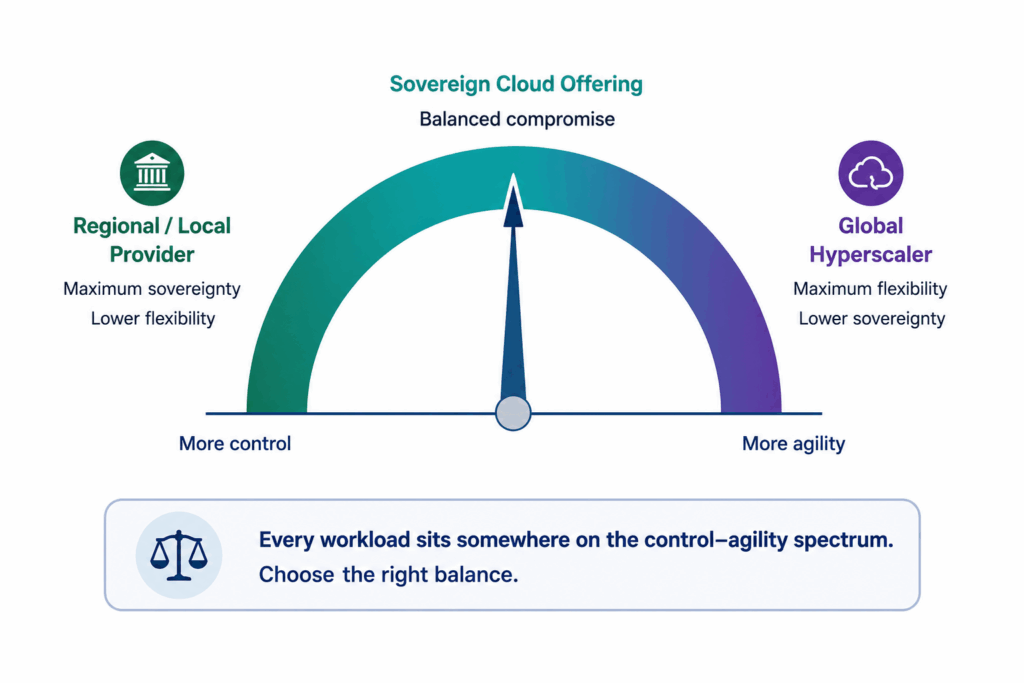
- Move to a sovereign offering from the same provider. Most hyperscalers now offer EU-controlled variants with European operators and key custody. Faster than rebuilding, but the contract details matter enormously, sovereignty lives in the small print.
- Move to a regional or local provider. Lower geopolitical risk, but typically a narrower feature set and a real migration project. This is the path most often associated with geopatriation in its strictest sense.
Which option is right is really a risk-tolerance question, dressed up in technology clothing. It needs answering before the next core system contract is renewed, well before any regulatory letter arrives.
The trade-offs nobody puts on the slide
Sovereign and regional providers solve one problem and create others. The honest list:
- Feature gap. Hyperscalers release new services almost weekly. A sovereign offering may lag by a year or more on the newest AI services, specialised databases, or analytics tools. For a workload that genuinely needs the bleeding edge, this is a real cost.
- Cyber risk changes shape rather than disappearing. Gartner predicts that by 2030, at least 20 sovereign cloud providers will have been successfully compromised by nation-state attacks. Smaller providers are softer targets. Treating “sovereign” as a synonym for “secure” is a costly mistake.
- Migration cost is front-loaded. The bill arrives in year one, the benefits accrue over years two through five. CFOs need to see this curve clearly, or the project gets cut at the first budget review.
Geopatriation can absolutely be the right call. The trade-offs simply deserve the same rigour as the original cloud migration did a decade ago.
What to do in the next 90 days
Whether or not geopatriation ends up being the answer, every Hungarian enterprise running material workloads on non-EU providers should be able to answer four questions before the end of Q3 2026:
- Inventory. Which workloads run on which providers, under which jurisdiction, with which data classifications? Most organisations cannot answer this in a single document, and that itself is the first finding.
- Exposure. For each workload, what is the realistic probability of a foreign access request, and what would the consequences be? Qualitative answers are fine here; direction matters more than precision.
- Alternatives. For the top three or four exposures, what concrete alternatives exist, sovereign variant, regional provider, on-prem, and what would each cost in money, time, and lost capability?
- Trigger. What event would push the decision from “monitor” to “act”? A specific regulatory letter, a contract renewal, a major incident? Naming the trigger in advance prevents the worst kind of decision-making, which is the kind made under deadline pressure.
None of this requires a strategy day or an external consultancy. It requires a careful afternoon with the CIO, the head of compliance, and somebody who knows where every workload actually lives.
The Takeaway
Geopatriation is less a new technology trend than the moment a long-running legal conflict, GDPR versus US extraterritorial law, becomes operationally unavoidable. The EU Data Act made it visible. Geopolitical instability made it urgent. Gartner gave it a name.
For Hungarian enterprises, the practical 2026 question is which workloads to geopatriate, when, and at what cost, and how to defend that answer when the supervisor, the customer’s lawyer, or the board chair asks for it.
The companies that will handle this well are the ones that decide before the deadline forces them to.
Where does your organisation stand on geopatriation
If you are not yet sure which of your workloads sit under which jurisdiction, or what realistic alternatives exist, a structured assessment is the fastest way to gain clarity. Omnit’s AI Compass Audit helps organizations map their AI, cloud, and data landscape, identify operational and regulatory exposure, and evaluate concrete next steps around sovereignty, compliance, and infrastructure strategy.
Depending on the organization’s maturity and objectives, this can extend into broader initiatives within Omnit’s AI Factory, including AI adoption planning, governance frameworks, intelligent automation opportunities, and enterprise AI implementation support. On the infrastructure and analytics side, Omnit’s Data Solutions services support data platform modernization, cloud architecture optimization, data governance, and scalable analytics foundations for regulated environments.
The goal is not to produce another theoretical strategy presentation, but to create a practical decision framework that technology, compliance, and business leaders can actually use when evaluating future AI, cloud, and sovereignty-related investments. For organizations operating in regulated industries such as banking, insurance, healthcare, utilities, or the public sector, these assessments increasingly become the foundation for defensible infrastructure and compliance decisions before regulators, auditors, customers, or board members start asking harder questions.
Sources
- European Commission. (n.d.). Data Act explained. European Commission Digital Strategy. Read article →
- Gartner. (2025). Top strategic technology trends for 2026. Gartner. Read article →
- Gartner. (2025, December 11). Gartner identifies the top trends impacting infrastructure and operations for 2026. Gartner Newsroom. Read article →
- Gartner. (2025, November 12). Gartner survey reveals geopolitics will drive 61 percent of CIOs and information technology leaders in Western Europe to increase reliance on local cloud providers. Gartner Newsroom. Read article →
- Gartner. (2025, October 20). Gartner identifies the top strategic technology trends for 2026. Gartner Newsroom. Read article →
- Hunton Andrews Kurth. (2025). Key provisions of the EU Data Act take effect. Hunton Privacy & Cybersecurity. Read article →
- The Register. (2025, November 13). Geopolitics push European CIOs to think local on cloud. The Register. Read article →

Csaba Fekszi
Csaba Fekszi is an IT expert with more than two decades of experience in data engineering, system architecture, and AI-driven process optimization. His work focuses on designing scalable solutions that deliver measurable business value.
Related posts




How your employees are already using ChatGPT without you — and why it's a board-level risk

Turning Organizational Knowledge into Confident Decisions
Are you sure AI is the right next step?
We help uncover the real opportunities, limitations, and realistic next steps.