Which Customer Record Is the Real One
The Hidden Cost of Master Data Chaos
- AI In Business
Poor data quality costs the average organisation $12.9 million a year, according to Gartner. For a wholesaler, a large share of that bill begins with one quiet problem: the same customer lives in several systems, and each one holds a slightly different name, address, or tax number. When finance pulls the monthly report, those records refuse to agree.
Master data management is the discipline that gives you one trustworthy record for each customer, so the numbers finally line up.
The same customer, three different records
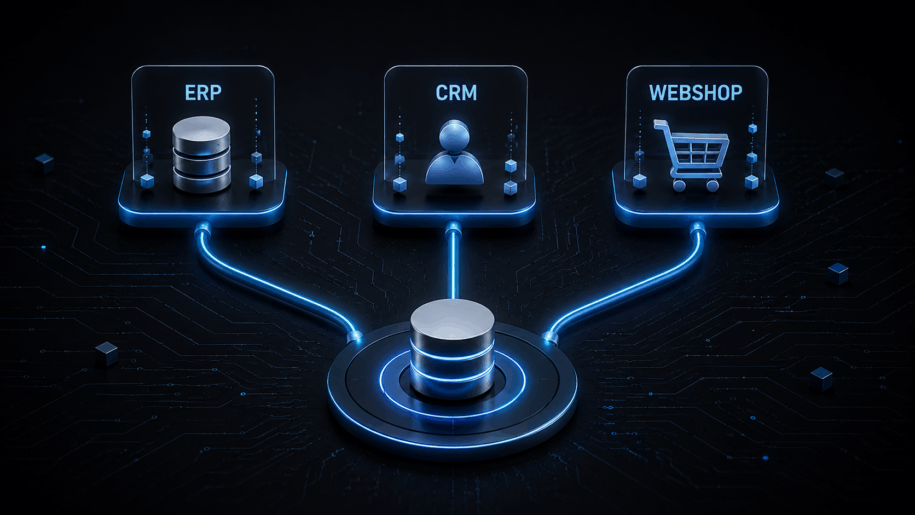
Most wholesalers run more than one system that touches customer data. An ERP, a CRM, a webshop, perhaps a separate logistics or invoicing tool. Each was set up at a different time, by different people, for a different job, and each keeps its own copy of the customer.
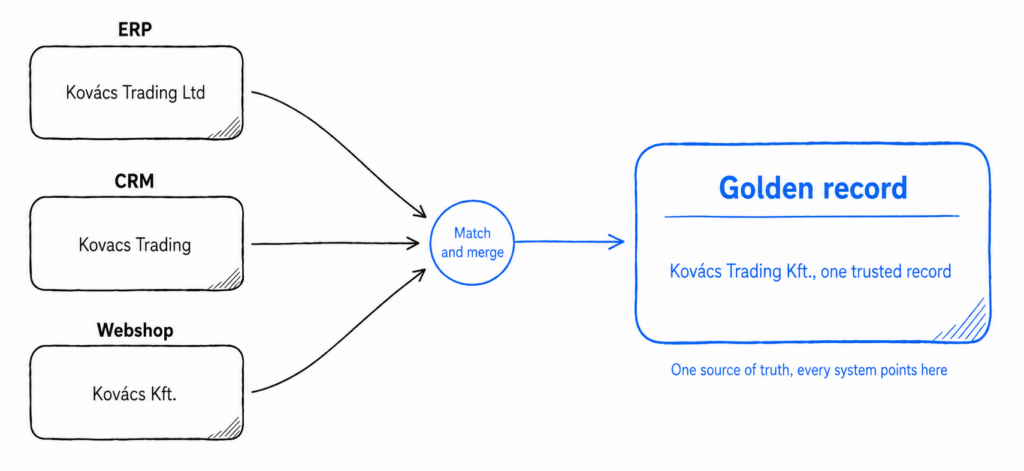
So one buyer becomes “Kovács Trading Ltd” in one place, “Kovacs Trading” in another, and “Kovács Kft.” in a third. A new sales rep creates a fresh record because the old one was hard to find. An address changes in the CRM and never reaches the ERP.
None of this looks dramatic on any single screen. The damage shows up later, when you try to add the numbers together.
Duplicate records are just one example of a broader data-quality challenge. We explored the current state of enterprise data extraction and quality in The State of OCR Technology →
What master data management does
Master data is the core information your business shares across systems: customers, suppliers, products. Master data management, or MDM, is the practice of keeping one agreed version of each of these, then feeding it to every system that needs it.
The goal has a name that comes up often in this field: a single source of truth. For each customer you keep one master record, sometimes called the golden record, and every other system points to it. When the address changes once, it changes everywhere. When finance counts customers, it counts each one a single time.
Why this lands on the CFO’s desk
For a sales team, duplicate records are an annoyance. For finance, they are a credibility problem.
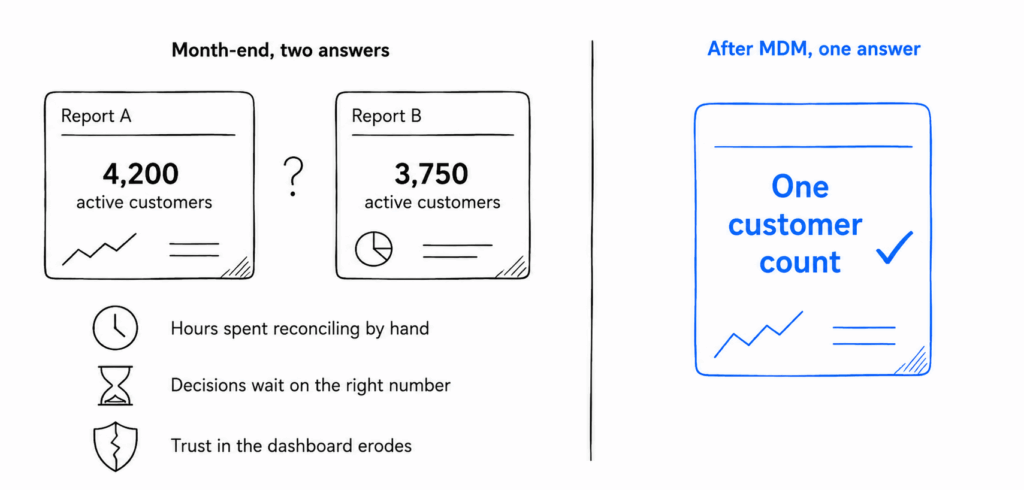
Picture the month-end review. One report says you have 4,200 active customers; another says 3,750. Revenue per customer shifts depending on which system fed the dashboard. A large account appears twice, so its true value sits split across two lines. The board asks a simple question, and two directors give two answers, both pulled from “the system.”
This is where the hidden cost lives. Time goes into reconciling figures by hand. Decisions wait while someone checks which number is right. Trust in the reporting erodes, and once leadership stops believing the dashboard, every meeting slows down. The Gartner figure above is the visible tip; the quiet daily tax is harder to measure and often larger.
Finding the real problem before fixing it
This the part that gets skipped. Teams often assume the fix is a one-time cleanup: dedupe the customer list, merge the obvious pairs, move on. Six months later the duplicates are back, because the process that created them is still running.
At Omnit we start by mapping how customer data moves through your operation in practice. We sit down with your team and draw the system as it truly runs, point by point, on a shared diagram. In fifteen-plus years of enterprise integration work, across Oracle systems, data warehouses, and ETL pipelines, one pattern holds: the cause of the chaos usually sits somewhere the team did not expect. A record gets created at a point nobody flagged as risky. Two systems sync in an order that quietly overwrites good data. The cleanup and the MDM rules then build on what the map shows, so the duplicates stop coming back.
Consider a regional wholesaler running an ERP and a separate webshop. Customers who order online get created fresh in the webshop, then re-keyed into the ERP by the back office, with no shared identifier linking the two. A meaningful share of accounts end up duplicated. Match the records, agree one golden record per customer, and the customer count, the credit checks, and the sales reports begin to agree.
Technology alone rarely solves operational problems. We explored why understanding the real workflow before building a solution is essential in Why Employees Quietly Work Around Your Software →
How you know it is working
Master data management turns the problem into something you can measure. Two figures are worth watching from the start.
- Customer match rate: how many of your records map cleanly to a single real customer. As the master records take hold, this climbs and the duplicate pile shrinks.
- Data consistency: how often the same customer carries the same details across every system. A high consistency percentage means the address in the webshop matches the address in the ERP, every time.
When both move in the right direction, the month-end argument quietly disappears. Finance reports one customer count, and it holds up to questions.
The takeaway
The goal here is realistic and specific: one record per customer that everyone trusts, and a process that keeps it that way. The reports start to agree, the month-end review gets shorter, and the question “which record is the real one?” stops being a question at all.
The first step is small: find out where your customer data splits today. Once you can see that on one diagram, the path to a single source of truth is clear.
Ready to find the real one?
If your customer numbers change depending on which system you ask, the place to start is a clear picture of where the data breaks.
The Omnit Data Assessment is a focused, fixed-price engagement. Over two to three weeks and a couple of short workshops with your team, you receive an 8 to 12 page executive summary that shows where your data stands, names the three to five main pain points, and sets the order to fix them. Pricing starts from €1,450 + VAT. If you prefer to open with a conversation, a free 30-minute consultation is the easier first step.
Source
- Gartner. (2020, July 27). Magic Quadrant for Data Quality Solutions. Gartner. Read article →

Csaba Fekszi
Csaba Fekszi is an IT expert with more than two decades of experience in data engineering, system architecture, and AI-driven process optimization. His work focuses on designing scalable solutions that deliver measurable business value.
Related posts

Turning Organizational Knowledge into Confident Decisions

The real barriers to enterprise AI, and what the companies that succeed do differently

The 70% Below the Surface That Most Quotes Never Show

Turning Ambition into Real, Scalable Results
Are you sure AI is the right next step?
We help uncover the real opportunities, limitations, and realistic next steps.