
What’s Holding Your Company Back from AI Adoption
The real barriers to enterprise AI, and what the companies that succeed do differently
- AI In Business
The technology exists. It is affordable. For a growing share of companies, it already pays for itself. So the honest question for any leader in 2026 points inward: what keeps your company from moving? The technology works. In our projects the answer lands in the same place every time: the barrier sits in the organization, well before it ever reaches the technology or the budget.
Where companies stand today
Start with the market, because the picture is clearer than the headlines suggest. Among the 3,235 leaders Deloitte surveyed across 24 countries, every organization is already doing something with AI. What separates them is how far they take it. Around 37% use it only on the surface, in a type-a-question-get-an-answer way that stays at the level of personal use inside the company. The other 64% have moved into real change: 30% are redesigning concrete business processes around AI, and 34% are rethinking operating and business models. That 64% is where enterprise AI adoption is genuinely happening.
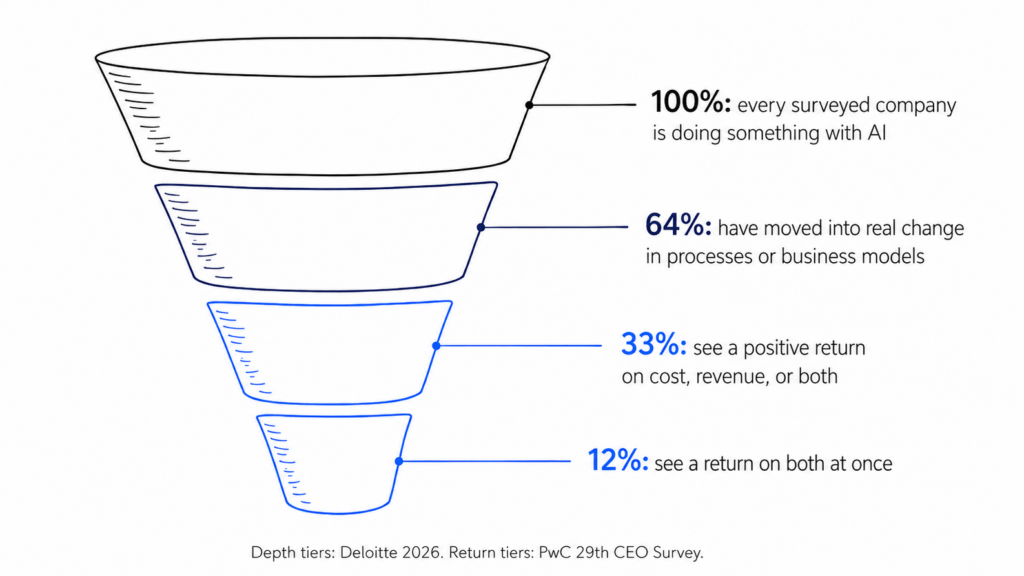
The results are showing up too. PwC’s 29th CEO Survey of 4,454 chief executives reports that 33% of leaders have already seen a positive return from AI on revenue, cost, or both, though only 12% have achieved both at once. Closer to home, GKI’s 2025 measurement puts the share of Hungarian companies using AI in some form at 32%, so the local market has moved as well. And a further wave is coming: close to three-quarters of companies, 74%, plan to introduce AI agents, software that carries out tasks on its own, beyond simply answering questions, within two years.
So the technology is here, it is affordable, many already see a return, and the next wave is already in view. Which makes the stall harder to explain, and more worth understanding.
Five barriers that keep companies from moving
Across the businesses we talk to, the same five reasons come up again and again. Every one of them sits outside the technology itself.
Uncertainty. One morning the news says AI takes jobs, by lunch it is the next industrial revolution, by evening LinkedIn promises everyone will be ten times more productive. Inside the company the picture is just as mixed: one colleague quietly uses it, another would ban it, finance worries about cost, legal about data. The way out is to change the question. Bring it down to one specific process and look at what you can see there with your own eyes. That is a far smaller, far calmer problem.
Use-case blindness. “Our company is special, this won’t work here.” We hear it from healthcare providers, manufacturers, financial firms, and law offices alike. The difficulty usually comes from somewhere else. The capabilities themselves stay unfamiliar, so the suitable area stays hidden. AI is best understood as six building blocks that mirror human abilities: sight, hearing, speech, reading, writing, and decision support. Once a leader sees them that way, the entry points appear. Hundreds of inbound emails a week that someone has to read, sort, and route, for instance, is a reading problem AI can handle at a fraction of the cost.
We explored the core capabilities of artificial intelligence and how they translate into real business applications in more detail in our Artificial Intelligence Explained → article
Noise overload. A decision-maker now fields five to ten vendor pitches a week, each one cheaper, faster, and safer than the last, on top of social-media hype and the quiet pressure of FOMO. Filtering the noise is exhausting and rarely conclusive. The better move is to start from your own questions: what would you want to do better, where do you lose time or money, and only then, what can AI do about it? At that point the answer comes from your situation, and the noise loses its grip.
Lack of direction. In many companies leadership has not yet said what it expects from AI: lower cost, higher revenue, time saved, a competitive edge. Without a stated goal, any pilot can be called a success or a failure, because no one knows what to measure. The fix is modest. A single sentence that sets a direction is enough. “This year we will see whether AI can cut office administration cost by 10%.” One sentence, and you have a heading.
Affordability doubt. Many leaders carry an image of AI as something only Google or Microsoft can afford. For a Central-European mid-sized company that image misleads. A typical project sits in the tens of millions of forints; the billion-forint budgets belong to the global giants. A meaningful pilot can often start from a few million, with sensible monthly running costs thanks to cloud services. The real dependency is the implementation logic: spread AI everywhere and it will not pay back; pick one process, measure today’s cost, calculate the saving, and you will know whether it is worth it.
Why moving isn’t enough
Here is the uncomfortable part. If the technology exists, it is affordable, and every company has entry points, where do the two-thirds of leaders who have yet to see a positive return come from? They did move. They invested and ran pilots. Something stalled.
The studies converge on three reasons. First, it is hard to do well: the prerequisites, clean reliable data and the right mix of technical and business expertise, are often missing, and AI built on scattered data is built on air. Second, people do not use it: 84% of companies have not redesigned roles around AI, so colleagues keep working the old way while the tool sits beside them. Third, there is no focus: companies try too much at once, or layer AI onto processes that were broken to begin with. Deloitte found that only 25% of large firms put 40% or more of their AI experiments into real use; the rest got stuck in pilot fatigue. The pattern is consistent: these are problems of organization and process.
What the successful ones do differently
The companies that pull ahead share three habits. They commit to deployment from day one, deciding early what the live system should look like and bringing legal, security, and integration into the room while the design is still open. They put the foundations in order first, organizing data, rethinking processes, and redividing work between people and machines so that human judgment and AI speed each do what they are best at. And they aim AI at a concrete business problem with a return model attached, choosing the technology once the problem and its measurable target are clear.
The insight behind it: AI reshapes its environment
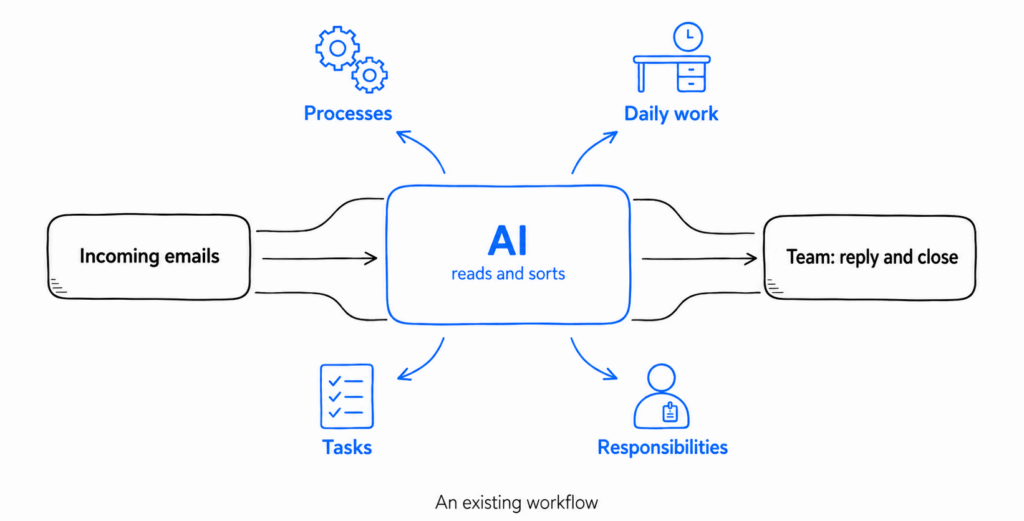
This is the part competitors rarely say out loud, and it is the most important thing we have learned across many implementations. When you introduce an AI solution, its surroundings change along with it. The connected processes, the daily way of working, the tasks, and the responsibilities all shift. That shift is the design working as intended. The efficiency you want comes precisely from reshaping the environment around the tool: the work itself changes, and that change is where the gain lives.
It is also why our work starts with a visual operational diagnosis. We sit with the people who run the company and map how it works today, and the real bottleneck often surfaces in a place the client had overlooked.
Take a representative case from our work: a Central-European financial services firm of around 400 people, where weekly management reporting consumed two to three days for four people, and the figures coming out of different systems refused to reconcile. The leadership assumed they needed an AI layer on top. The diagnosis pointed somewhere else: three core data flows were broken at the integration level, and master data sat duplicated across four systems with no single source of truth. A language model laid over that would have produced confident answers built on incoherent inputs, the exact failure that erodes trust in AI for years. The map is what tells you where AI belongs, and what has to change around it first.
We explored why organizational knowledge, business processes, and company-specific context are becoming increasingly important competitive advantages in the AI era in our From Open to Owned: Will AI Repeat the Internet’s Story? → article
How we would start
Four supports carry a project from idea to working system.
- Assessment of processes, data, and background, so you can see where time and money leak, what data exists and in what shape, and who can access what. These are the entry points, and the risks.
- Focused pilot definition, choosing the area with the most potential and, at the same time, writing down the goals, the expected measurable result, and the success threshold. Decide this now, or you will only rationalize it later.
- Pilot run with a fixed goal, fixed time, and fixed budget, in a limited scope with one team, designed to produce fast, measurable learning, organizational as much as technical.
- Gradual rollout, the step most companies skip. You build the pilot into operations step by step, bringing new teams, areas, and functions on board as you reshape the processes and the environment around them. This is where the opening insight returns: the AI changes its surroundings.
The payoff of starting small shows up again and again. Most engagements begin with one contained step, a fixed-scope assessment or a single pilot with a small team. Once that step produces a clear result, the next move becomes concrete, and most clients carry the build forward with the same team, because the groundwork already maps their environment. The early, modest start is what makes the wider rollout straightforward later.
These four supports describe a path that has worked for us. Following it moves a company out of the two-thirds that has yet to see results, toward the third already measuring the gain.
So, what’s holding you back?
The technology exists. It is affordable. Every company has concrete entry points, and others are already succeeding. That leaves one question worth sitting with: is it uncertainty, use-case blindness, the noise, the missing direction, the cost question, or something else? Whatever the answer, it is something you can name, and naming it is the first step past it.
Take the next step
If the question of AI has come up in your company but the right place to start is still unclear, begin with a structured assessment as your first step. The AI Compass Audit is a four-week, fixed-fee process that ends with a clear answer: which pilot is worth starting, with what success criteria, and what risks to plan for. If you would rather sort out the questions first, a free 30-minute consultation is a good place to begin.Sources
- Deloitte. (2026). State of AI in the Enterprise 2026. Deloitte. Survey of 3,235 business and IT leaders across 24 countries. Read article →
- GKI Economic Research Co. (2025, July). Artificial intelligence use among Hungarian companies (English summary). GKI Economic Research Co. Survey of 390 Hungarian companies. Read article →
- PwC. (2026, January). 29th Annual Global CEO Survey. PwC. Survey of 4,454 CEOs across 95 countries. Read article →

Csaba Fekszi
Csaba Fekszi is an IT expert with more than two decades of experience in data engineering, system architecture, and AI-driven process optimization. His work focuses on designing scalable solutions that deliver measurable business value.
Related posts


Why So Many AI Projects Stall — and How to Finally Move Beyond the Pilot Phase

Turning Ambition into Real, Scalable Results


Are you sure AI is the right next step?
We help uncover the real opportunities, limitations, and realistic next steps.