What Does an AI Project Really Cost
The 70% Below the Surface That Most Quotes Never Show
- AI In Business
Over the past few years, I have guided several Hungarian companies through their AI implementations, and one pattern shows up almost every time: by the end of the project, the cost exceeds the quoted amount.
The cause is not attributable to the vendor’s bad faith. By its nature, a quote shows only 25 to 30 percent of the actual cost. You pay the remaining share, too. It lands inside your own organization, on lines that never reach the supplier’s invoice.
Below, I lay out a framework that makes this submerged 70-75 percent visible. With it in hand at your next request for proposal, you will know what you are committing to before you sign, and six months later, you will not be saying the project “spiraled out of control”.
The iceberg model
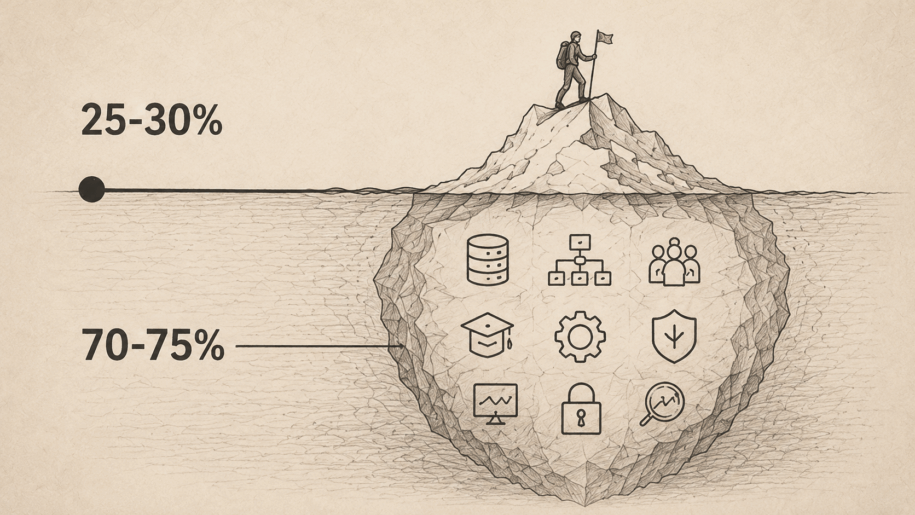
Picture an iceberg. About 25 to 30 percent of its mass is above the waterline; the remaining 70 to 75 percent remains hidden below. The cost structure of an AI project is built the same way.
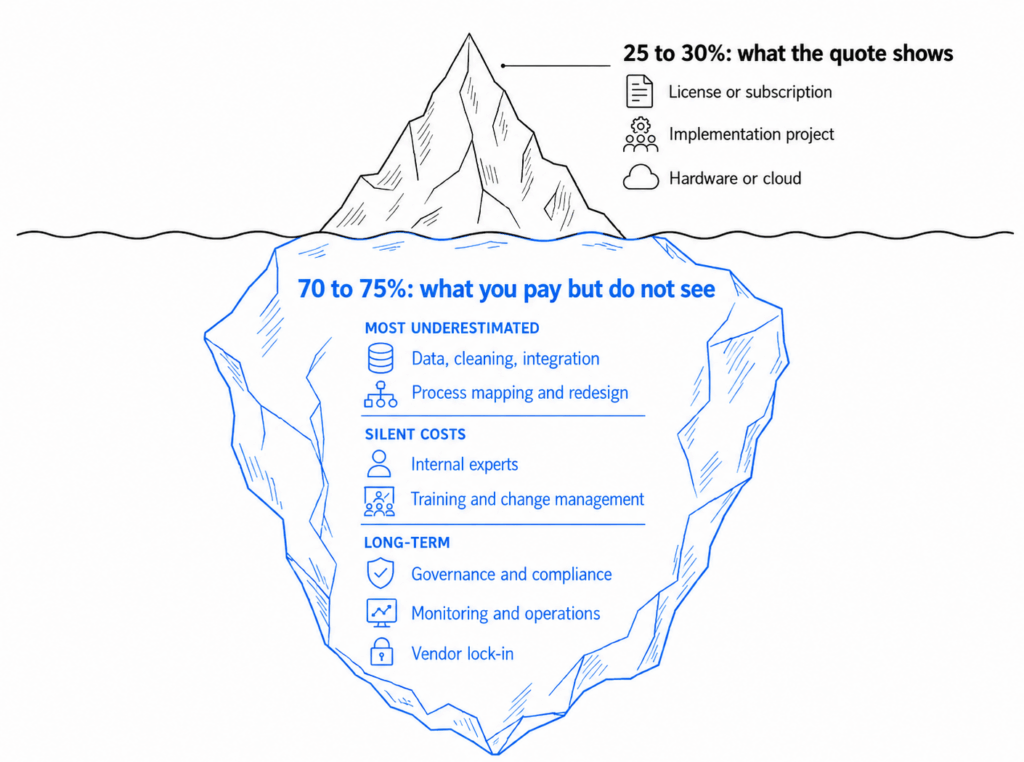
What you receive in the quote is the tip, which typically consists of three items. Beneath it sit seven more that never appear in the document, yet still land on you at the final reckoning. They arise inside your own organization, so no supplier itemizes them for you.
Above the water: what you see in the quote
- License or subscription: the monthly or annual fee for the AI software. With SaaS, you pay it continuously; with self-hosting, you typically pay once.
- Implementation project: the supplier’s team designs, builds, trains, deploys, and integrates the AI solution into your existing systems, then tests it. A one-off item, and often the largest figure on the invoice.
- Hardware or cloud: GPUs and servers if you run it in-house, or the cloud provider’s bill. The latter is rarely a fixed amount.
That is roughly all the quote contains. Here is the point: this is 25-30 percent of the total cost. The rest sits below the waterline.
Below the water: what you pay but do not see
The seven hidden items are worth reviewing in three groups, because they surface at different times and follow different logic.
The most underestimated items
- Data, cleaning, and integration: AI works from your company’s data. That data was built for people to interpret, never for an autonomous system to process. A colleague asks when something is missing, sets aside what looks contradictory, and knows from experience which source to trust when two records disagree. AI does none of this. It works confidently on flawed data and confidently returns a flawed answer. What does that mean in money? At a typical Central European mid-sized company, 30 to 40 percent of project time is spent purely on putting data in order. If the supplier quoted €40,000 for the implementation, data preparation would cost an additional €13,000 to €20,000. That sum would be allocated to the time of your own staff, your consultants, and your data owner.
- Process mapping and redesign: think of an AI solution as a box that slots into the life of the company and helps. When you introduce AI, the surrounding processes generally all change. Around a quote-generating AI, for instance, the request, the calculation, and the approval all shift. That shift has to be thought through, designed, and carried out. Budget for this work and its cost, because no supplier does it for you.
The silent costs
- Internal experts: an AI project does not deliver itself. You need the subject-matter lead who understands what happens in the area and has a view on how a new AI-supported process should run; the data owner who knows exactly where everything sits; the IT person to connect the systems; and management attention for the decisions. Every one of them would otherwise be doing their day job, so while they work on the project, the company gives up something else.
- Training and change management: this is before anyone has even mentioned it. People have to be taught to use the new tools, drilled on the new workflow, and helped through resistance, because some will fear for their position and some will not see why it benefits them. Training is a continuous item too: new colleagues arrive, new features ship, and the AI itself keeps changing.
The long-term items
These items are hard to estimate because they surface months or years after launch, never at the start.
- Governance and compliance: a major set of EU AI Act obligations starts to apply in August 2026, the GDPR remains in force, and internal policy sits on top: who decides what counts as responsible AI use, and who steps in when a problem arises. Treat this as a mandatory requirement.
- Monitoring and operations: AI is not accounting software that you switch on and leave running for years. It has to be checked continuously for whether it answers correctly, where it errs, and whether it is slowing down, and it needs periodic retraining. This is a monthly cost that never ends; in the second and third years, it typically matches the first year, and sometimes runs higher.
- Vendor lock-in: what happens if in two years you want to change supplier, provider, or service? Can you extract your data, your results so far, your models, the knowledge in those models, and carry your settings to another supplier? Experience shows this is often only possible with difficulty and at real cost.
The two numbers
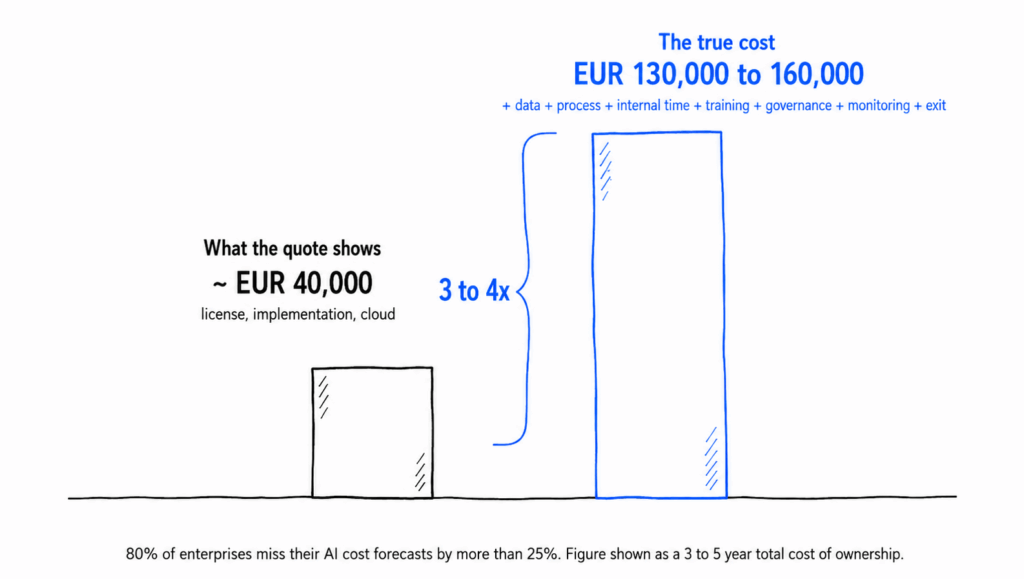
Take a typical Central European mid-sized AI project.
- WHAT THE QUOTE SHOWS: ~ €40,000
license, implementation, cloud
- THE TRUE COST: €130,000–160,000
+ data + process + internal time + training + governance + monitoring + exit
When counted as a 3- to 5-year total cost of ownership, the full cost of the implementation can run to three or four times the starting price. The real scale of an AI project exceeds the figure on the price list. Know this in advance, and there is no surprise; miss it, and the unpleasant surprise arrives half a year later.
International data points in the same direction. According to the 2025 State of AI Cost Management report, 80 percent of enterprises miss their AI infrastructure cost forecasts by more than 25 percent. The quoted figure does not cover the actual outlay.
Take-home: 7 questions for every AI quote
Here is the uncomfortable part. If the technology exists, it is affordable, and every company has entry points, where do the two-thirds of leaders who have yet to see a positive return come from? They did move. They invested and ran pilots. Something stalled.
The studies converge on three reasons. First, it is hard to do well: the prerequisites, clean reliable data and the right mix of technical and business expertise, are often missing, and AI built on scattered data is built on air. Second, people do not use it: 84% of companies have not redesigned roles around AI, so colleagues keep working the old way while the tool sits beside them. Third, there is no focus: companies try too much at once, or layer AI onto processes that were broken to begin with. Deloitte found that only 25% of large firms put 40% or more of their AI experiments into real use; the rest got stuck in pilot fatigue. The pattern is consistent: these are problems of organization and process.
1. What is and is NOT included?
Ask for an itemized breakdown of what the price covers and, separately, what it does not. The “not included” list tells you as much as the “included” one.
2. What data preparation do they expect from us?
If the answer is “nothing special”, treat it as a warning sign. Ask: whose job is it, how long does it take, and in what form must the data be handed over?
3. Which integrations are in the price, and which are not?
CRM, ERP, document management, and email: each integration is a separate task. An AI project typically needs three to five of them.
4. What does “implementation” mean here: a pilot or live use?
It often happens that the supplier hands over a working pilot and leaves the substantive work to you. Clarify upfront how far their responsibility extends.
5. What monthly cost should we expect in years 2 and 3?
The launch discount ends, while monitoring, support, and model maintenance stay on as standing items.
6. How does exit work if we switch in two years?
Can you extract your data? Can you carry over your settings? How much time and cost does all of that take?
7. Who is responsible if the AI gives a wrong answer? Is it auditable?
How far does the supplier’s responsibility reach, and where does yours begin? Three months on, can you trace why the AI gave that particular answer? (And remember: the AI Act is coming into force.)
A good AI proposal should answer these questions clearly:
Two things worth remembering
The first: the quote is only the tip of the iceberg. Seventy to seventy-five percent of the total cost sits below the surface: data, processes, internal working time, training, governance, monitoring, and exit. The supplier does not do this for you; you have to budget for it.
The second: there are seven questions to ask of every AI quote. Whoever carries these two ideas into their next implementation has already covered half the distance.
At Omnit, we believe the numbers in an AI project have to be clean. Clean numbers are what let you decide on a sound basis whether the project is worth starting. For us, this is the signal in the noise: clear figures that cut through the hype.
Take the next step
If your company is weighing an AI implementation but the right starting point is not yet clear, a structured assessment is the place to begin. The AI Compass Audit is a four-week, fixed-price process. At the end, you know precisely which AI pilot is worth pursuing, with what success criteria, and against what risks. If you only want to clarify your questions first, you can start with a free 30-minute consultation.Sources and data
- Benchmarkit & Mavvrik. (2025). 2025 State of AI Cost Management Report. Benchmarkit & Mavvrik. Read article →
- European Union. (2024). Regulation (EU) 2024/1689 laying down harmonised rules on artificial intelligence (AI Act). Official Journal of the European Union. Read article →
Omnit project experience: the cost structure of AI implementations at Central European mid-sized companies.

Csaba Fekszi
Csaba Fekszi is an IT expert with more than two decades of experience in data engineering, system architecture, and AI-driven process optimization. His work focuses on designing scalable solutions that deliver measurable business value.
Related posts

The real barriers to enterprise AI, and what the companies that succeed do differently


Why So Many AI Projects Stall — and How to Finally Move Beyond the Pilot Phase

Turning Ambition into Real, Scalable Results

Are you sure AI is the right next step?
We help uncover the real opportunities, limitations, and realistic next steps.