
Duplicate Leads in Your CRM
How Data Governance Cleans Up the Sales Pipeline
- AI In Business
Fewer than half of sales leaders trust their own forecast, and one of the quietest reasons sits in the CRM: the same buyer recorded three times, in three spellings, owned by three people. This is what those records cost in finance terms, and how a governance-led cleanup holds for longer than a single quarter.
Gartner’s State of Sales Operations Survey found that only 45% of sales leaders and sellers have high confidence in the accuracy of their own forecasting. The survey names poor data quality as one of the main contributors: 47% of respondents believed their organization held high-quality data, and 13% described it as poor. Among the three factors Gartner lists behind low data quality, one is data governance, described as the absence of agreed data quality standards derived from the purpose of the CRM.
That last point is where a pipeline cleanup either works or repeats itself. Merging duplicate records is a weekend of effort. Keeping them from coming back is a question of definitions, ownership, and controls.
Two teams, one pipeline, two different numbers
The quarterly review starts well. Sales presents pipeline coverage at a comfortable multiple of target. Finance applies historical conversion rates to the same pipeline and lands on a materially lower number. Both sides are reading their own data correctly.
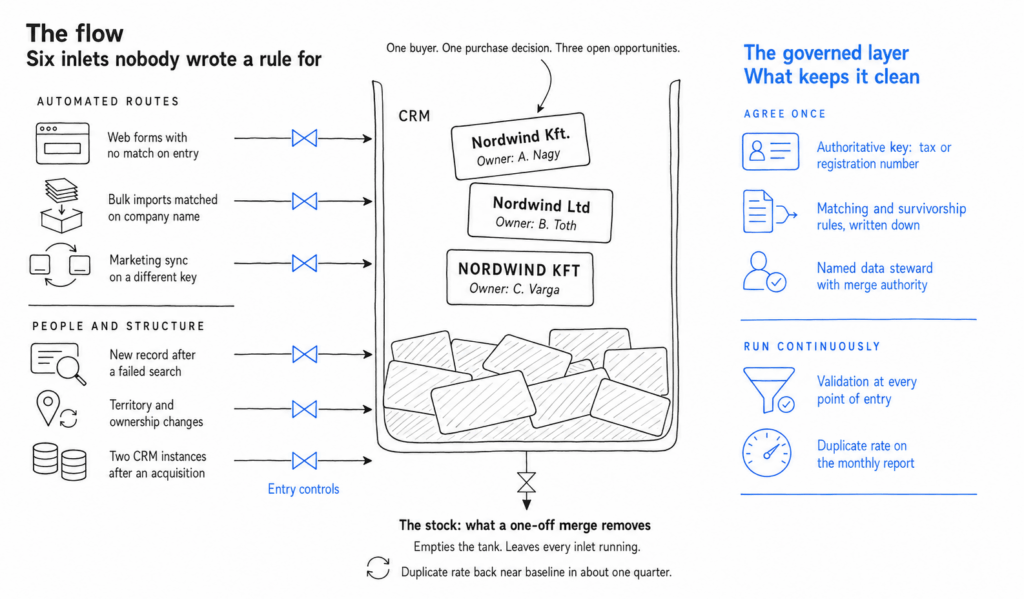
The gap sits in the record layer. Somewhere in the CRM, one client exists as three accounts, carrying three open opportunities, owned by three salespeople. One of the three lost its accents on the way in from a web form, which is why every name-based search for it comes back empty. One procurement decision is going to happen once. The pipeline counts it three times.
At a company running a few hundred open opportunities, a duplicate rate in the high single digits is enough to move the coverage ratio by a full multiple. That is the number the board hears, and the number that drives hiring plans, capacity commitments and cash timing.
Where duplicates come from
Duplicate records are a process artifact. Each one arrives through a route that nobody wrote a rule for:
- Web forms that create a record without matching on email domain, company registration number or tax number.
- Trade show lists and purchased databases imported in bulk, matched on company name alone.
- Marketing automation syncing contacts back into the CRM on a different key from the one sales uses.
- Manual creation after a failed search: the earlier record was spelled differently, so the search returned nothing and the salesperson created a new one.
- Territory and ownership changes, where creating a fresh record is the path of least resistance in an ownership dispute.
- Two CRM instances merged after an acquisition, with the reconciliation deferred to a later phase that never got scheduled.
Reliable forecasting depends not only on having the right data, but also on making trusted information easy to find and use. We explore that challenge in AI Search: Turning Organizational Knowledge into Confident Decisions →
Gartner names inconsistency of data across sources as the most challenging data quality problem organizations face, and puts the average annual cost of poor data quality at USD 12.9 million across industries. In a mid-sized company, the absolute figure is smaller, and the mechanism is identical: the same entity stored differently in several places, with no agreed answer on which version is correct.
What a duplicate costs, in finance language
Sales operations sees duplicates as an annoyance. On the finance side, the same records show up as five distinct exposures.
1. Forecast inflation
A deal counted more than once inflates pipeline coverage and weighted forecast value. Decisions built on that number- headcount, capacity, inventory commitments, credit lines- all rest on a demand signal that overstates reality.
2. Distorted unit economics
Cost per lead, lead-to-opportunity conversion, and customer acquisition cost are all computed on record counts. Inflated denominators make marketing look more efficient at the top of the funnel and less efficient at the bottom, which sends the budget to the wrong channel.
3. Commission and territory friction
When two salespeople hold a record for the same buyer, one of them is going to lose an argument at quarter end. The cost lands in management time, in the credibility of the compensation plan, and occasionally in turnover.
4. Compliance exposure
Article 5(1)(d) of the GDPR requires personal data to be accurate and kept up to date, with reasonable steps taken to erase or rectify inaccurate data without delay. Article 17 gives the data subject the right to erasure. An erasure request executed against one contact record while two copies stay live in the same CRM leaves the obligation unmet and creates evidence of that gap in the system.
5. AI and scoring models that learn the wrong pattern
Lead scoring, propensity models, and any AI layer placed on top of the CRM learn from historical records. Duplicated history teaches the model that certain accounts convert at rates that the underlying business never produced. The model performs well in backtesting and misfires in production.
A one-off deduplication run buys about one quarter
Every major CRM ships with merge functionality, and specialist deduplication tools do the job well. Run one, and the record count drops the same afternoon.
Three months later, the rate is back near where it started. The merge cleaned the backlog while every rule that produced the backlog kept running: the same forms, the same imports, the same silence about which identifier is authoritative. The cleanup addressed the stock and left the flow untouched.
This is the point where data governance earns its cost. Governance in this context is a small, concrete set of agreements about the customer record, and someone whose name is attached to each one.
What data governance adds to a CRM cleanup
Definitions, written down once
One page covers it: what counts as a lead, a contact, an account and an opportunity; at what point a lead becomes an opportunity; and which identifier is authoritative for each object. For Hungarian and Central European B2B, the company registration number or tax number is a far more reliable key than the company name, which arrives in a different form from every source.
Matching and survivorship rules
Two decisions have to be explicit first: how a match is determined- exact match on the authoritative key, fuzzy match with a stated threshold on name and address, or a review queue between the two. Second, what survives a merge: which record keeps the account owner, which address wins, and what happens to activity history, notes, and attachments. Written survivorship rules turn merging from a judgment call into an operation anyone can execute.
Named ownership
A data steward inside sales operations, with the authority to approve merges, maintain the matching rules, and reject imports that fail validation. This is typically a portion of an existing role, defined in writing. Ownership without a named person tends to expire quietly within two quarters.
Controls at the point of entry
Real-time matching on web forms and on manual creation, validation on bulk imports, and a duplicate check on the integration that writes into the CRM from marketing automation. Every duplicate caught at entry is one that never needs merging, and correcting a record at the moment it is created is the cheapest point in its whole lifecycle.
Poor data quality often starts before the data reaches a report: when systems create too much friction, employees find their own workarounds. We examine why this happens in Why Employees Quietly Work Around Your Software →
Measurement
Duplicate rate becomes a reported metric: duplicates as a percentage of active accounts and of open opportunities, reviewed monthly alongside pipeline metrics. A number that appears on a management report stays inside a range. A number nobody reports drifts.
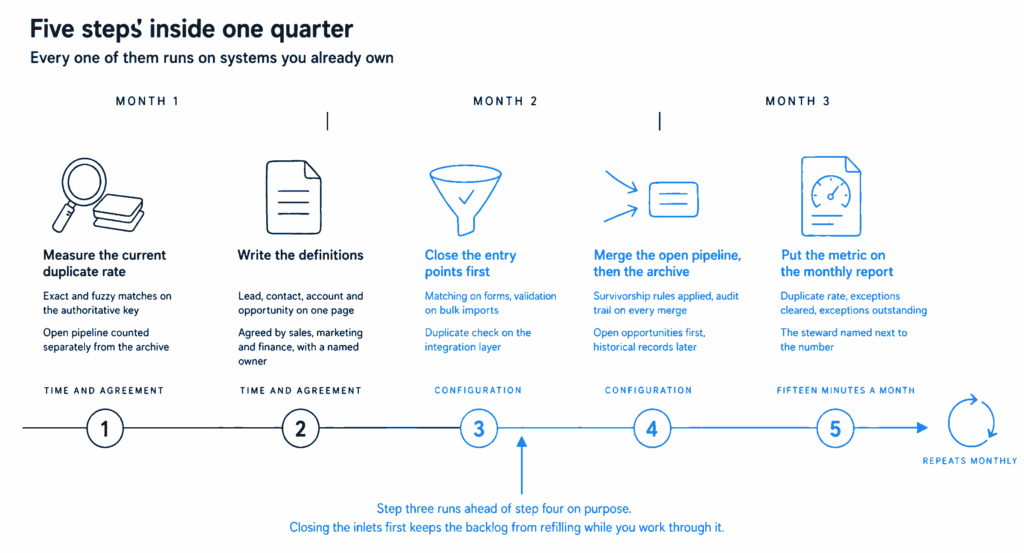
Five steps you can run inside one quarter
- Measure the current duplicate rate. Count exact and fuzzy matches on the authoritative key across accounts, contacts, and open opportunities. Report the result as a percentage, and separate the open pipeline from the historical archive. This number is the baseline for everything that follows.
- Write the definitions. One page, agreed by sales, marketing, and finance, covering the four objects and the authoritative key for each. Circulate it and assign a named owner.
- Close the entry points first. Matching on forms, validation on imports, a duplicate check on the integration layer. Sequencing this ahead of the merge keeps the backlog from refilling while you work through it.
- Merge the open pipeline, then the archive. Apply the survivorship rules, start with open opportunities where the forecast impact is immediate, and keep an audit trail of every merge. The historical archive can follow at a slower pace.
- Put the metric on the monthly report. Duplicate rate, exceptions cleared, exceptions outstanding, with the steward named next to it. Fifteen minutes a month sustains what the cleanup produced.
All five steps run on systems you already own. Steps one, two and five cost time and agreement; steps three and four are configuration work.
What the next forecast review looks like
The version of that quarterly meeting worth aiming for is unremarkable. Sales presents pipeline coverage. Finance applies its conversion rates and arrives close to the same place. The twenty minutes previously spent reconciling two numbers goes to the deals themselves, which is what both sides wanted from the meeting.
Getting there comes down to a short set of agreements about what a customer record is, who owns it, and what happens when a new one arrives. The cleanup is the visible part, and the agreements are the part that holds.
If you want one question to take into your next sales operations meeting, make it this one: what percentage of our open opportunities point at a buyer who already exists somewhere else in the system? If nobody in the room can answer it, that is the first thing worth measuring.
Where do you stand with your own customer data?
If your reports disagree with each other, if the same customer appears several times under different names, or if a data migration or ERP replacement is on the horizon, a structured assessment is the fastest way to see the full picture. The Data Assessment is a fixed-price engagement of 2 to 3 weeks: a preparation questionnaire, 2 to 3 workshops, and an 8 to 12-page executive summary setting out where you stand today, the 3 to 5 main pain points, and the order in which they should be addressed. From EUR 1,450 + VAT.
If you would prefer to clarify the questions first, a free 30-minute consultation is a sensible place to begin.
Sources
- Gartner. (2020, February 12). Less Than 50% of Sales Leaders and Sellers Have High Confidence in Forecasting Accuracy. Source of the 45%, 47%, and 13% figures and the factors behind low data quality. Read article →
- Gartner. (2020). Data Quality. Source of the USD 12.9 million annual cost estimate and the finding on data inconsistency across sources. Read article →
- European Parliament & Council of the European Union. (2016). Regulation (EU) 2016/679 (General Data Protection Regulation). Articles 5(1)(d) on data accuracy and 17 on the right to erasure. Read article →

Csaba Fekszi
Csaba Fekszi is an IT expert with more than two decades of experience in data engineering, system architecture, and AI-driven process optimization. His work focuses on designing scalable solutions that deliver measurable business value.
Related posts




The real barriers to enterprise AI, and what the companies that succeed do differently
Are you sure AI is the right next step?
We help uncover the real opportunities, limitations, and realistic next steps.