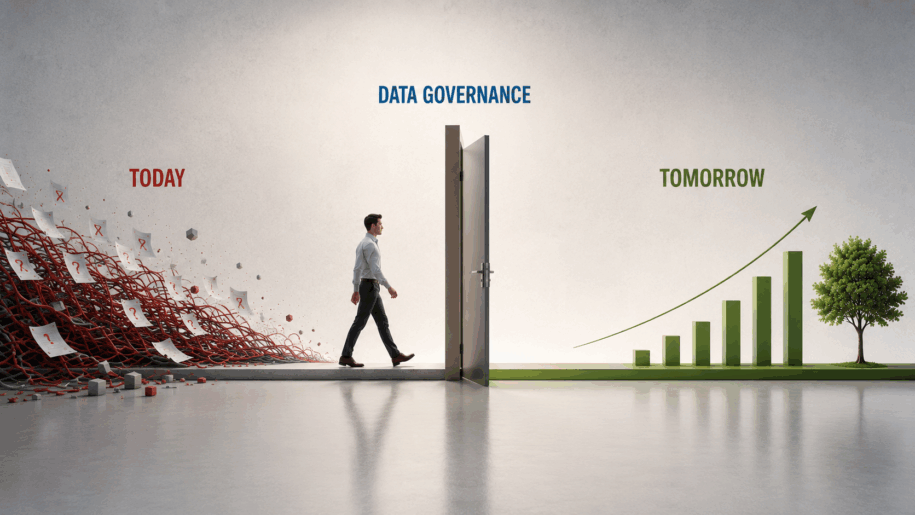
The Benefits of Data Governance
Short-Term and Long-Term Returns
- AI In Business
Gartner puts the average annual cost of poor data quality at USD 12.9 million per organization.
The figure is large enough to feel abstract, and that is part of the problem. The cost arrives in small installments: a report rebuilt by hand, a customer contacted twice, a forecast that two departments defend with different numbers. Data governance is the discipline that stops the installments. The fair question from any management team is what it returns, and when. This article covers both horizons: what returns in the short term, and what returns over the long term.
Four commitments, before any tooling
Governance carries a committee reputation. In practice, it comes down to four commitments. Every important data domain has a named owner. The definitions live in one written place. The rules for creating and changing records are agreed and known. There is a way to see when the rules get broken.
Keep that in mind while reading what follows. Every benefit below comes from those four commitments. Platforms and catalogs accelerate them, and they do not replace them.
Short-term returns: friction disappears
Early returns are operational. They show up on calendars before they appear in the accounts.
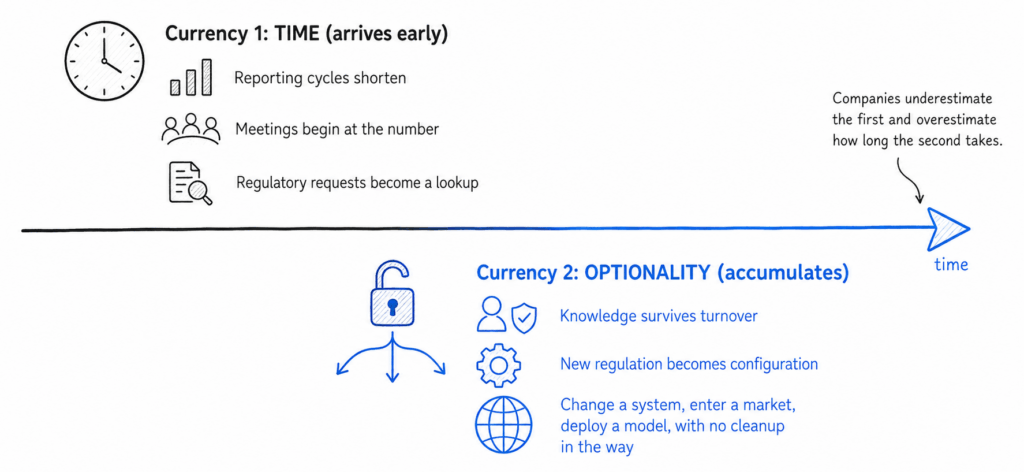
- Reporting cycles shorten. One agreed definition of revenue, customer, and product removes the reconciliation work that opens every cycle. What used to be an investigation shrinks to a short check.
- Meetings begin at the number. Management discussions move from arguing about whose figure is correct to deciding what to do about it. This is the change people notice first, and it is difficult to reverse once it happens.
- Regulatory requests become routine. A documented map of where personal data lives turns a GDPR access request or an internal audit query into a lookup, and the scramble across four departments disappears.
- New colleagues become productive sooner. An analyst who can open a catalog and find the owner of a field needs far less supervision from the start.
None of this requires a completed enterprise program. It follows from clarity on a handful of domains that everyone already argues about.
Governance becomes significantly more valuable when employees can actually find and use trusted information. See how this works in AI Search: Turning Organizational Knowledge into Confident Decisions →
The next stage: the cost line moves
Once ownership and definitions are in place, second-order effects reach the budget.
- Rework falls. An error caught at data entry costs a fraction of the same error caught by a customer. Credit notes, corrected invoices and repeated deliveries trace back to mistakes in individual records.
- Automation becomes feasible. Process automation and system integrations break on inconsistent data. Reliable master data is a prerequisite for almost every automation business case, which explains why two companies with identical tooling can report very different results.
- System replacement gets cheaper. Most of the effort in an ERP or CRM migration is data preparation. A company that maintains governance carries that cost once. A company without it pays the same cost again at every project.
- AI projects survive contact with reality. Gartner expects organizations to abandon 60% of AI projects through 2026 where the underlying data is unfit for AI use, and a 2024 Gartner survey of 248 data management leaders found that 63% either lack appropriate data management practices for AI or are unsure whether they have them. For most companies of this size, the AI question and the data governance question are the same, asked at different moments.
Long-term returns: optionality
Over the longer term, the return changes character. It becomes the freedom to move.
- Knowledge survives turnover. When definitions sit in documents and ownership belongs to roles, the departure of one experienced analyst stops being a risk event.
- New regulation becomes configuration work. Each new reporting duty lands on a mapped data landscape, and the answer to the question “where does this figure come from” already exists in writing.
- Acquisitions and market entries get faster. Integrating an acquired company is largely a data exercise. A team that has run governance once has a method for it.
- Data can carry value outward. Dependable internal data makes customer-facing reporting, service-level evidence, and shared dashboards realistic commitments.
Governance changes processes, responsibilities, and everyday work — not just data. We look at the organizational side of that transition in AI and Humans Together: How to Transform the Organization? →
The honest part: four out of five programs stall
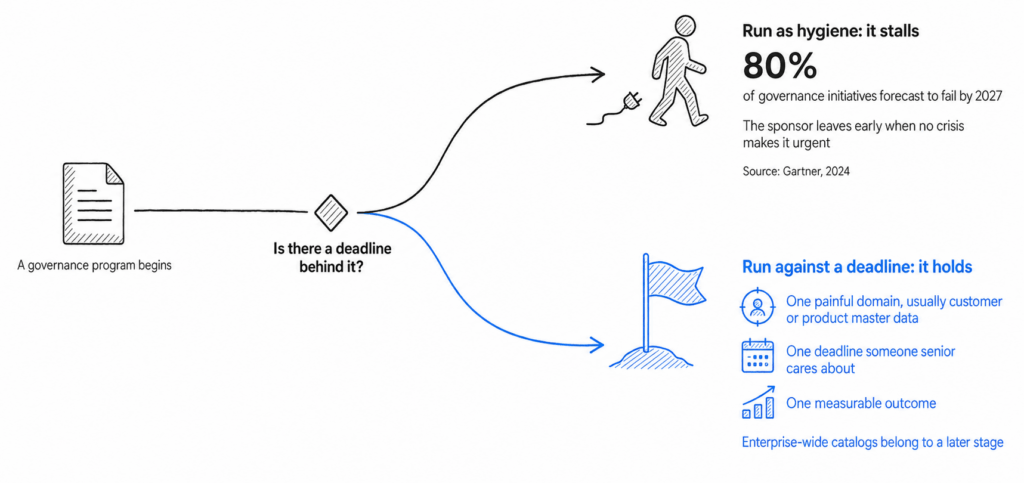
Gartner predicts that 80% of data and analytics governance initiatives will fail by 2027, and the stated reason deserves repeating: the absence of a real or manufactured crisis. Governance run as a hygiene project loses its sponsor early. Governance attached to a visible business deadline keeps it.
The practical consequence is a narrow start. One painful domain, usually customer or product master data. One deadline that someone senior cares about. One measurable outcome. Enterprise-wide catalogs belong to a later stage.
Five questions that show where you stand
- If two departments report the same figure differently this month, who decides which one is correct?
- Can you name the owner of your customer master data?
- How long would it take to list every system holding personal data on one client?
- When a field changes meaning, who gets told?
- What was the last decision delayed because the numbers were in dispute?
If those answers take more than a few minutes to assemble, the short-term benefits described above are available to you now.
The two currencies
Data governance pays in two currencies. The first is time, and it arrives early. The second is optionality, and it accumulates: the freedom to change a system, enter a market or deploy a model with no data cleanup standing in the way. Companies tend to underestimate the first and overestimate how long the second takes.
One question is enough for your next management meeting. If you had to prove the headline figure of your last quarterly report from the source systems tomorrow, how long would it take, and whom would you ask?
Where do you stand with your own data?
If the figures in your company live in several systems, the reports need manual assembly, or part of the operation runs on Excel, a structured assessment is the sensible first step. The Omnit Data Assessment takes two to three weeks, runs on two to three workshops with your own team, and closes with an executive summary of eight to twelve pages: where the breaks in your data are, what they cost you, and which three steps are worth taking first. Price from EUR 1,450 plus VAT.
Sources
- Gartner. (2020). Magic Quadrant for Data Quality Solutions. Gartner Research. Source of the widely cited estimate that poor data quality costs organizations an average of USD 12.9 million per year. Read article →
- Gartner. (2024, February 28). Gartner Predicts 80% of Data and Analytics Governance Initiatives Will Fail by 2027. Gartner Newsroom. Forecast on the success rate of data governance initiatives, with commentary from Saul Judah, VP Analyst. Read article →
- Gartner. (2025, February 26). Gartner Predicts 60% of AI Projects Will Be Abandoned Through 2026 Due to Poor Data Quality. Gartner Newsroom. Includes Gartner’s forecast on AI project abandonment and findings from the Q3 2024 survey of 248 data management leaders on AI data readiness. Read article →

Csaba Fekszi
Csaba Fekszi is an IT expert with more than two decades of experience in data engineering, system architecture, and AI-driven process optimization. His work focuses on designing scalable solutions that deliver measurable business value.
Related posts

The 70% Below the Surface That Most Quotes Never Show

A practical guide for CFOs and senior decision-makers at mid-sized companies

The real barriers to enterprise AI, and what the companies that succeed do differently
Are you sure AI is the right next step?
We help uncover the real opportunities, limitations, and realistic next steps.