
What Is Data Governance
And Why You Cannot Avoid It
- AI In Business
Your company already governs its data. The question is whether anyone wrote the rules down.
Every company has data governance. In most mid-sized firms, it lives in the heads of three or four people who know which report can be trusted, which spreadsheet is the current one, and who to call when two numbers disagree. The arrangement works until one of them takes a two-week holiday, or until an auditor asks who approved a figure. At that moment the company discovers that its most important control system was never documented.
Data governance is the decision to write that knowledge down, give it an owner, and make it enforceable. This article explains what the term covers in practice, why it moved from good practice to obligation, and what a realistic first quarter looks like.
What data governance means in practice
Textbook definitions of data governance tend to be abstract enough to be useless in a management meeting. A working definition is narrower. Data governance is the set of decisions about who owns each data domain, who may change it, what quality level it must meet, and how the company finds out when those rules are broken.
In practice, it answers four questions:
- Who is accountable for customer data, product data, and financial data? Accountable means one named person who holds the authority to decide.
- What counts as a valid record? A customer without a tax number, a product without a unit of measure, an invoice without a cost center: which of these may enter the system at all?
- Where does the authoritative version live? When the CRM and the ERP disagree about an address, which one wins?
- How does the company notice when something breaks? A rule with no measurement is a wish.
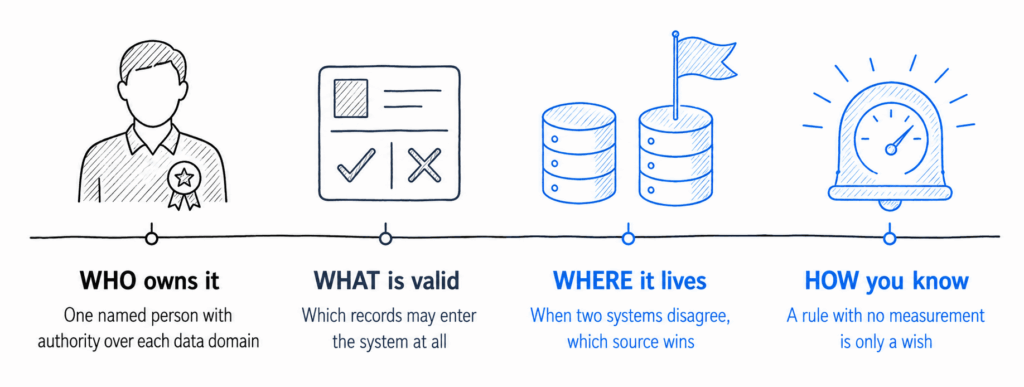
Everything else follows from those four answers. Catalogs, quality dashboards, stewardship workflows, and master data platforms are instruments for enforcing decisions that a human being has already made. Buying the instrument before making the decision is the most common and most expensive sequencing error in this field.
Data governance tools cannot solve unclear ownership, fragmented responsibilities, or missing decision rights. We examine these organizational barriers in What’s Holding Your Company Back from AI Adoption →
Why the topic became unavoidable
For years, data governance was a good practice that a company could postpone. Two regulatory developments moved it into the category of obligations.
The GDPR made accountability a legal principle in 2018. Article 5(2) states that the controller is responsible for compliance with the data processing principles and must be able to demonstrate that compliance. Demonstrating something requires records: who owns which data, on what legal basis it is held, and how long it stays. A company without a governance structure has no way to produce that evidence when asked for.
The EU AI Act went further. Article 10 carries the heading Data and data governance, and it requires that training, validation, and testing datasets used by high-risk AI systems be subject to appropriate governance practices, including examination of possible biases and identification of gaps or shortcomings. For any company planning AI in a regulated function such as credit scoring, recruitment, or critical infrastructure, data governance has become a precondition for deployment.
The regulatory pressure and the operational pressure point in the same direction, which is unusual and convenient. The work that satisfies an auditor also produces reports that agree with each other.
Three misconceptions worth clearing up
Data governance is an IT project
It is a business decision structure that IT supports. When governance is delegated entirely to IT, the outcome is a technically correct model of a business nobody agreed on. The rules about what constitutes a valid customer record belong to the people who sell to customers.
It starts with buying a platform
A governance platform enforces rules. Where there are no agreed rules, the platform becomes an expensive inventory of the existing chaos. The right sequence starts with one domain, one owner, and a two-page rule set.
It slows the organization down
The slowdown is already happening, distributed across every reconciliation meeting and every report that took three weeks. Governance concentrates that cost into a visible, finite piece of work and then removes most of it.
Governance only works when the rules and systems reflect how people actually work. Learn why employees bypass tools that create friction instead of clarity in Why Employees Quietly Work Around Your Software →
A realistic first quarter
The failure mode of governance programs is scope. A company that begins by mapping every data domain produces a document nobody reads. A narrower start works better.
- Pick the domain that hurts. Usually, customer master data or product master data. Choose the one that appeared in the last three arguments about numbers.
- Name one owner with authority. A business leader who can decide what a valid record is and make the decision stick. One name on the org chart.
- Write the rules on two pages: mandatory fields, the authoritative source, the approval path for changes, and the retention period. Two pages get read, and a rule that gets read is a rule that gets applied.
- Measure one metric every week: duplicate rate, completeness of a mandatory field, or the share of records failing validation. A single trended number creates more discipline than a policy document.
- Review after ninety days, then extend to the second domain. The second domain takes half as much time because the pattern is now known.
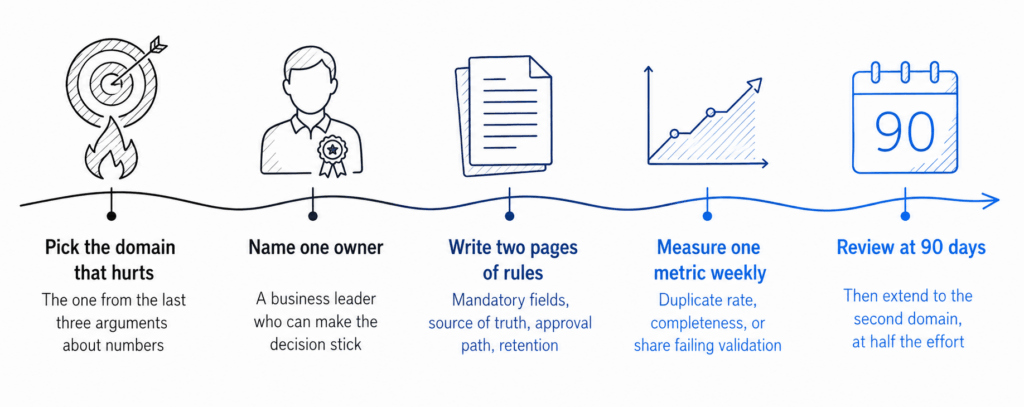
A company that does these five things in one quarter has more working governance than most organizations achieve with a two-year program and a six-figure platform license.
The point to take away
Data governance rarely appears on a strategy slide. Its value shows up in negative space: the meeting that did not need a reconciliation round, the auditor question answered in an hour, the AI pilot that reached production on the original timeline.
The companies that handle this well share one habit. They stopped treating data as a technical by-product of their systems and started treating it as an asset with a named owner. Everything else is implementation detail.
Ask yourself one question this week: if a regulator asked who is accountable for your customer data, could you give a name within a minute?
Where do you stand today?
If the situation described above sounds familiar, if data lives in several systems, reports do not reconcile, or part of your operation runs on Excel and manual workarounds, a structured assessment is the sensible first step.
The Omnit Data Assessment is a two- to three-week engagement: two to three workshops, an eight- to twelve-page executive summary, and a concrete development direction from EUR 1,450 plus VAT.
Sources
- EUR-Lex. (2026). Regulation (EU) 2016/679 (General Data Protection Regulation), Article 5(2) – Accountability principle. Consolidated text of the GDPR describing the accountability principle and the obligation to demonstrate compliance with data protection requirements. Read article →
- EUR-Lex. (2026). Regulation (EU) 2024/1689 (Artificial Intelligence Act), Article 10 – Data and data governance. Consolidated text of the AI Act describing governance requirements for training, validation and testing data used in high-risk AI systems. Read article →

Lajos Fehér
Lajos Fehér is an IT expert with nearly 30 years of experience in database development, particularly Oracle-based systems, as well as in data migration projects and the design of systems requiring high availability and scalability. In recent years, his work has expanded to include AI-based solutions, with a focus on building systems that deliver measurable business value.
Related posts

A practical guide for CFOs and senior decision-makers at mid-sized companies

The 70% Below the Surface That Most Quotes Never Show

Turning Ambition into Real, Scalable Results
Are you sure AI is the right next step?
We help uncover the real opportunities, limitations, and realistic next steps.