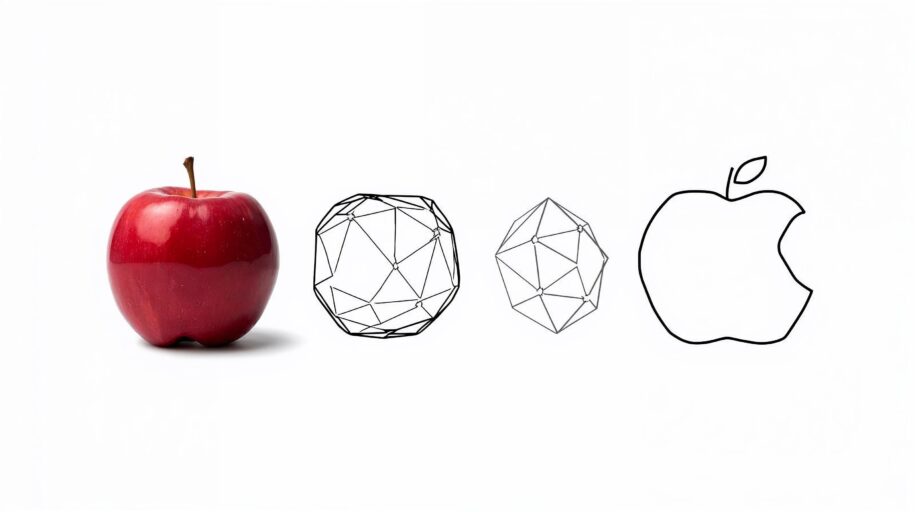
What is Computer Vision
How machines turn visual data into actionable business insight
- AI Building Blocks
At its core, Computer Vision is a field of artificial intelligence that enables machines to interpret visual data: images, videos, and live camera feeds.
Humans process visual information instantly and intuitively. A warehouse scene, a production error, or a worker’s action is recognized without conscious effort. Machines, by contrast, do not “see” — they process numerical data. Every image is a grid of pixels, each represented by values encoding color and brightness.
The role of Computer Vision is to turn this raw numerical input into meaningful conclusions.
For a business decision-maker, this is a critical shift in thinking: Computer Vision is not about replicating human sight. It is about extracting actionable signals from visual data — at scale, consistently, and without fatigue.

How did machines “see” before
Before deep learning, visual AI relied on rule-based logic. Engineers manually defined what the system should look for. For example: “If there are at least X red pixels in this area, trigger an alert.” As a result, early Computer Vision systems were rigid.
However, this approach had one advantage: predictability. In controlled environments, with fixed lighting and stable conditions, these systems could perform reliably.
But the moment conditions shifted — lighting changed, camera angle moved, objects varied slightly — performance degraded sharply or failed. These systems could not generalize.
This is the core issue: rule-based vision does not scale to real-world complexity.
Every exception required a new rule. Every new scenario increased system fragility. Over time, maintenance became unmanageable.
The breakthrough came when the paradigm flipped.
Instead of telling the machine what to look for, we started showing it examples — and letting it learn the patterns on its own.
This shift is structural. It is the difference between programming behavior and training capability.
The shift and the role of neural networks
The real shift in Computer Vision came from abandoning rules altogether.
Modern systems use deep learning — specifically, convolutional neural networks (CNNs) — to learn directly from data.
This approach mirrors how human vision works.
The brain processes visual information in layers. It starts with simple elements — edges, contrasts — then builds up to shapes, objects, and eventually full scenes. CNNs follow the same logic:
- Early layers detect basic patterns such as edges and contrasts.
- Intermediate layers combine these into shapes (corners, curves).
- Deeper layers recognize parts of objects.
- Final layers identify complete objects and relationships.
The system is not told what a “hand” looks like. It learns from thousands — often millions — of labeled examples until the pattern becomes statistically recognizable.
A rule-based model answers: “Does this match the predefined condition?” A neural network answers: “How similar is this to what I have learned before?”
This distinction defines performance.
A simple analogy makes this explicit: A child learns to distinguish a dog from a cat by exposure, not rules. No one provides a checklist. Recognition emerges from repeated examples. CNNs operate the same way — except they rely entirely on the quality and quantity of training data.

What can Computer Vision do today
1. Image Classification — What is in the image
This is the simplest use case.
The system looks at the entire image and assigns a single label. Example: “defective product” vs. “non-defective product”.
There is no localization. No explanation. Just a decision.
Use it when the question is binary or categorical, and spatial detail is irrelevant.
2. Object Detection — What is where
Here, the system does more than classify — it identifies multiple objects and their positions.
Example: “3 operators and 2 conveyor sections detected at these coordinates.”
This is the first level where operational insight appears. You are no longer asking what, but where and how many.
3. Segmentation — What exactly belongs to what
Segmentation operates at the pixel level.
Instead of drawing rough boxes, it precisely outlines objects. Example: separating material from background with exact boundaries.
This is critical when precision matters — quality inspection, medical imaging, or material analysis.
4. Pose Estimation — How is the body positioned
The system identifies key points of the human body (joints, limbs) and maps their spatial relationships.
This enables tracking posture and movement structure.
It is not about identity. It is about geometry.
5. Activity Recognition — What is happening
This moves beyond static images.
The system interprets actions — not just objects. Example: detecting whether a worker is assembling, lifting, or violating a safety rule.
This typically requires video, not just images. Time becomes a factor.
What does a system need to learn
There is no shortcut here. If one of the following is weak, the system will underperform.
1. Data
A model learns from examples. Nothing else.
If it sees 10,000 images of defective products and 10,000 of non-defective ones, it can learn the distinction. If it sees 50, it cannot.
This is the main driver of performance.
More importantly, the data must reflect reality. If your dataset does not include variations (lighting, angles, edge cases), the model will fail the moment those appear in producti
2. Labeling
Data without labels is useless for supervised learning.
Humans must annotate:
- What is in the image?
- Where it is?
- What is happening?
This is manual, time-consuming, and expensive. And it is often underestimated.
Poor labeling = poor model. Not slightly worse — fundamentally unreliable.
3. Computing
Deep learning models require significant computational power, typically GPUs.
Today, this is accessible via cloud infrastructure. But it is neither instant nor free.
Training takes time. Iteration takes time. Optimization takes time.
Why now (Why Computer Vision took off)
Three shifts happened at the same time. Without all three, the technology would still be stuck in the experimental stage.
1. Data became abundant
Organizations now generate massive amounts of visual data — cameras in factories, warehouses, retail spaces, and hospitals.
More data means better training. And better training means usable models.
2. Computing power became accessible
Training deep learning models used to be prohibitively expensive.
Now, GPUs are cheaper, and cloud infrastructure makes large-scale training available on demand.
This removed a major barrier. You no longer need specialized hardware on-site to build working systems.
3. Algorithms improved dramatically
The breakthrough came with deep learning — especially after the 2012 ImageNet competition, where neural networks significantly outperformed previous methods.
These three factors reinforce each other:
- More data → better models,
- Better models → more use cases,
- More use cases → more data.
That feedback loop is why Computer Vision is now a business tool rather than a research topic.
Where are its limits
Computer Vision is powerful — but highly conditional. Its performance depends on factors that business stakeholders often underestimate.
1. Strong dependence on context
A model does not generalize well across environments.
A system trained in a well-lit, fixed-camera setup can perform near perfectly. Move it to a different site — different lighting, angles, background — and performance can collapse.
There is no universally “good” model. There is only one model that works in a specific context.
2. Data defines the ceiling
The model cannot recognize what it has not seen.
If training data does not include:
- night conditions,
- unusual angles,
- different clothing or object variations.
Then the system will fail in those cases.
3. No real understanding
The system does not understand cause and effect.
It detects patterns.
It cannot explain why something is happening, only that it resembles previously seen examples.
This is a hard boundary. Not a temporary limitation.
4. Edge cases break systems
Real environments are messy:
- reflections,
- occlusions,
- motion blur,
- unexpected behavior.
These environmental factors can degrade performance.
Why this matters for business decision-makers
Computer Vision is already delivering value.
Today, it is used to:
- perform automated quality inspection on production lines,
- count and track goods in logistics environments,
- monitor patient movement in healthcare,
- analyze shelf conditions and customer behavior in retail,
- enforce safety compliance in industrial settings.
These are all operational deployments.
The key question when adopting computer vision is: “Will it work reliably in our specific environment, for our specific problem?”
A well-scoped, narrow use case — with controlled conditions and proper data — can deliver immediate, measurable value.
A vague, overly broad initiative will fail, even with strong technology behind it.
The correct approach is disciplined:
- Define a concrete problem, not a general ambition.
- Validate data availability and quality upfront.
- Test in the actual operating environment.
- Set expectations aligned with real-world performance.
What to Remember
Computer Vision is not about replicating human sight. It is about extracting patterns from visual data — and turning them into decisions.
- Performance is driven by data, not algorithms.
- Models work only within the context they are trained for.
- There is no real understanding — only pattern recognition.
- Narrow, well-defined use cases deliver value.
- The next step is understanding processes over time, not just images.
What comes next: from images to understanding processes
Computer Vision performs well on static images. But most business value does not come from isolated snapshots.
It comes from understanding what unfolds over time.
A single frame can tell you what is visible. It cannot reliably tell you what is happening.
Operational reality is temporal:
- a worker completes a task,
- a process deviates from standard,
- a safety violation occurs over several seconds.
This is where video analysis and activity recognition become critical. They extend Computer Vision into the time dimension — enabling systems to detect patterns, behaviors, and workflows, not just objects.
For decision-makers, this is the next level of maturity, where they move from detecting states to understanding processes.
That shift is where most of the remaining business value sits.
Sources
- Infor. (2024). What is computer vision? Read article →
- Mindee. (2024). Computer vision explained. Read article →
- Snowflake. (2024). Computer vision fundamentals. Read article →
- Tericsoft. (2024). Computer vision. Read article →
- Ultralytics. (2024). From visualizations to business insights with computer vision. Read article →

Lajos Fehér
Lajos Fehér is an IT expert with nearly 30 years of experience in database development, particularly Oracle-based systems, as well as in data migration projects and the design of systems requiring high availability and scalability. In recent years, his work has expanded to include AI-based solutions, with a focus on building systems that deliver measurable business value.
Related posts

A Business Use Case of Visual Verification in Operational Monitoring

What an Early Video Analysis Pilot Revealed About Operational Insight


Are you sure AI is the right next step?
We help uncover the real opportunities, limitations, and realistic next steps.