
Why Do AI Projects Fail Without Data Governance
AI project data quality decides the outcome long before the first model is trained
- AI In Business
Gartner predicts that through 2026, companies will abandon 60% of the AI projects that lack AI‑ready data. A Gartner survey of 1,203 data management leaders, conducted in July 2024, put a second figure beside it: 63% of them either lack data management practices suited to AI or remain unsure whether they have any. For a mid-sized company weighing its first serious AI investment, those two numbers belong on the same slide.
They describe a failure that arrives quietly, several months after the pilot demo that everyone applauded.
The pilot works, the rollout stops
The pattern repeats across industries and company sizes. A team picks a promising use case, buys or builds a model, and runs a proof of concept on a hand-prepared data extract. The demo lands well. Then the project moves toward production, where the model has to read live systems, and progress slows to a halt.
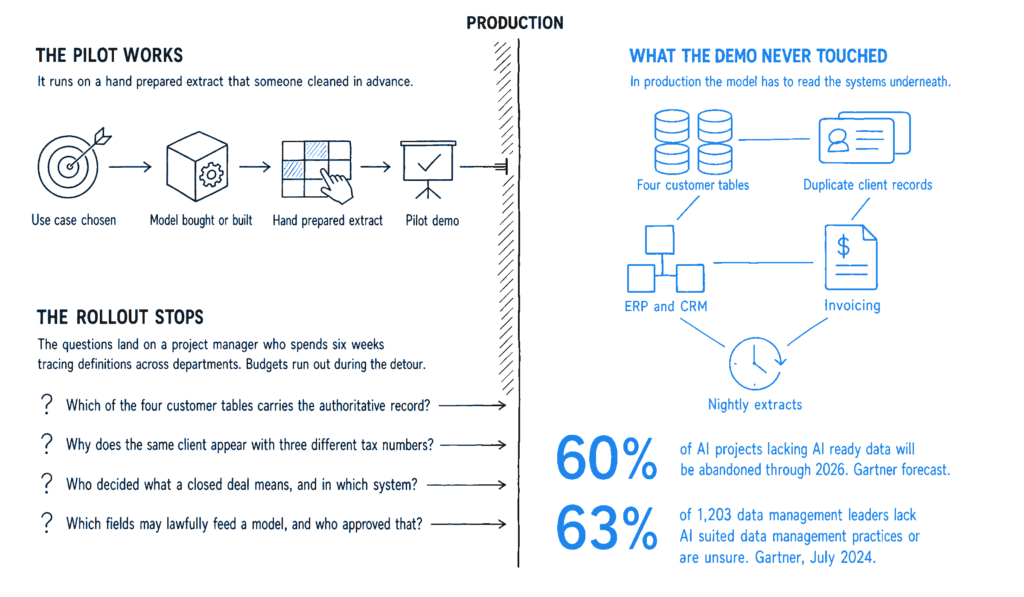
At that point the questions arrive:
- Which of the four customer tables carries the authoritative record?
- Why does the same client appear with three different tax numbers?
- Who decided that a closed deal means a signed contract in one system and an issued invoice in another?
- Which fields may lawfully feed a model, and who approved that?
When several systems hold different versions of the same customer, deciding which record to trust becomes a governance problem of its own. We explore this in Which Customer Record Is the Real One →
In a well-run company, each of these has an owner, and the answer takes minutes. Elsewhere, the questions land on a project manager who spends the next six weeks tracing definitions across departments. Budgets tend to run out during that detour.
Where AI project data quality breaks down
In 2024, the RAND Corporation published the results of 65 interviews with experienced data scientists and engineers, conducted to establish why AI projects fail. The headline figure travels widely: by some estimates more than 80% of AI projects fail, twice the failure rate recorded for conventional IT projects. The useful part of the study sits in the root causes.
Data-driven failures ranked as the second most common cause, behind decisions taken by business leadership. Thirty of the 50 industry interviewees raised persistent data quality problems on their own initiative. Several described the same trap: leadership assumes the company has good data because the weekly sales reports arrive on time. At the same time, data gathered for reporting or compliance purposes carries too little context to train a model on.
The RAND recommendation to industry leaders names the remedy directly. Up-front investment in infrastructure that supports data governance and model deployment shortens AI projects and increases the volume of high-quality training data available to them. The report treats delayed investment here as a driver of longer timelines and higher failure rates.
What data governance covers in this context
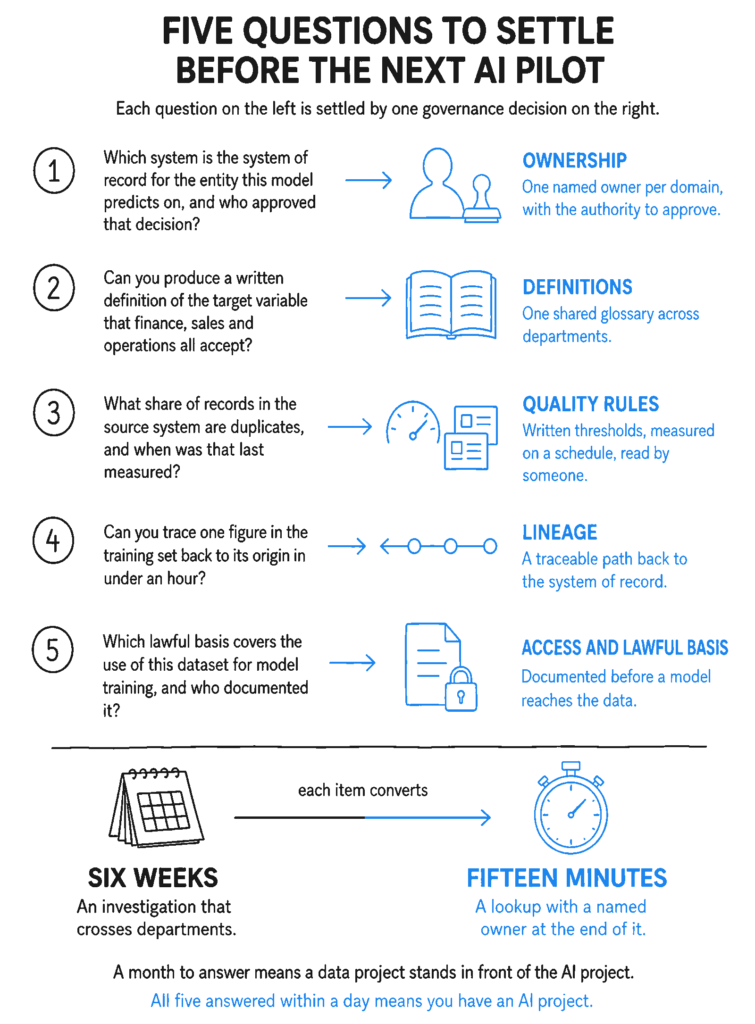
Data governance sounds like a compliance program, and that framing costs companies money. In an AI context, it settles five operational questions:
- Ownership. One named data owner per domain, holding the authority to approve a definition and the accountability to maintain it.
- Definitions. A shared glossary, so that customer, active contract and closed deal carry one meaning across finance, sales and operations.
- Quality rules. Written thresholds for completeness, format and duplication, measured on a schedule, with results that reach a named reader.
- Lineage. A traceable path from every figure back through each transformation to its system of record.
- Access and lawful basis. A register of which datasets may serve which purpose, with the legal ground documented before a model reaches them.
Data quality is only part of AI readiness. The data also has to be appropriate and lawful to use. We examine that side of the problem in AI Data Privacy Risks →
Each item on that list converts a six-week investigation into a fifteen-minute lookup. That is the whole business case.
Five questions to settle before the next AI pilot
- Which system is the system of record for the entity this model predicts on, and who approved that decision?
- Can you produce a written definition of the target variable that finance, sales, and operations all accept?
- What share of records in the source system are duplicates, and when was that last measured?
- Can you trace one figure in the training set back to its origin in under an hour?
- Which lawful basis covers the use of this dataset for model training, and who documented it?
A team that answers all five within a day has an AI project. A team that needs a month to answer them has a data project standing in front of the AI project, and the sequence matters.
The order of work
Governance has a reputation for being slow and abstract, which keeps it off the roadmap. In practice, the first useful pass is narrow. Pick the one use case the business wants, map the three or four systems it depends on, name an owner for each, write down the six definitions that matter, and measure duplication once. For a mid-sized company, that is a 2- or 3-week exercise, and it converts an open-ended risk into a costed decision.
The cost of skipping it compounds quietly. Gartner puts the cost of poor data quality at a minimum of USD 12.9 million a year for the average organization, a 2020 research figure the firm still publishes. At mid-sized scale, the absolute number lands lower, and the mechanism stays identical: hours spent reconciling figures, decisions taken on numbers that turn out to be wrong, and investments abandoned partway.
There is evidence on the other side of the ledger. The 2026 State of Data Integrity and AI Readiness study, produced by Precisely with the LeBow College of Business at Drexel University from a survey of more than 500 senior data and analytics leaders, found that 71% of companies running a governance program report high trust in their data, against 50% of those operating without one. The same study observed that the organizations getting the most out of AI extended their existing data governance to cover AI oversight.
The 60% abandonment rate in the Gartner forecast describes a choice about sequence. The companies that treat data governance as the first phase of the AI project keep their pilots. The companies that treat it as cleanup work meet the same five questions later, at a higher price.
Where to start
If your company is preparing an AI initiative and the five questions above would take more than a day to answer, a structured assessment is the faster route.
The Omnit Data Assessment runs for 2 or 3 weeks, includes 2 or 3 workshops with your teams, and delivers an executive summary of 8 to 12 pages with a prioritized action list. Pricing starts from EUR 1,450 plus VAT.
Sources
- Gartner. (2020). Data Quality. Source of the USD 12.9 million annual cost estimate for poor data quality. Read article →
- Gartner. (2025, February 26). Lack of AI-Ready Data Puts AI Projects at Risk. Source of the 60% abandonment forecast and the 63% figure on AI-ready data management practices. Read article →
- Precisely & Drexel University LeBow College of Business. (2026). 2026 State of Data Integrity and AI Readiness. Source of the 71% and 50% data trust figures and the finding on extending data governance to AI oversight. Read article →
- RAND Corporation. (2024, August). The Root Causes of Failure for Artificial Intelligence Projects and How They Can Succeed. Source of the 80% failure estimate, data-related failure findings, and recommendation on data governance infrastructure. Read article →

Csaba Fekszi
Csaba Fekszi is an IT expert with more than two decades of experience in data engineering, system architecture, and AI-driven process optimization. His work focuses on designing scalable solutions that deliver measurable business value.
Related posts


Why So Many AI Projects Stall — and How to Finally Move Beyond the Pilot Phase

Turning Ambition into Real, Scalable Results
The 70% Below the Surface That Most Quotes Never Show
Are you sure AI is the right next step?
We help uncover the real opportunities, limitations, and realistic next steps.