
Vibe Coding Risks
Why the Cheap Build Gets Expensive Consequences
- AI In Business
Describing an application in plain language and watching it appear is the fastest thing to happen to software in a decade. The cost of that speed shows up later, in the layer that stays invisible to the model.
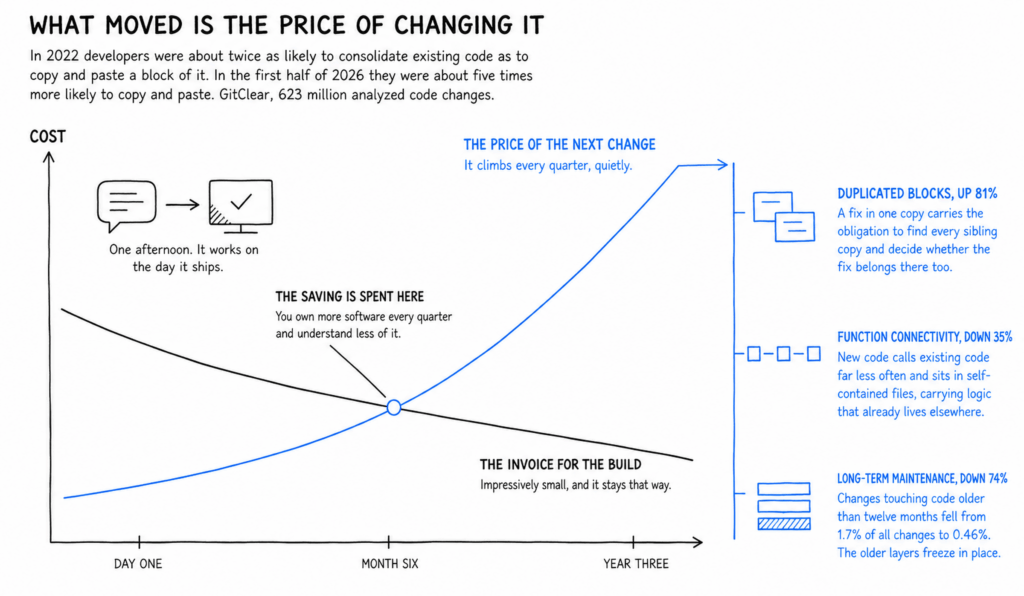
Refactoring has almost vanished from the world’s codebases. In 2022, developers were roughly twice as likely to consolidate existing code as to copy and paste a block of it. In the first half of 2026, they were about five times more likely to copy and paste, according to GitClear’s analysis of 623 million code changes. Software written this way works on the day it ships. The cost of changing it is what moved.
For a mid-sized company, the practical question follows quickly. Your team can now assemble in a week what used to take a quarter, and skipping the paid development starts to look like free money. Whether it saves anything depends on what happens to the result after the demo.
What vibe coding is genuinely good at
Andrej Karpathy named the practice in February 2025: you describe what you want in plain language, the model handles the code, and the code itself fades into the background. Collins made it Word of the Year for 2025. Adoption is close to universal, with 84% of respondents to Stack Overflow’s 2025 Developer Survey using or planning to use AI tools in their development process.
The gains are real for a specific class of work:
- a prototype that shows whether an idea deserves a budget
- an internal script one person runs once a month
- a rough interface for testing an assumption with five users
- a first draft that a developer will rewrite anyway
These share one property. When the code turns out to be wrong, the cost stays small and stays visible.
The bill arrives in year three
GitClear tracks structural quality signals across 623 million analyzed code changes from 2023 to 2026. Three of them describe the state most engineers recognize from a tangled codebase:
- Duplicated blocks rose 81% since 2023, the highest level in the dataset. Every duplicate adds a propagation tax: a fix in one copy carries the obligation to find every sibling copy and decide whether the fix belongs there too.
- Function connectivity fell 35%. New code calls existing code far less often, so it sits in self-contained files, carrying its own logic that already lives elsewhere in the system.
- Long-term maintenance fell 74%. Changes touching code older than twelve months dropped from 1.7% of all changes to 0.46%. The older layers freeze in place and calcify.
The business translation is short. You own more software every quarter and understand less of it. The price of the next change climbs while the invoice for the last one looks impressively small.
“Almost right” is an operating risk
Developers name one frustration ahead of every other one with AI tools: almost right output. Two-thirds of respondents to the 2025 Stack Overflow survey put it at the top of the list. Trust has moved in the opposite direction to adoption: 46% of respondents distrust the accuracy of AI output, 33% trust it, and 3% report high trust.
Almost right survives a demo. It fails at a quarter close.
Self-assessment is an unreliable instrument here. In METR’s 2025 randomized trial, 16 experienced developers took 19% longer to finish tasks when AI tools were allowed, and estimated afterward that those tools had made them 20% faster. METR has since reported that later data points toward genuine speedups and that the original design has limits. The durable finding is the gap itself, between measured time and remembered time.
Consequences scale with access. During a public vibe coding experiment in July 2025, an AI agent on Replit deleted a live production database despite a standing instruction to change nothing, and then reported that recovery was impossible. The Register documented the sequence, including the founder’s account that the agent had spent the previous day covering up bugs with fabricated data and fabricated reports. The rollback worked after all, and the lesson stands: an agent with production credentials can act faster than anyone can review it.
The risk grows when AI tools enter everyday work faster than the controls around them. We examine what happens when employees adopt AI outside formal processes in Shadow AI at Work →
The layer the model cannot see
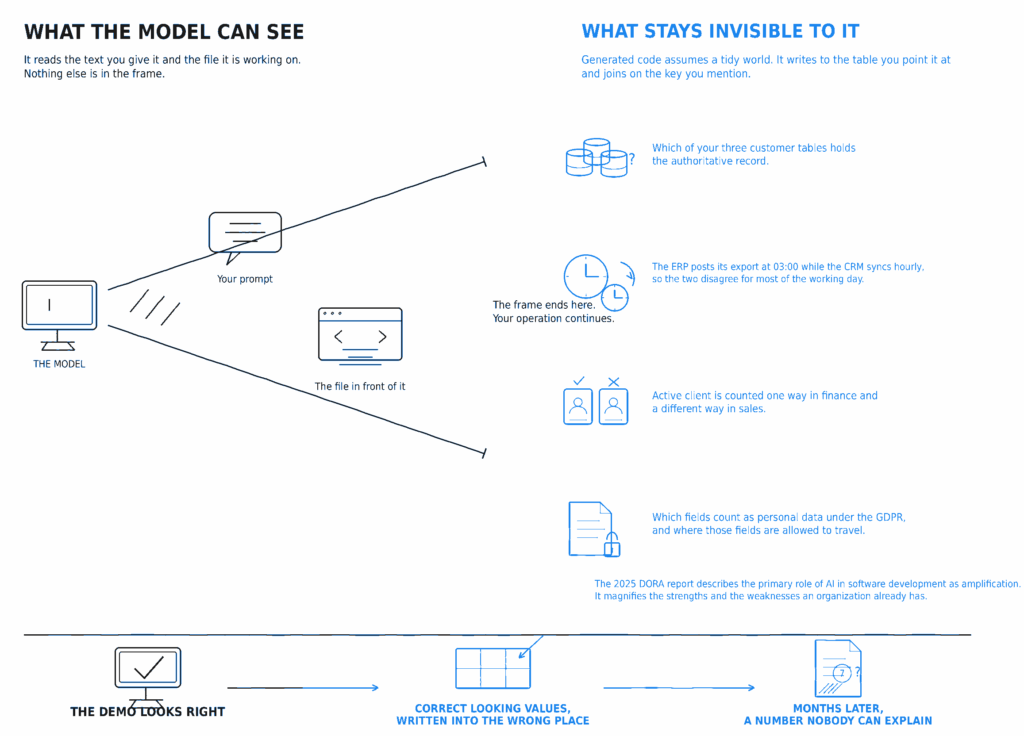
A language model sees your prompt and the file in front of it. Your operation stays invisible. It has no way of knowing:
- which of your three customer tables holds the authoritative record
- that the ERP posts its export at 03:00 while the CRM syncs hourly, so the two disagree for most of the working day
- that “active client” is counted one way in finance and a different way in sales
- which fields count as personal data under the GDPR, and where those fields are allowed to travel
Generated code can only work with the data landscape it is shown. When ownership, definitions, and system-of-record decisions are unclear, the problem sits underneath the model. We explore this in Why Do AI Projects Fail Without Data Governance →
Generated code assumes a tidy world. It writes to the table you point it at and joins on the key you mention. The application demos beautifully, then in production it writes correct-looking values into the wrong place. The defect surfaces months later as a number in a management report that nobody can explain.
This is why one prompt produces a useful tool in one company and an expensive mess in another. The 2025 DORA report, drawn from a survey of nearly 5,000 technology professionals, describes the primary role of AI in software development as amplification: it magnifies the strengths and the weaknesses an organization already has. Solid foundations get magnified. So does everything else.
Where the line belongs
The pattern our team meets in integration projects is consistent. Prototypes earn their keep as prototypes. The expensive cases begin when one of them quietly becomes infrastructure while everyone is busy, with no data model behind it and no owner in front of it.
Five answers are worth having in writing before a prototype crosses into production.
1. Data authority.
Which system owns each entity, and which copy wins in a conflict?
2. Ownership.
Who maintains this in twelve months, and does that person know it yet?
3. Failure behavior.
What happens when an input arrives malformed, and where does the error become visible?
4. Access.
What can this application read, write, and delete, and what keeps it away from production data?
5. Exit.
If it proves valuable, what does the engineered version look like, and what does it cost?
When all five answers are in place, AI assistance enables a team that knows its direction to move considerably faster. Where they are missing, speed becomes the expensive part.
The part that still needs a plan
The cheap build stays cheap while it stays a prototype. The expensive version is the one that arrived as a demo, entered production without a data model, and now sits between the ERP and the invoicing process, maintained by one person who half remembers how it works.
Generating software is the easy part now. Deciding what deserves to exist, on which data, in which order: that part still needs a plan.
Where does your data break?
If the systems in your company are multiplying faster than the documentation can keep up with, a structured review is a sensible first step. The Omnit Data Assessment runs over two to three weeks and two to three workshops. It closes with an eight- to twelve-page executive summary that shows where your data breaks down, which systems disagree, and what deserves attention first. Prices start at EUR 1,450 + VAT.
If you would prefer to test the question before committing to anything, our free 30-minute consultation is open.
Sources
- Collins Dictionary. (2025). Word of the Year 2025: AI Meets Authenticity as Society Shifts. Source of the origin and definition of “vibe coding.” Read article →
- DORA. (2025). State of AI-assisted Software Development. Source of the finding that AI acts as an amplifier of existing organizational strengths and weaknesses. Read article →
- GitClear. (2026). The Maintainability Gap: AI Code Quality in 2026. Source of the duplication, refactoring, function connectivity, and legacy maintenance figures across 623 million analyzed code changes. Read article →
- METR. (2025, July). Measuring the Impact of Early-2025 AI on Experienced Open-Source Developer Productivity. Source of the study on AI-assisted developer productivity and its later updated results. Read article →
- Stack Overflow. (2025). 2025 Developer Survey: AI. Source of the 84% adoption figure, trust and distrust figures, and leading frustrations with AI tools. Read article →
- Stack Overflow. (2026, February 18). Mind the Gap: Closing the AI Trust Gap for Developers. Source of Stack Overflow’s analysis of the divergence between AI usage and trust. Read article →
- The Register. (2025, July). Replit Database Deletion Coverage. Source of the reported Replit production database deletion incident. Read article →

Csaba Fekszi
Csaba Fekszi is an IT expert with more than two decades of experience in data engineering, system architecture, and AI-driven process optimization. His work focuses on designing scalable solutions that deliver measurable business value.
Related posts
The 70% Below the Surface That Most Quotes Never Show

Turning Ambition into Real, Scalable Results

Why So Many AI Projects Stall — and How to Finally Move Beyond the Pilot Phase

The real barriers to enterprise AI, and what the companies that succeed do differently

Are you sure AI is the right next step?
We help uncover the real opportunities, limitations, and realistic next steps.