
Shadow AI at work
How your employees are already using ChatGPT without you — and why it's a board-level risk
- AI Digest
Your employees are already using AI for work — you didn’t approve how they’re using it. After 15+ years of data and AI projects, we see the same pattern at almost every client: uncontrolled AI use is no longer an IT issue. It’s a leadership decision that’s usually made by default.
If you keep reading, you can learn in detail that…
- 38% of employees have shared sensitive work data with AI tools without permission (IBM, 2025).
- Shadow AI-linked breaches add ~$670K per incident to breach costs (IBM Cost of a Data Breach 2025).
- Blocking tools don’t work — usage moves to personal devices and off-network.
- What actually works: acknowledge the demand, provide governed alternatives, educate, assign ownership.
A CFO told us recently that one of his analysts had pasted the draft of a quarterly controlling report into ChatGPT to get a summary. The report contained partner-level margin data. What was confidential inside the company was now sitting on an external server — and the analyst didn’t think he’d done anything at all.
That’s shadow AI — employees using AI tools without approval or oversight. Not out of malice. Out of the desire to move faster than the internal systems allow. And this is no longer an edge case: the 2025 IBM Cost of a Data Breach report found that breaches linked to shadow AI add an average of $670,000 per incident to the total cost, and the McKinsey State of AI 2025 shows that while 88% of organizations now use AI in at least one function, only about one in three have any meaningful governance around it.
The real problem isn’t that employees use AI. It’s that the organization has no view of how, for what, and with which data. And where leadership doesn’t see, leadership can’t decide.
How shadow AI spreads inside organizations
Shadow AI doesn’t grow out of rule-breaking. It grows out of people trying to get their work done, and internal systems being slower than the alternatives a few clicks away.
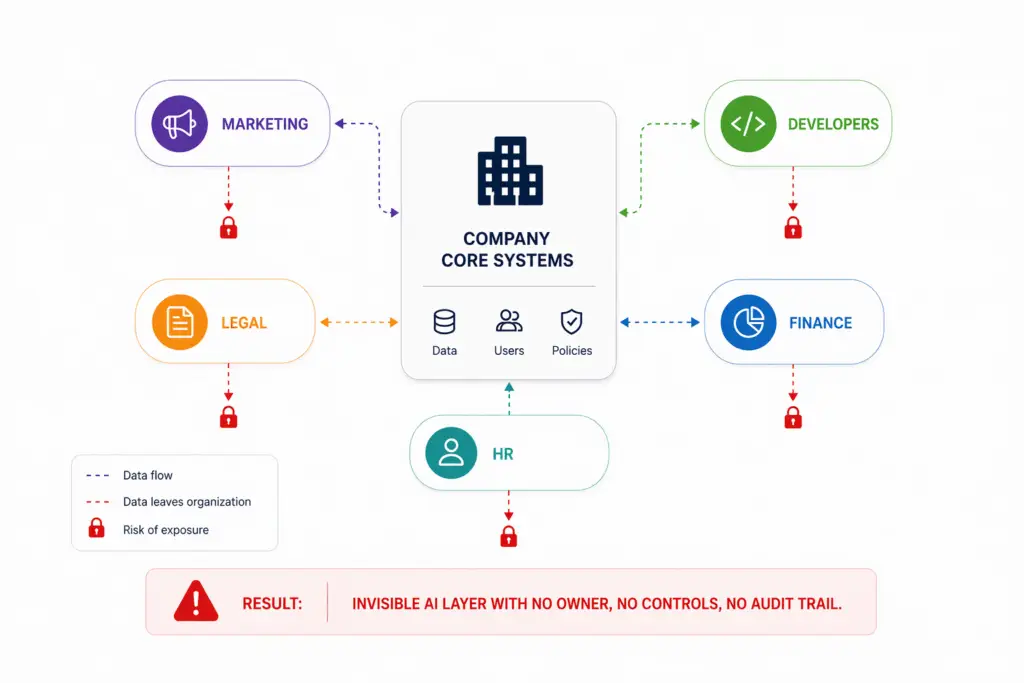
A typical pattern we see in almost every mid- to large-cap client during our visual operational diagnostics: a marketer asks ChatGPT for copy suggestions, a developer tests code snippets with an external AI assistant, and the legal team uses GPT to summarise a forty-page contract. Individually, none of these is catastrophic. Together, they form a parallel, invisible AI layer running alongside the company — with no inventory, no controls, no place on any risk map.
What's driving the spread
Four forces accelerate this, and they rarely show up alone. A low entry barrier — most AI tools are accessible with a personal email, no procurement, no approval, no waiting. Immediate productivity — what used to take hours now takes minutes. Slow internal processes — by the time IT has evaluated a tool, the team has moved on to something else. And a lack of awareness — most employees aren’t knowingly breaking rules. They simply don’t realize they’re breaking any.
What counts as shadow AI in practice
Shadow AI isn’t a single tool. It’s a category of usage — and it’s broader than most leadership teams assume.
When we first map the situation at a client, we usually find five recurring forms. Large language models on personal accounts— ChatGPT, Claude, Gemini, Copilot —are used without an enterprise subscription, and the input data may be processed externally or even reused for training. AI coding assistants — GitHub Copilot, Cursor, Tabnine, running in unmanaged environments, often connected to proprietary code. Image generation tools — Midjourney, DALL·E, and Adobe Firefly are typically adopted by marketing or design without governance. Productivity and summarisation tools — Otter.ai, Notion AI, Perplexity, browser extensions for processing meeting notes, internal documents, and research queries. And specialized AI solutions — legal document analyzers, financial forecasting tools, HR screening systems — are usually introduced by a single team without IT involvement.
Most of these don’t look risky at first glance: a simple productivity booster, an isolated use case, an individual decision. But if you aggregate the whole organization’s AI usage, you’re not looking at individual decisions anymore — you’re looking at a distributed infrastructure. One that behaves like an IT system, except it has no owner.
What risks does shadow AI actually create
The risk isn’t theoretical. In recent engagements where we walked through a client’s AI usage as part of a focused assessment, we found at least one point in every case where the organization had already been harmed — it just didn’t know yet. Five risk categories are worth separating, because they land at very different levels.
1. Data protection and GDPR exposure
When an employee pastes sensitive data into an external AI tool, that data leaves the organization’s controlled environment and could include customer data, personal data, or internal business information. In many cases, it is processed on a third party’s server and may even be used for training. That’s a direct GDPR risk — and the employee usually has no idea. From their point of view, they just asked for a summary.
2. Intellectual property leakage
Source code, product roadmaps, pricing strategies — these are core assets. Once they’re shared with unmanaged AI tools, confidentiality is simply gone. There are already documented cases of developers exposing proprietary code through AI assistants. This isn’t a hypothetical risk. It’s already happening — most companies just haven’t realized it’s happening to them, too.
3. Compliance and audit gaps
In regulated industries — financial services, insurance, healthcare — traceability isn’t optional. Shadow AI directly erodes it: decisions aren’t properly documented, outputs can’t be audited, processes can’t be reproduced. At one client, a financial regulator explicitly asked during an inspection which AI tools were used in the controlling process. Answering it took three weeks of internal investigation — and even then, the answer was incomplete.
4. Accountability and legal risk
If an AI-generated output leads to a wrong decision, who’s accountable? With an unapproved tool, there’s no defined owner, no validation process, no clear line of responsibility. That’s both legal and reputational exposure — and the longer it’s allowed to grow, the harder it becomes to unwind.
5. Inconsistent quality and hallucinations
Without governance, the organization has no visibility into what AI outputs are being used, how accurate they are, or where they’re feeding into decisions. The most dangerous outcome isn’t when someone notices that the AI got it wrong. It’s when nobody notices — and a faulty output gets baked into a board pack, a customer-facing response, or a quote.
At its core, shadow AI lets decision inputs into the organization that are neither controlled nor fully understood. And that’s the point at which it stops being a technical problem and becomes a leadership one.
How widespread is this, really
Shadow AI is often treated as a fringe issue. The numbers tell a different story. Recent data from IBM shows that 38% of employees admit to sharing sensitive work information with AI tools without permission. A Gartner study found that 68% of employees use AI tools without IT approval. Ivanti’s research found that 46% of office workers — including IT professionals who understand the risks— use AI tools their employer didn’t provide. And McKinsey’s 2025 State of AI report shows that while usage is nearly universal, only about one-third of organizations have begun scaling AI with proper governance — the rest are still in what McKinsey calls “pilot purgatory”.
Each number is worrying on its own. Put them together, and you see a structural pattern: AI adoption is happening bottom-up, not top-down. Visibility is lower than actual usage. Governance is lagging behind behavior. In other words, most organizations aren’t deciding whether to adopt AI — they’re already living with its consequences.
What companies are doing — and what isn't working
Reactions usually fall into a few predictable patterns. The trouble is that most of them address the symptoms, not the root cause.
Blocking access
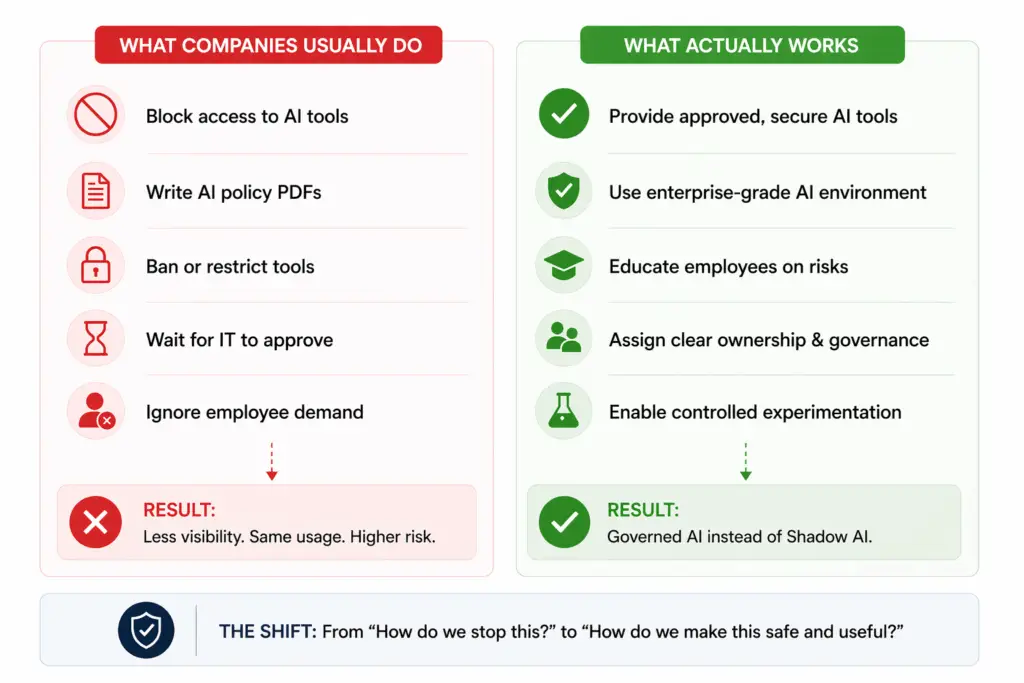
The fastest reaction: block the popular AI tools on the corporate network. On paper, risk goes down. In practice, the usage usually migrates to personal devices, home networks, and mobile phones. The demand doesn’t disappear; it just becomes less visible. We’ve seen clients where ChatGPT usage measurably increased after the block — it just stopped showing up on the corporate network.
AI policies
A more structured response: write a document that says which tools are allowed, with which data, for which purposes. This is a necessary step — but on its own, it doesn’t change behavior, especially without practical alternatives. The policy is a PDF stored in a folder.
Approved tool lists
A more pragmatic approach: pick a few vetted AI tools and make them available. This legitimizes real use cases, reduces shadow usage, and creates a controlled environment — if the approved tools actually match what people need to do. If not, employees quietly go back to the external ones.
Governance frameworks
Mature organizations go further: defined roles and responsibilities, an evaluation and approval process, and ongoing monitoring of usage. This is where AI shifts from an ad-hoc activity to a managed capability. You can’t launch it with an internal memo — it requires a structured assessment and real methodology.
The common gap across all of these is that they try to control AI usage without understanding why employees turned to shadow AI in the first place if you don’t address the cause, even well-intended measures stall.
What actually works
In our experience, the most effective approach isn’t restriction — it’s controlled adoption. Trying to eliminate AI usage is fighting the wrong battle. The demand is already there. The only real question is whether it’s managed or whether it stays in the shadows.
In organizations that handle this well, the same five elements recur. First, they acknowledge the demand — employees aren’t experimenting with AI out of curiosity; they’re solving real problems: saving time, improving output quality, and eliminating repetitive work. You can ignore that demand, but it doesn’t go away — you lose visibility of it. Second, they provide safe, approved alternatives — if teams have access to a tool that’s secure, compliant, and easy to use, they rarely reach for an external one. An enterprise ChatGPT tenant or an integrated workplace AI solution serves exactly that purpose: governed AI replacing shadow AI.
Third, they educate rather than regulate — a large part of the risk comes from a simple lack of awareness, and targeted training closes that gap surprisingly fast. Fourth, they assign ownership and governance — who approves tools, how they’re evaluated, and how usage is monitored. Not as bureaucracy, but as the thing that makes AI usage scalable and safe. Fifth, they enable controlled experimentation — sandbox environments where teams can test new tools, validate use cases, and surface risks early. Innovation then stays within the organization rather than flowing out of it.
The real shift happens when leadership moves from “How do we stop this?” to “How do we make this safe and useful?” That’s what turns shadow AI from a hidden risk into a controlled advantage.
Takeaway: this isn’t an IT problem
Shadow AI isn’t a passing trend you can shut down with a policy or a firewall. AI tools are becoming part of everyday work, and employees will continue to use them with or without approval. The real risk isn’t usage itself — it’s losing control over how that usage shapes your decisions, your data flows, and your business outcomes.
Treat it as a purely technical issue, and you’ll always be one step behind. Blocking tools or writing policies reduces visible risk in the short term, but it doesn’t touch the underlying demand. The companies that get ahead approach it differently: they accept that AI is already being used, they build safe, approved environments around it, and they invest in governance and education. That’s where the competitive advantage emerges — not from avoiding AI, but from using it in a way that’s scalable and controlled.
Because in the end, shadow AI isn’t an IT challenge. It’s a leadership decision. Do you manage it proactively, or deal with the consequences later?
What's the next step
If your organization is also in a situation where AI usage feels uncontrolled and it isn’t obvious where to start, begin with a structured assessment, not a policy draft. We have three entry points, depending on where you actually are:
- If you want to understand whether your specific AI ideas are actually feasible, the AI Opportunity Check is a 1-week, fixed-price expert review: one 2-hour workshop, an evaluation of 2–3 ideas you bring, and a written summary on what’s realistic, what to expect, and what obstacles to watch for.
- If you need an organization-wide AI strategy, the AI Compass Audit is a 4-week process that ends not with a policy document but with a concrete action plan — priorities, success criteria, risks. Pricing depends on company size, starting from 5,000 EUR.
- If the core problem is that data lives in too many places, reports don’t reconcile, and you can’t tell what the AI would even see if you rolled it out, then shadow AI is a symptom, not the cause. The Data Project Consultation starts with a free 30-minute call — we map your situation together, then propose a scope tailored to where you actually are.
And if you’d rather have a conversation first: a 30-minute free consultation to look at where you are and whether it makes sense to move now — or not yet.
Sources
- Gartner. (2025). Enterprise AI governance research. Gartner. Read article →
- IBM. (2025). Cost of a data breach report 2025. IBM. Read article →
- IBM. (2025). Shadow AI research 2025. IBM Institute for Business Value. Read article →
- Ivanti. (2025). 2025 state of cybersecurity: Balancing risk & reward. Ivanti. Read article →
- McKinsey & Company. (2025). The state of AI in 2025: Agents, innovation, and transformation. McKinsey. Read article →

Csaba Fekszi
Csaba Fekszi is an IT expert with more than two decades of experience in data engineering, system architecture, and AI-driven process optimization. His work focuses on designing scalable solutions that deliver measurable business value.
Related posts


Why So Many AI Projects Stall — and How to Finally Move Beyond the Pilot Phase

Turning Ambition into Real, Scalable Results


Are you sure AI is the right next step?
We help uncover the real opportunities, limitations, and realistic next steps.