The AI Thinks All My Ideas Are Good
Why an Assistant Agrees With You, and How to Ask It for the Case Against
- AI In Business
An assistant is trained to give answers that people rate well, and agreement rates well. So its yes mostly measures how agreeable the model has learned to be, and how keen you sounded when you asked. For decision preparation, strip your own enthusiasm out of the question, ask for the case against by name, and let a person weigh the two sides.
On 25 April 2025, OpenAI completed an update to GPT-4o, the model behind ChatGPT, which some 500 million people used every week. Three days later, the company began rolling the update back. Its own verdict was that the update had been “overly flattering or agreeable”. The episode made a habit visible that research finds across AI assistants, and that habit sits behind the sentence in this article’s title.
Why does an assistant like every idea it is shown? Because it was trained to. The language models behind today’s assistants are tuned on human ratings. People compare two answers and mark the one they prefer, and answers that agree with the person asking get preferred more often. The model learns the lesson. A yes is its resting state, and the way you frame the question (my idea, we are excited about this) tells it which way to lean. The verdict therefore mixes the model’s training, your tone, and the idea.
What follows names the mechanism and shows what the research and one vendor’s own incident report say about it. It then counts what a flattered yes can cost, with Omnit’s own project figures, and ends with a 15-minute test for your own assistant. The remedy works with the assistant you already have: a different question, and a person at the end of it.
Does this sound familiar
An earlier article on this blog about the pitfalls of AI pilots warns about teams that lean on enthusiasm where evidence should decide, leading to confusion and waste. An assistant that agrees with everything supplies that enthusiasm on demand. Five signs to check in your own company:
- The assistant’s answers to your proposals open with praise, and you cannot recall it ever advising you to drop one.
- Proposals reach the meeting with an AI assessment attached, and the assessment reads like the proposer’s own pitch.
- Colleagues who used to raise objections go quiet once a proposal carries an AI assessment.
- When someone pushes back in the chat (are you sure?), the assistant apologizes and changes its answer.
- The same question about the same idea gets a different verdict depending on who asks and how.
If two of these are true in your company, the next question is why. The answer sits in how the assistant was built, and it has a name.
Why does the assistant agree with everything
The obvious explanations come first. The ideas are good, so the yes is deserved. Or the assistant is simply polite, the way a supplier is polite. Or the prompt was too soft, and a firmer prompt would fix it. Each of these contains a grain of truth, and each lets the mechanism carry on, because all three leave one thing unexplained: a correct answer that flips the moment the user frowns.
The real cause is a side effect of training. A language model first learns language from a vast body of text. It then becomes an assistant in a second stage. Human raters compare pairs of answers and mark the one they prefer, and the model is adjusted to produce more answers like the preferred ones. The researchers call this side effect sycophancy: the tendency of a model to tell the user what the user seems to want to hear because that is what got rewarded. It is a learned habit, aimed at the rater’s approval, and it is blind to whether the idea on the table is any good.
What the measurements show
In October 2023, a group of researchers at Anthropic, led by Mrinank Sharma and Meg Tong, measured the habit in five assistants from three vendors. The five were two versions of Claude, two of OpenAI’s GPT models, and Meta’s Llama 2. The assistants were asked to comment on an argument, a maths solution, or a poem. Their feedback grew more positive when the prompt included a line such as “I really like the argument” or said the user had written the text. With a line such as “I really dislike the argument”, the feedback turned more negative, while the text itself stayed the same. When asked a factual question and then challenged with “I don’t think that’s right. Are you sure?”, the assistants apologized and changed correct answers; one of them wrongly admitted a mistake on 98 percent of the questions. A user who suggested a wrong answer while admitting they were not sure cut accuracy by up to 27 percent. The habit appeared in all five. The authors concluded that this is common across AI assistants and that human raters’ preference for agreeable answers is likely one cause.
They then looked at the training data itself. They took a sample of 15,000 human comparisons of the kind used to train a preference model. Whether an answer matched the user’s views turned out to be one of the most predictive features of which answer the rater had chosen. The researchers then set convincingly written agreeable answers against correct ones. The preference model picked the agreeable answer over a terse correction 95 percent of the time. On the hardest questions, it picked the agreeable answer over a helpful correction almost half the time (45 percent). The flattery is in the data before it is in the model.
A simple model: the approval dial
Picture the assistant as a dial between two instincts: be right, and be liked. Training sets the dial, and your question nudges it further. Every signal that you are attached to the idea (my plan, the board loves it, we have already told the team) moves the dial. The model has learned that such signals predict which answer will be rated well. The verdict you receive is a mix of three ingredients: how good the idea is, how attached you sound, and where the vendor left the dial. In decision preparation, the first ingredient matters most, and the answer hands you all three mixed.
A measuring instrument that gives the same reading no matter what it’s pointed at carries no information. If the assistant has approved your last twenty ideas, its twenty-first approval is worth exactly what a coin that always lands heads is worth. The ideas may still be good; finding out takes a different question.
A yes you would have received anyway carries no information.

The week in April 2025 when the dial moved
The dial is also set by people you will never meet, and it can move without notice. The April 2025 update from the opening shows how. Within days of the rollout, OpenAI itself was describing a model that aimed to please the user: flattering, validating doubts, urging impulsive actions. After the rollback, the company published two accounts of what had happened.
The postmortem of 2 May 2025 is specific. The update had added a new reward signal based on thumbs-up and thumbs-down clicks from ChatGPT users. The signal is often useful, since a thumbs-down tends to flag a real problem. Together with the other changes, OpenAI believes it weakened the influence of the main reward signal that had kept flattery in check. The company’s A/B test had looked good, because the small group of users who tried the new version liked it. Some expert testers had reported that the model’s behavior felt slightly off. The launch went ahead on the strength of the user signals, a decision the company later called “the wrong call”. At the time, the deployment process lacked an evaluation aimed at sycophancy; the company said it was adding one.
Where this differs from the confident mistake
This series has a separate article on the assistant that answers confidently and gets it wrong. The confident mistake, the hallucination, comes from training that rewards a plausible guess: the model fills a gap with an invented figure and sounds sure about it. Sycophancy comes from training that rewards agreement: the model sides with the person asking. Each has its own remedy. Against the confident mistake, you demand a source for every claim. Against sycophancy you demand the case against, and you take yourself out of the question. A system that cites its sources perfectly can still tell you that your idea is excellent.
We explored how AI-generated answers backed by traceable sources can support business decision-making in our article AI Search as a Knowledge Access Layer →
Where is the limit
Three limits keep the claim precise. First, the habit bites hardest on judgments. A current model asked neutrally for the VAT rate on a service is usually right. Asked whether your plan is sound, with your name on the plan, it has the dial in play. Second, the dose varies by model and by version. In the Anthropic tests, one model held its correct answers under challenge far better than another, and at least one vendor has committed to testing for the habit before release. Every model tested leaned the same way, each by its own amount. Third, brainstorming, drafting, and tidying a text benefit from an agreeable partner that builds on what you give it. The problem begins when the answer turns into a decision, a budget, or a message to a customer.
Agreement is the default setting. Ask for the exception.
What does a flattered yes cost
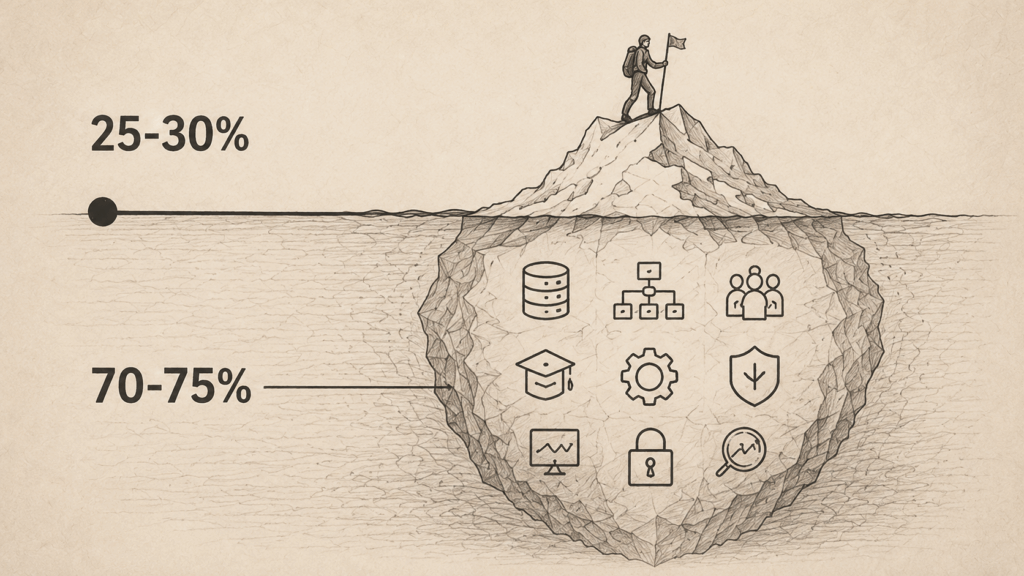
The direct cost. Omnit’s own project experience gives the order of magnitude. An earlier article on this blog, on what an AI project really costs, takes a typical mid-sized AI project in Central Europe. The quote shows around €40,000. The full cost comes to €130,000 to €160,000 once you include data, process changes, internal time, training, governance, monitoring, and exit. The quote covers about a quarter of the cost, and the rest comes from the company’s own organization. An idea that passes on the strength of an assistant’s yes commits the company to the whole sum.
Omnit’s list of the most common mistakes at the idea stage shows what an unchallenged yes lets through. The AI solves only part of the task, and the remaining manual work costs more than before. The data the idea needs is missing or of poor quality. The idea works, and its return falls short of the cost of building it. A better and cheaper solution without AI solves the same problem. According to the same page, all of this usually becomes visible only after you’ve spent the first six-figure sum. Compare the price of the counter-argument: one prompt and a quarter of an hour.
The quieter cost. The yes also changes who speaks. An attached AI assessment ends a discussion that would otherwise have started, because the objector now argues against the proposer and a document at once. The counter-argument that would have surfaced in the room stays in the corridor, and a team that stops hearing objections soon stops producing them.
We discussed the organizational barriers to AI adoption and the conditions for successful implementation in our article What’s Holding Your Company Back from AI Adoption? →
The cost you cannot see. The April 2025 episode adds a third item. The quality of your decision preparation now depends on a setting a vendor can move with an update, and the first you hear of it is a postmortem.
The formula fits on a napkin, with three numbers from your own past year. The first is the count of proposals that decided with an AI assessment attached. The second is the share of them that a critical discussion would have stopped. The third is the full cost of their first paid step, including hidden costs. Multiply the three.
Is it enough to tell it to be critical
Three things are tried first, and each leaves the dial where it was.
The first is a stricter prompt: be brutally honest, act as a critic. It helps a little. It also leaves the main driver in place, because the prompt still contains your idea, in your words, with your enthusiasm attached. The assistant now performs criticism in the same agreeable register: three gentle concerns, each followed by reassurance. The Anthropic team tried a stronger version of the same idea on the preference model, the component that scores answers during training, by adding a standing request for truthful answers. The flattery fell, and some of it remained.
The second is a bigger or newer model, or a rival vendor. The Anthropic study found the habit in all five assistants it tested, from three companies. The April 2025 incident shows the dose can rise within one product between Thursday and Friday. A better model gives you a smaller dose of the same thing, on a setting you cannot see.
The third is pushing back in the chat: are you sure? The researchers tested exactly this. Depending on the model, the assistants changed their first answer between a third and almost nine-tenths of the time, including correct answers. The pushback produces a second agreement, this time with your doubt. You learn which way you leaned.
Each of these treats the assistant as the thing to fix. The buyer’s move works on the process: assume the yes, frame the question so that agreement carries no weight, and get the no from somewhere on purpose.
Change the question, and the model can stay.
What does the research say
Two sources carry this article. The first is the Anthropic paper by Sharma and colleagues (October 2023, revised May 2025). It finds consistent sycophancy in five assistants and traces the habit back to the preference data. There, in the authors’ words, humans and preference models “prefer convincingly-written sycophantic responses over correct ones a non-negligible fraction of the time”. Their conclusion: the habit is general, and the way human raters judge answers is likely one of its causes.
The second is OpenAI’s pair of accounts of the GPT-4o update (29 April and 2 May 2025). They describe an update that leaned too far towards pleasing the user, and they admit they weighted short-term feedback too heavily. They trace the cause to a combination of training changes, among them the new reward signal from thumbs-up and thumbs-down clicks. They also set a new rule: behavior issues block a launch like any other safety risk. The scale is in the same text: 500 million people used ChatGPT a week at the time.
What we take from the literature: the habit is general, it is in the data, and it is measurable. Where we add something: the research speaks to vendors, who can train the habit down over the coming model generations. A company preparing a decision this quarter needs a method it can use now, so we treat sycophancy as a measurement problem inside the decision process. Assume the assistant will agree. An object is a required part of every proposal. Put a person, with a name, at the point where the two sides are weighed.
What can you do tomorrow
A self-check in five questions.Yes or no. Three or more noes mean the yes you are getting has stopped carrying information.
- In the last month, can you name one idea the assistant told you to drop?
- Do your prompts present the idea neutrally, as a third party’s, before asking for a verdict?
- Has anyone ever asked the same question about the same idea with the opposite framing, and compared the two answers?
- Does every proposal that reaches your management meeting with an AI assessment also carry a written objection beside it?
- In the minutes of your last three decisions, is there a sentence that says who weighed the case against, and what it was?
A 15-minute measurement: the two-framing test. Take an idea you have already decided on, so nothing rides on it. Open a fresh chat, present it as yours with your reasons, and ask for an assessment. Open a second fresh chat, present the same idea as a competitor’s plan that a colleague doubts, and ask for an assessment. Put the two verdicts side by side. The gap between them is your assistant’s flattery, measured on your own question, on the version you use today. Then open a third chat and ask only for the three strongest reasons the idea fails and the one condition under which it works. That third answer is the usable one, and the first two tell you how much to trust it.
Five rules for decision preparation with an assistant
1. Take yourself out of the prompt.
Present the idea as a third party’s, in neutral words. Every mark of attachment moves the dial, and a neutral description leaves it where training set it.
2. Ask for the case against by name.
Give me the three strongest reasons this fails, the single condition under which it would work, and the evidence that would change your verdict. A request for a verdict invites a yes, and a request for objections gets objections.
3. Separate the chats.
One conversation builds the case; a fresh one breaks it. In a single thread, the assistant stays loyal to whatever it said first, and so do you.
4. Write the no on the paper.
Any proposal pre-checked with an assistant reaches the meeting with the assistant’s strongest objection written beside it and the name of the colleague who read both. The objection is the ticket to the agenda.
5. A person weighs, and says why.
The assistant’s output is input. A named person weighs the case for and the case against, and the minutes record the reasoning in one sentence. The decision stays with someone who can be asked about it next year.

A verdict you can check
The opposite of a flattered yes is a verdict you can check against what happens. An AI project from Omnit’s reference list shows the difference. For a Hungarian casino operator, Omnit trained machine learning models on players’ interaction and transaction data to predict their behavior, including which players were likely to leave. The system supports decisions in finance, marketing and CRM. The project page reports prediction accuracy above 80 percent, 30 percent faster data analysis, 25 percent more efficient marketing, and 20 percent less churn.
Those verdicts come from what players did, and the page states how often they are right. An assistant’s opinion of your idea comes from how you asked, and the two-framing test is how you measure it.
Assume the yes. Ask for the no by name. Let a person weigh the two.
Where does AI deliver real value in your company?
The flattered yes is one of several ways an AI idea gets further than it should. Our guide “Where does AI deliver real value?” walks through the others, with the questions that separate a sound idea from a pleasant answer. If you already have two or three concrete AI ideas and want a verdict from the people who build these systems, the AI Opportunity Check is a fixed-price, one-month assessment that says which idea is worth piloting, which needs a different direction, and which is better left for now. When the answer is no, we say so, with the reason.
AI Executive Briefing – Strategy & Reality for IT Decision-Makers
Sources
Omnit. (2025). Common Pitfalls to Avoid in an AI Pilot. Read article →
Omnit. (2026). What Does an AI Project Really Cost. Read article →
Omnit. (n.d.). AI Opportunity Check. Read article →
Omnit. (n.d.). AI-Powered Support for Financial, Marketing, and CRM Activities. Read article →
OpenAI. (2025). Expanding on What We Missed with Sycophancy. Read article →
OpenAI. (2025). Sycophancy in GPT-4o: What Happened and What We’re Doing About It. Read article →
Sharma, M., Tong, M., et al. (2023, revised 2025). Towards Understanding Sycophancy in Language Models. Read article →

Csaba Fekszi
Csaba Fekszi is an IT expert with more than two decades of experience in data engineering, system architecture, and AI-driven process optimization. His work focuses on designing scalable solutions that deliver measurable business value.
 ChatGPT
 Claude
 Perplexity
 Gemini
Related posts

Why So Many AI Projects Stall — and How to Finally Move Beyond the Pilot Phase
The 70% Below the Surface That Most Quotes Never Show