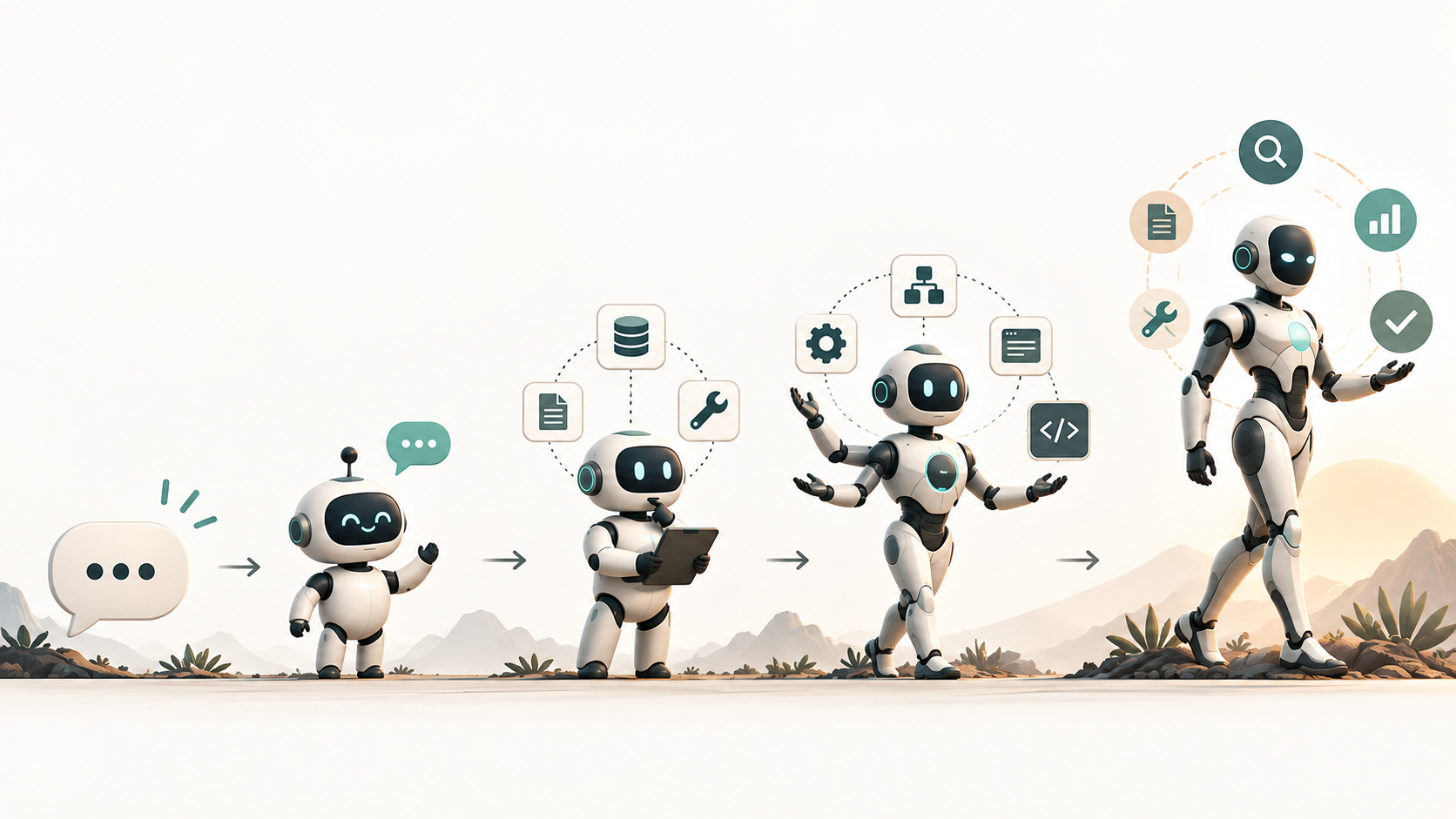
What Is an AI Agent
And How Is It More Than a Chatbot
- AI Building Blocks
Vendors have relabelled almost everything as agentic. Here is a working definition, a picture that holds up in a procurement meeting, and the numbers that show when autonomy earns its cost.
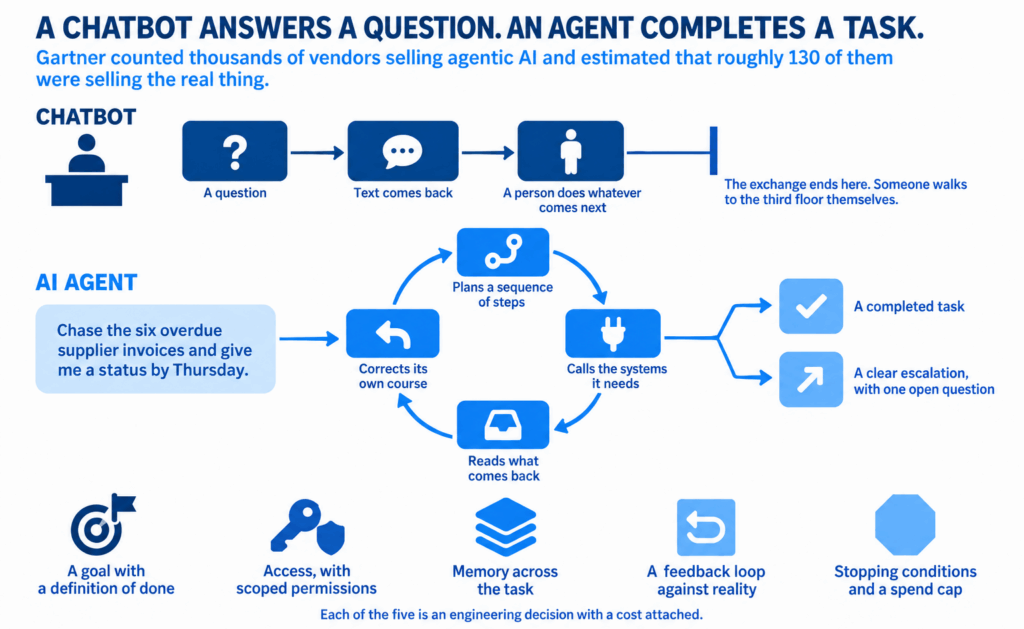
Gartner counted thousands of vendors selling agentic AI and estimated that roughly 130 of them were selling the real thing. The rest were practicing what Gartner calls agent washing: a fresh label for assistants, RPA scripts, and chatbots. If you sat through three vendor demos this year and came away unable to say what separated them, the vocabulary was the problem. What follows is the working definition, a way to picture it, and the figures that decide whether an agent is worth building at all.
The difference in one sentence
A chatbot answers a question. An agent completes a task.
Ask a chatbot something and text comes back. The exchange ends there, and a person does whatever comes next. Give an agent a goal, and it plans a sequence of steps, calls the systems it needs, reads what comes back, corrects its own course, and stops when the goal is met or when it hits a wall it cannot pass.
Anthropic’s engineering team draws the line at autonomy over the process itself. Their published framing separates workflows, where the route through the code is fixed in advance, from agents, described as “systems where LLMs dynamically direct their own processes and tool usage”. In an agent, the model chooses the route.
How to picture it
Picture the reception desk in a large office building.
A chatbot is the person behind that desk. They know the building, they answer well, and they will tell you that supplier payments run through finance on the third floor. Then you walk to the third floor yourself.
An agent is a new colleague in their first week. You hand them a task: “Chase the six overdue supplier invoices and give me a status by Thursday.” They pull the list from the ERP, check each one against the purchase orders, email two suppliers, escalate a third to a buyer because the invoice price and the contract price disagree, and come back on Wednesday with a summary and one open question for you.
Five things make the second version possible. Each is an engineering decision with a cost attached.
- A goal with a definition of done. “Status by Thursday on six invoices” is checkable. “Help with invoices” cannot.
- Access to systems, with permissions. The colleague needs an ERP login and a mailbox. So does the agent, and yours will need scoped credentials, logging, and a way to revoke them in an afternoon.
- Memory across the task. Step four depends on what step two returned. A chatbot session forgets; an agent carries the thread.
- A feedback loop against reality. The agent has to see the result of every call, so it knows the email bounced and the query came back empty. Anthropic’s guidance treats this grounding in real results as the mechanism that keeps the loop honest.
- Stopping conditions. The colleague goes home on Friday. The agent needs a maximum number of iterations, a spend cap, and an escalation route, or it will loop.
| Chatbot | AI agent | |
|---|---|---|
| What you give it | A question | A goal, with a definition of done |
| What comes back | Text for a person to act on | A completed task, or a clear escalation |
| System access | Read, usually a knowledge base | Read and write, across several systems |
| Memory | Within the conversation | Across the whole task, often between runs |
| Who picks the next step | The user | The model |
| Typical failure | A wrong answer | A wrong action, repeated |
| How you measure it | Answer quality, containment rate | Tasks completed, cost per completed task |
Why the label costs money
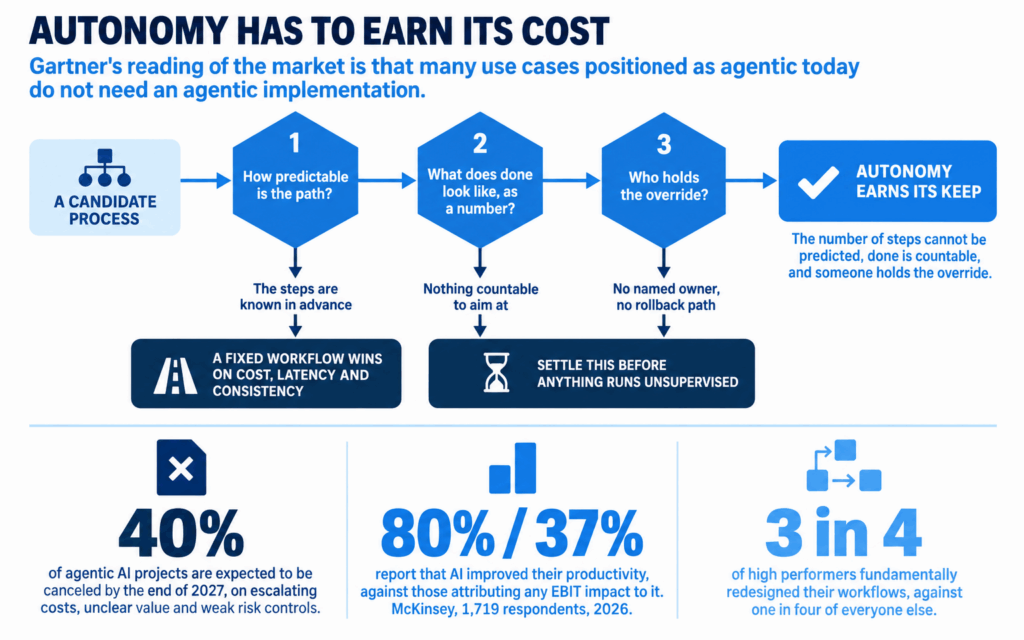
Gartner expects more than 40 percent of agentic AI projects to be canceled by the end of 2027, and names three causes: escalating costs, unclear business value, and inadequate risk controls. Senior Director Analyst Anushree Verma compresses the pattern into one line:
“Many use cases positioned as agentic today don’t require agentic implementations.”
That is the commercially important sentence in the whole debate. Autonomy carries a price: more model calls, longer runs, errors that compound across steps, and a governance burden that a read-only chatbot never generates. Anthropic’s advice to developers points the same way, recommending the simplest solution that works and more complexity only when it demonstrably improves the outcome.
That governance burden starts well before the agent goes live. When the underlying data has no clear owners, definitions or lineage, autonomy simply moves bad decisions faster. We examine that foundation in Why Do AI Projects Fail Without Data Governance →
Gartner expects the opposite trend to hold at the same time: at least 15 percent of day-to-day work decisions made autonomously through agentic AI by 2028, up from zero in 2024, and 33 percent of enterprise software applications carrying agentic features by 2028, up from under 1 percent in 2024. Both forecasts can be true. A shakeout of badly chosen projects and a structural shift run on different clocks.
Where companies have got to
McKinsey’s 2026 State of AI survey, fielded in May and June 2026 across 1,719 respondents in 97 countries, puts numbers on the gap. Chatbots are the most widely scaled AI tool, with 47 percent of respondents saying their organization has scaled them across the enterprise. For AI agents, the figure is about two in ten.
Company size explains most of the difference. Among organizations with over one billion US dollars in annual revenue, the share scaling agents in one or more functions rose from 27 percent to 40 percent in a year. Among smaller organizations, it stayed flat at 22 percent. One in five respondents report that AI operating costs, including token spend, have started to constrain their use of AI.
One figure should shape your plan more than any other. Eighty percent of respondents say AI improved their productivity, while 37 percent attribute any EBIT impact to AI, unchanged from a year earlier. Individual gains are everywhere. Enterprise-level financial impact sits with a small group that redesigned the work itself: among McKinsey’s high performers, nearly three-quarters report fundamentally redesigning workflows, up from 55 percent a year earlier, versus a quarter of everyone else.
The chatbot lesson that transfers directly to agents
A Gartner survey of 3,566 customers, run in February and March 2026, found that 49 percent would have used a service chatbot had one been offered, while 7 percent used one in their most recent service interaction. Only 27 percent said they would try a chatbot again after a bad experience. And 87 percent said access to a human is essential when a company uses generative AI in service.
Read that as a governance lesson for agents. One visible failure sets the tolerance level for everything that follows, and this holds inside your own organisation as firmly as it holds with customers. A finance team that watches an agent post the wrong entry will meet every later proposal with the same 27 percent goodwill. A narrow scope that works every time buys ground. Widen it once the numbers hold.
What we look for before recommending one
In our assessment work, the agent question is rarely settled by a technology conversation. It gets settled at the wall, when the client’s own team draws the process end to end, and we count the decision points together. Three questions decide it.
- How predictable is the path? When the steps are known in advance, a fixed workflow with model calls inside it wins on cost, latency, and consistency. Autonomy earns its keep where the number of steps cannot be predicted.
- What does done look like, as a number? Invoices cleared per run, tickets closed without escalation, cost per completed task. A goal you can’t count can’t be handed to a system that runs unsupervised.
- Who holds the override? A named owner, scoped credentials, a logged trail of every action, and a rollback path for write operations. This is what turns a demo into something a CFO will sign.
If the honest answer to the first question is that the path is predictable, you have just saved yourself a project. That outcome is worth as much as a successful pilot, and it arrives far cheaper.
The same control problem already exists with much simpler AI tools: employees often start using them before ownership, permissions and policies catch up. We examine that gap in Shadow AI at Work →
The question to ask in the next demo
The vocabulary problem from the first paragraph has a simple resolution. Ignore the label on the slide and ask three things: what the system may do on its own, what it can reach, and what happens when it is wrong. A chatbot that answers well is good. An agent that clears six invoices and escalates the seventh is good. Only one of them needs a governance conversation before go-live, and the demo will never tell you which you are buying.
Where would an agent finish a task in your operation?
Understanding the technology matters. The question that decides your budget is different: where in your operation could a system finish a task end to end, and what would that be worth? That answer sits in your processes. In a free 30-minute consultation, we walk through the candidate processes with you and say plainly whether an agent fits. For a structured answer, the AI Opportunity Check is a one-week assessment: one workshop, an 8- to 12-page summary, and a clear verdict on starting a pilot now.
Sources
- Anthropic. (2024, December 19). Building Effective Agents. Source of the distinction between workflows and agents. Read article →
- Gartner. (2025, June 25). Gartner Predicts Over 40% of Agentic AI Projects Will Be Canceled by End of 2027. Source of agentic AI project risks and cancellation forecasts. Read article →
- Gartner. (2026, September 2). Gartner Survey Finds Only 27% of Customers Would Try a Chatbot Again After a Negative Experience. Source of chatbot adoption and trust figures. Read article →
- McKinsey & Company. (2026, August 25). The State of AI in 2026: On the Road to ROI. Source of AI agent adoption, costs, productivity, and ROI findings. Read article →

Csaba Fekszi
Csaba Fekszi is an IT expert with more than two decades of experience in data engineering, system architecture, and AI-driven process optimization. His work focuses on designing scalable solutions that deliver measurable business value.
Related posts


Why So Many AI Projects Stall — and How to Finally Move Beyond the Pilot Phase
The 70% Below the Surface That Most Quotes Never Show


Turning Ambition into Real, Scalable Results
Are you sure AI is the right next step?
We help uncover the real opportunities, limitations, and realistic next steps.