Multi-Agent Systems
When AI Agents Work Together, and When One Is Enough
- AI Building Blocks
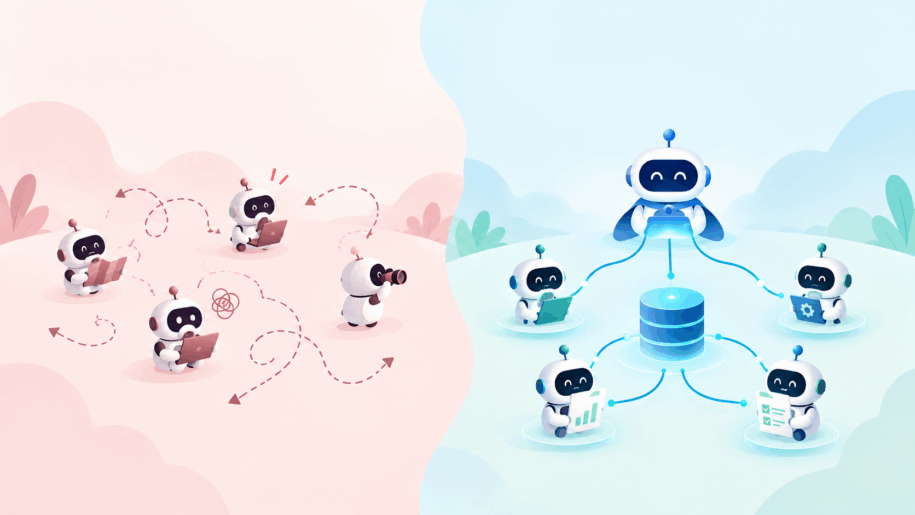
A team of AI agents can outperform a single agent by a wide margin. It also costs more and fails in new ways. The shape of the work decides whether the team pays off.
Should AI agents work as a team? Two companies that build AI agents for a living published their answers a day apart, and the answers looked like opposites.
Cognition, the developer of the coding agent Devin, published an essay in June 2025 titled “Don’t Build Multi-Agents”. The next day, Anthropic described a research system in which a lead Claude agent directs several sub-agents. On Anthropic’s internal research evaluation, this team of agents outperformed a single agent by 90.2%.
Ten months later, Cognition reported that it had begun to deploy a narrower class of multi-agent setups. It also noted that the two posts had reached similar conclusions about where teams of agents work first.
For your company, the useful question is which processes suit a team of agents. This article explains what a multi-agent system is, where it pays off, what it costs, how it fails, and what to settle before you build one.
What is a multi-agent system
An AI agent is a language model that works towards a goal over several steps. It plans, uses tools such as web search, documents, or a company database, checks the result, and decides what to do next.
A multi-agent system divides that work among several agents. A common arrangement resembles a small department. A lead agent breaks the task into parts, hands each part to a specialized agent, and assembles the results. Anthropic calls this the orchestrator-worker pattern.
Two other arrangements come up often. In a pipeline, each agent completes one step and passes its output to the next, as on an assembly line. In a review loop, one agent produces the work and another checks it.
Interest is running well ahead of deployment. In Gartner’s 2026 CIO and Technology Executive Survey, 17% of organizations had deployed AI agents, and more than 60% expected to do so within two years. Gartner places agentic AI at the Peak of Inflated Expectations on its 2026 Hype Cycle.
When does a team of AI agents pay off
Work that splits into independent parts
Anthropic’s 90.2% came from a particular kind of task: research questions that branch into many independent directions. In one example, the system had to find the board members of every information technology company in the S&P 500. The team divided the companies among sub-agents and found the answers. The single agent failed, held back by slow, sequential searches.
Google researchers tested where this advantage holds. They compared a single agent with four kinds of agent teams, across 180 configurations and three model families: GPT, Gemini, and Claude.
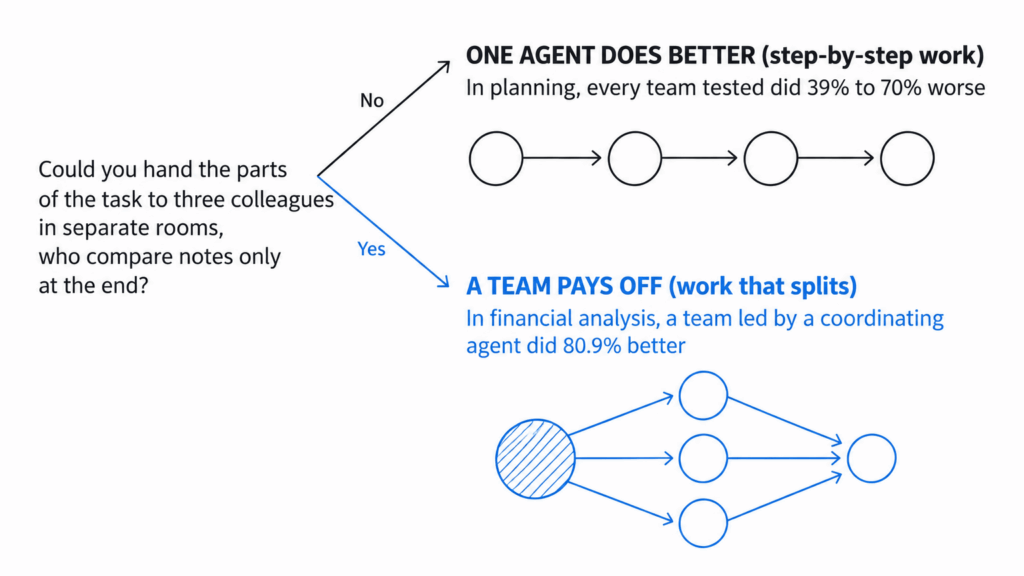
Financial analysis split well, because separate agents can study revenue trends, cost structures, and market comparisons at the same time. Here, a team led by a coordinating agent performed 80.9% better than a single agent.
Step-by-step planning, where each step depends on the previous one, showed the opposite. Every team the researchers tested did worse than a single agent, by between 39% and 70%. Coordination fragmented the reasoning and left too little capacity for the task itself.
A practical test follows. Could you hand the parts of the task to three colleagues in separate rooms, who compare notes only at the end? If you could, the task is a candidate for a team of agents. If they would need to consult each other at every step, one agent will usually do better.
A second pair of eyes
The other pattern that works today is independent review. Cognition reports that its review agent finds an average of two bugs in each code change written by its own coding agent, and roughly 58% of them are severe.
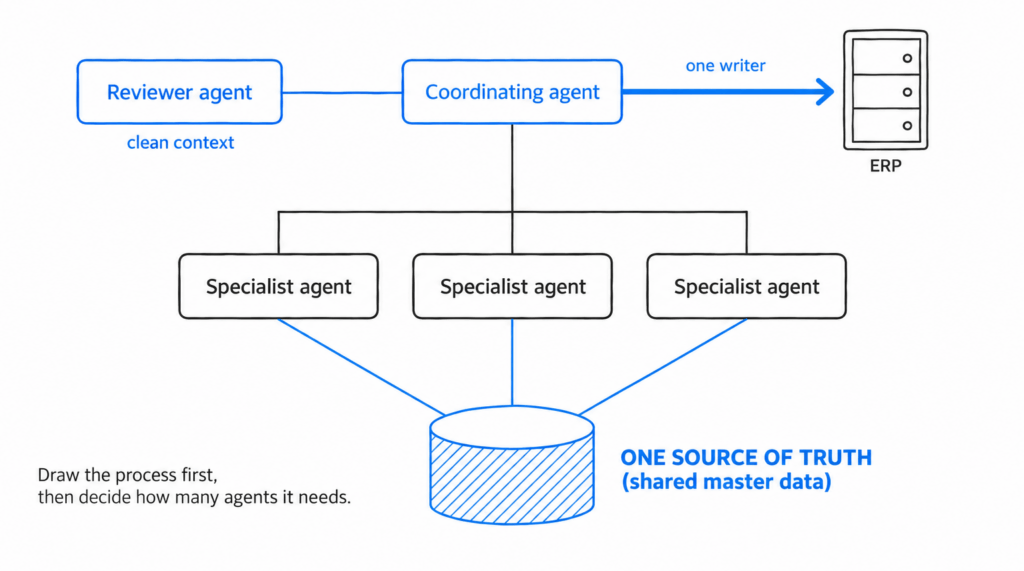
The reviewer works best when it starts with a clean slate, without the coding agent’s context. Finance teams call this the four-eyes principle. Cognition’s overall conclusion: teams of agents work best today when a single agent makes the changes, and the others contribute analysis, advice, and review.
Split the work only where it splits naturally, and let one agent make the changes.
What a multi-agent system costs
The gains have a price. Anthropic reports that its agents typically use about four times as many tokens as a chat, and its multi-agent systems about 15 times as many. Tokens are the units of text that AI providers bill for, so token use converts directly into cost.
Much of the improvement comes from that extra spending. In Anthropic’s analysis of a web-browsing benchmark, token usage alone explained 80% of the differences in performance. Anthropic draws a commercial conclusion: a team of agents suits tasks valuable enough to pay for the extra performance.
Token usage is only one part of the cost. Integration, internal time, data preparation and ongoing operation can add substantially more to the business case. We break down those less visible costs in What Does an AI Project Really Cost? →
Cost also decides which projects survive. Gartner predicts that more than 40% of agentic AI projects will be canceled by the end of 2027, because of escalating costs, unclear business value, or inadequate risk controls. Its analyst Anushree Verma adds a warning that applies with extra force to teams of agents:
“Many use cases positioned as agentic today don’t require agentic implementations.”
Anushree Verma, Senior Director Analyst, Gartner, June 2025
For a business case, measure the cost per completed task. Compare it with the same task done by a single agent and with your current process.
How multi-agent systems fail
Researchers at UC Berkeley analyzed more than 1,600 recorded runs from seven popular open-source multi-agent frameworks. Depending on the framework, the systems failed on between 41% and 86.7% of their tasks. The researchers grouped the causes into 14 failure modes across three categories: system design, misalignment between agents, and verification.
Many of the failures read like familiar office problems. Agents proceeded on wrong assumptions without asking for clarification, ignored other agents’ input, repeated finished steps, or stopped too early. In one run, an agent never passed on the required username format, its supervisor never asked, and the logins kept failing.
Checks were often superficial. A chess game built by one of the systems passed the compilation check and still failed in use, because no agent tested it against the rules of chess.
The authors conclude that many failures stem from how teams are organized and coordinated. They note that organizations of capable people can fail in the same way when their structure is flawed.
Every agent decides something
Cognition illustrates the risk with a thought experiment. Two sub-agents each build part of a Flappy Bird clone. One produces a background in the style of Super Mario, the other a bird that looks and moves nothing like the original. In a company, the equivalent would be two agents working from different price lists, each output plausible on its own.
Structure decides how far such an error travels. In the Google study, agents working in parallel without a coordinator amplified errors by a factor of 17.2. With a coordinating agent acting as a checkpoint, the factor fell to 4.4.
Before you build a multi-agent system
A team of agents raises the questions every integration project raises: which system owns which data, what passes across each interface, and who notices when a handover fails. At Omnit, we answer them by drawing the process with the client before automating anything. The five points below turn that drawing into a brief for agents.
The same principle applies beyond multi-agent systems: successful AI implementations start with the process, the data and clear ownership before the technology is added. We cover that broader implementation framework in The Key Steps to a Successful AI Implementation →
Five checks before you rely on an AI’s picture of your operation
1. Start with one agent.
Build the simplest version that could work and measure it. Anthropic’s guidance for developers recommends adding complexity only when it is needed.
2. Draw the process before the agents.
Map who does what, what is handed over, in which format, and what counts as done. Anthropic’s lesson from its own system: each sub-agent needs a goal, a defined output, guidance on tools and sources, and clear limits to its task.
3. Give every agent the same source of truth.
Agents that read different versions of a customer, a product, or a price make conflicting decisions that each look reasonable. Agree on master data, the shared core records, before you add a second agent.
4. Let one agent write.
Decide which single agent may change the system of record, such as the ERP. The other agents read, analyze, and review, which matches what Cognition found works today.
5. Name the checker and the budget.
Decide who verifies the result, against which criteria, and what a completed task may cost. Log every handover, so you can trace an error to the step where it began.
You can decide on building anything. The Google researchers built a model that picked the best team structure for 87% of task configurations it had not seen, using measurable properties of each task.
Draw the org chart before you hire the agents
Should AI agents work as a team, then? The two posts that looked like opposites describe one rule. A team pays off where the work splits into independent parts, and every such team needs a coordinator, a shared source of truth, and someone who checks the work.
Every well-run department already has all three. Agents need them written down before the first task arrives.
Draw the process first, then decide how many agents it needs.
One agent, a team of agents, or neither?
If you are weighing where AI agents could take over work in your company, start with the process. The AI Opportunity Check is a focused, fixed-price assessment for €1,450 plus VAT. At the end, you know whether an AI pilot is worth starting now, and how simple it can be. If you would first like to talk the question through, you can start with a free 30-minute consultation.
AI Executive Briefing – Strategy & Reality for IT Decision-Makers
Sources
Anthropic. (2024, December 19). Building Effective Agents. Source of Anthropic’s guidance on keeping agent systems simple and adding complexity only when it clearly improves results. Read article →
Anthropic. (2025, June 13). How We Built Our Multi-Agent Research System. Source of the reported 90.2% performance result, the higher token costs of multi-agent systems, and the S&P 500 research example. Read article →
Cemri, M., Pan, M. Z., et al. (2025, October 26). Why Do Multi-Agent LLM Systems Fail? NeurIPS 2025 Datasets and Benchmarks Track, arXiv:2503.13657, Version 3. Source of the failure analysis covering 1,642 multi-agent runs and the caution that failure rates across different benchmarks are not directly comparable. Read article →
Gartner. (2025, June 25). Gartner Predicts Over 40% of Agentic AI Projects Will Be Canceled by End of 2027. Source of Gartner’s forecast that more than 40% of agentic AI projects will be canceled by the end of 2027 and the related Anushree Verma commentary. Read article →
Kandaswamy, R. (2026, April 15). What the 2026 Hype Cycle for Agentic AI Reveals. Gartner. Source of agentic AI adoption figures from the 2026 Gartner CIO and Technology Executive Survey. Read article →
Kim, Y., & Liu, X. (2026, January 28). Towards a Science of Scaling Agent Systems: When and Why Agent Systems Work. Google Research. Source of findings from the 180-configuration study on when scaling agent systems improves performance and when it does not. Read article →
Yan, W. (2025, June 12). Don’t Build Multi-Agents. Cognition. Source of the Flappy Bird thought experiment illustrating why splitting work across multiple agents can introduce coordination problems. Read article →
Yan, W. (2026, April 22). Multi-Agents: What’s Actually Working. Cognition. Source of Cognition’s review-agent results and the conclusion that a single-writer architecture can outperform more distributed multi-agent setups. Read article →

Lajos Fehér
Lajos Fehér is an IT expert with nearly 30 years of experience in database development, particularly Oracle-based systems, as well as in data migration projects and the design of systems requiring high availability and scalability. In recent years, his work has expanded to include AI-based solutions, with a focus on building systems that deliver measurable business value.
Are you sure AI is the right next step?
 ChatGPT
 Claude
 Perplexity
 Gemini
Related posts


Why So Many AI Projects Stall — and How to Finally Move Beyond the Pilot Phase