
AI automation isn't valuable on its own
The key question in an AI project is which processes deserve automation
- AI In Business
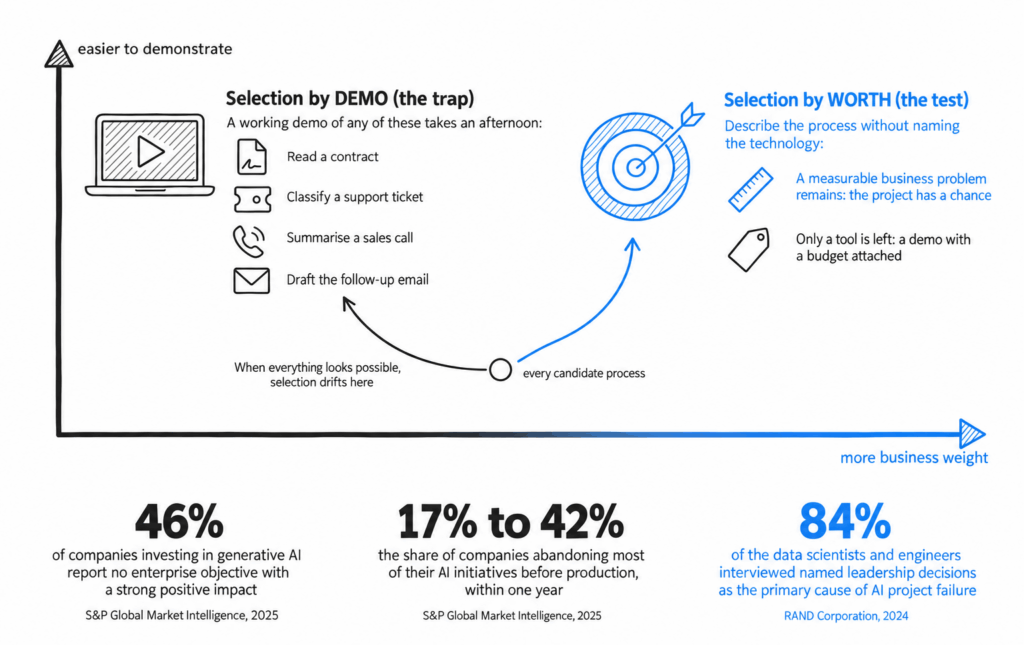
Among companies that have invested in generative AI, 46% report that no enterprise objective has seen a strong positive impact from that investment. The figure comes from S&P Global Market Intelligence, whose 2025 Voice of the Enterprise survey covered 1,006 IT and business leaders across North America and Europe. The same survey records the share of companies abandoning most of their AI initiatives before production rising from 17% to 42% in a single year.
In enterprise AI, the hard part has moved to selection: deciding which processes deserve to be handed to a machine at all.
Feasibility got cheap, judgment stayed expensive
Three years ago, the honest answer to most enterprise AI proposals was that the technology could not do it yet. That answer has largely expired. A model will read a contract, classify a support ticket, summarise a sales call, and draft the follow-up email, and a working demo of any of those takes an afternoon.
Cheap feasibility creates a specific trap. When everything looks possible, the selection criterion quietly becomes whatever is easiest to demonstrate, and the processes that are easiest to demonstrate are usually the ones carrying the least business weight. The S&P survey shows where that leads. Cost is now the most commonly named factor in deciding which AI projects move forward, and process automation sits among the areas where reported benefits have fallen short of what companies expected.
There is a simple test for this trap. Describe the process without naming the technology. If the sentence still contains a measurable business problem, the project has a chance. If the sentence collapses into a description of a tool, you are looking at a demo with a budget attached.
What automating the wrong thing costs
The RAND Corporation interviewed 65 data scientists and engineers, each with at least 5 years of hands-on experience, to find out why AI projects fail. The headline figure, which the report itself hedges as an estimate, is that more than 80% of AI projects fail, twice the failure rate of IT projects with no AI in them. The more useful number sits further down: 84% of those interviewed named leadership decisions as the primary cause, ahead of data quality, infrastructure, and the limits of the technology itself.
One of the anti-patterns in that report describes this topic exactly. Teams get asked to apply machine learning to problems that a handful of if-then rules would settle. Those projects often finish, the model works, and the effort still counts as a failure, because the work was never needed in the first place. A second example from the same research is sharper: leadership asks for a model that predicts the right price for a product, when the business needs the price that delivers the best margin. The model performs exactly as specified, and the specification measured the wrong thing. The report puts the underlying point in one line: “AI is not a magic wand that can make any challenging problem disappear.”
The bill for a misdirected project is always larger than its budget line. It consumes the one data engineer who understood the source system. It consumes a process owner’s attention for a quarter. And it consumes credibility: after one canceled pilot, the next proposal faces a colder room.
The visible project budget is only part of the real cost. Internal time, integration, testing and correction often sit below the surface. We break that down in What Does an AI Project Really Cost? →
5 questions that separate can from worth
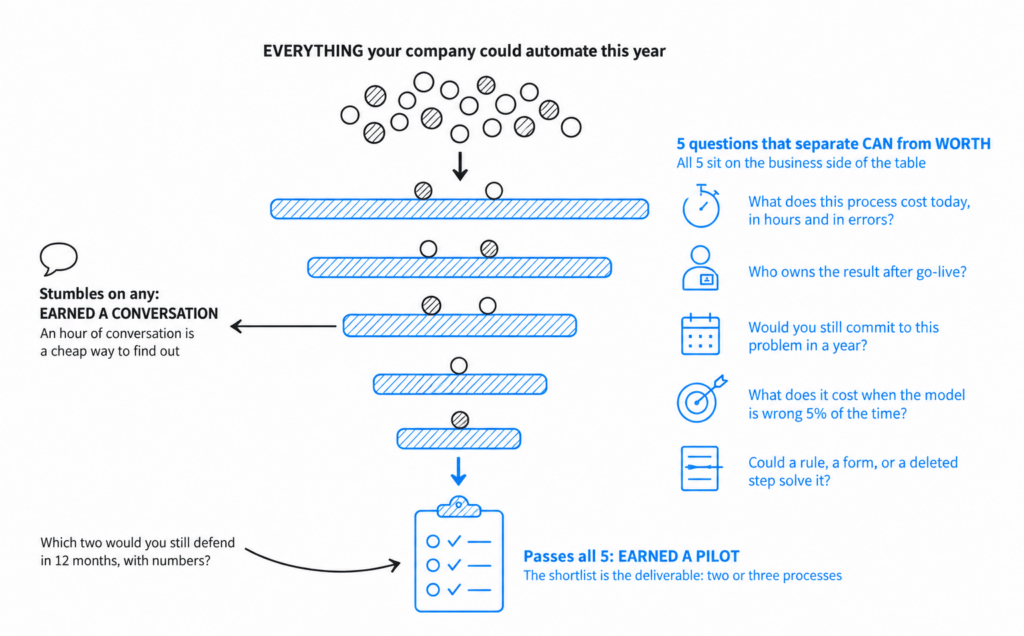
Before an AI proposal reaches a budget line, these 5 questions filter out most of the expensive mistakes. All 5 sit on the business side of the table.
- What does this process cost today, in hours and in errors? If nobody has measured it, every ROI figure in the business case is a guess wearing the costume of a forecast.
- Who owns the result after go-live? A process with no named owner has nobody to notice when the model drifts, and drift is a certainty.
- Would you still commit to this problem in a year? RAND recommends committing a product team to one specific problem for at least a year. Treat that year as the bar, and leave anything below it on the shelf.
- What does it cost when the model is wrong 5% of the time? In draft generation, that is a rounding error. In payment approval or regulatory reporting, it is an incident with a name and a date.
- Could a rule, a form, or a deleted step solve it? The cheapest automation is often removing a step that survives only because somebody once built a spreadsheet around it.
A process that passes all 5 has earned a pilot. A process that stumbles on any of them has earned a conversation, and an hour of conversation is a cheap way to find that out.
The shortlist is the deliverable
The most useful finding in the S&P data concerns the companies that get this right. What separates the organizations with the lowest project failure rates is how they prioritize: they weigh compliance, risk, and data availability alongside cost when they choose what to build. Selection discipline shows up in the failure rate long before it shows up in any ROI calculation.
Prioritization is not only about cost and upside. Data exposure, permissions and compliance can eliminate an otherwise attractive use case before the pilot begins. We examine those risks in AI Data Privacy Risks →
The useful output of an AI assessment is a short list. Two or three processes where the cost is measured, the owner is named, the error tolerance is understood, no simple rule would replace the work, and the commitment survives a year. Everything outside that list is a demo, and a demo is worth an afternoon.
So the question worth carrying into your next AI discussion is a small one: of everything your company could automate this year, which two processes would you still defend in 12 months, with numbers?
Where to start
If AI adoption is on the agenda at your company and the starting point is still unclear, a structured assessment is the practical first step. The AI Compass Audit is a 4-week, fixed-fee process. By the end, you’ll know which pilot is worth starting, against which success criteria, and with what risks. If you would prefer to clarify the questions first, a free 30-minute consultation is a good place to begin.
Sources
- RAND Corporation. (2024, August). The Root Causes of Failure for Artificial Intelligence Projects and How They Can Succeed. Source of AI project failure causes and leadership-related findings. Read article →
- S&P Global Market Intelligence. (2025, May 30). AI Experiences Rapid Adoption but with Mixed Outcomes. Source of AI project abandonment, business impact, and prioritization findings. Read article →

Csaba Fekszi
Csaba Fekszi is an IT expert with more than two decades of experience in data engineering, system architecture, and AI-driven process optimization. His work focuses on designing scalable solutions that deliver measurable business value.
Related posts

Why So Many AI Projects Stall — and How to Finally Move Beyond the Pilot Phase


Turning Ambition into Real, Scalable Results

AI project data quality decides the outcome long before the first model is trained

Are you sure AI is the right next step?
We help uncover the real opportunities, limitations, and realistic next steps.