
Time Saved, Attention Spent
What AI Does to Your Company’s Cognitive Capacity
- AI In Business
AI makes work faster. Whether it also makes work better depends on what it does to your team’s attention and expertise, two assets few business cases measure.
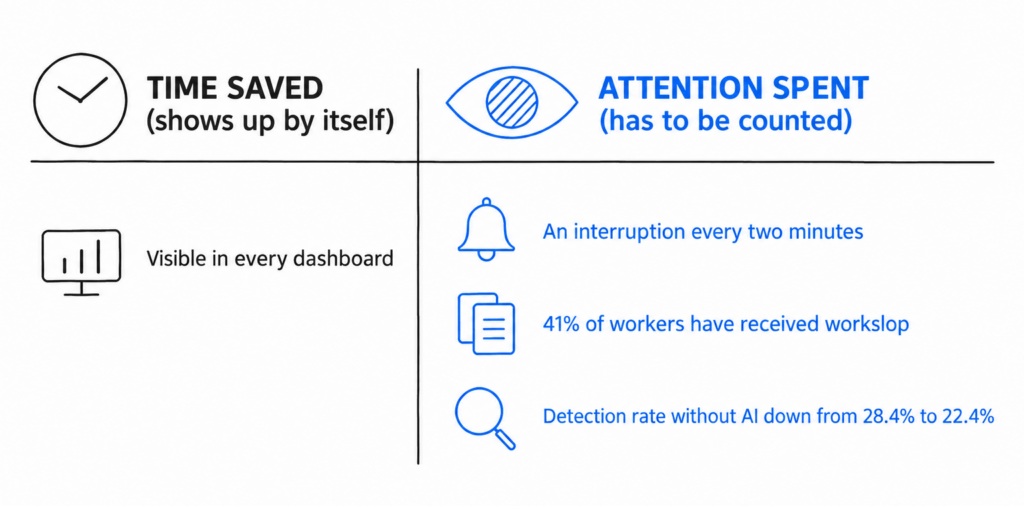
Four endoscopy centers in Poland introduced an AI system that flags possible precancerous growths during colonoscopies. Researchers then compared the colonoscopies doctors performed without AI assistance in the three months before the system arrived and in the three months after. According to a study in The Lancet Gastroenterology & Hepatology, the detection rate without AI fell from 28.4% to 22.4%.
The authors suggest that continuous exposure to AI may have changed how the doctors worked whenever the system was off. The drop became clear because someone measured performance without the tool.
Every company rolling AI into daily work faces a version of this blind spot. AI and digital tools can save time while consuming cognitive capacity. Most companies have already decided to use AI. The open question is whether you build it into your operations so that attention, expertise, and the ability to check results survive.
This article looks at the cost to competence and the cost to attention, then sets out five checks to run before you scale an AI tool.
You got faster. Did you get better?
Speed is the easiest AI benefit to see and the easiest to overestimate. In a 2025 trial by the non-profit research group METR, 16 experienced software developers expected AI tools to make them 24% faster. After finishing, they believed the tools had sped them up by 20%. The measurements disagreed: with AI, their tasks took 19% longer.
METR now labels these results out of date for today’s AI tools. The lesson that holds concerns perception: the researchers concluded that people’s own estimates of their speed-up can be very inaccurate.
The boundary is hard to see
Quality depends on the task. In a pre-registered experiment by Fabrizio Dell’Acqua and colleagues, published in Organization Science, 758 Boston Consulting Group consultants worked on realistic tasks with or without GPT-4. On tasks within the AI’s capabilities, those using it completed 12.2% more tasks and worked 25.1% faster, with significantly higher quality.
On a business problem chosen to lie outside those capabilities, consultants with AI were more likely to reach a wrong conclusion than colleagues working without it. The researchers call this uneven boundary a jagged frontier: tasks that look equally hard can fall on opposite sides.
Time saved is only one side of an AI business case. Internal review, rework and process changes can carry costs of their own. We look at that wider picture in What Does an AI Project Really Cost →
Confidence shapes how much checking happens
Researchers at Microsoft and Carnegie Mellon University asked 319 knowledge workers about 936 real tasks they had done with generative AI. The more people trusted the AI, the less critical thinking they reported. The more they trusted their own skills, the more they applied them.
The same study found that AI shifts critical thinking towards verifying information, integrating responses into the work, and overseeing the task. A growing share of the job becomes checking, and checking draws on expertise.
Here the two findings meet. Expertise grows by doing the groundwork that AI now takes over. A team that hands over all of it may find, a few years on, that fewer people can tell a correct answer from a fluent one.
Time saved appears in the dashboard by itself. Expertise and the ability to check appear only when someone measures them.
We pay for eight hours. How much attention do we get?
Herbert Simon, a Carnegie Mellon professor who later won the Nobel Prize in economics, described the underlying problem in a talk published in 1971:
“What information consumes is rather obvious: it consumes the attention of its recipients. Hence a wealth of information creates a poverty of attention.”
Herbert A. Simon, “Designing Organizations for an Information-Rich World”, 1971
Simon treated attention as an economic resource. When information is plentiful, attention becomes scarce, and most of the cost of information falls on the person who receives it. In the discussion after the talk, the political scientist Karl Deutsch summed up one of Simon’s contributions: “attention economy is proposed as a design criterion for large organizations”.
Today the scarce resource can be counted
Microsoft’s Work Trend Index special report on the “infinite workday” found that employees are interrupted every two minutes, 275 times a day. The interruptions come from meetings, emails, and chat notifications. The average employee receives 117 emails and 153 Teams messages daily.
Half of all meetings fall in peak productivity hours, from 9 to 11 in the morning and from 1 to 3 in the afternoon. Nearly half of employees (48%) say their work feels chaotic and fragmented. The Microsoft 365 usage data in the report excludes customers in the European Union, so treat the figures as a global benchmark and compare them with your own collaboration data.
For a company, this is a capacity question. Salaries buy working hours, and those hours create value through attention. Every interruption takes a slice of that attention, and no payroll report shows the loss.
AI can add to the noise
AI can relieve this load, and it can add to it. Researchers at BetterUp Labs and the Stanford Social Media Lab use the term workslop for AI-generated work that looks polished and lacks the substance to move a task forward.
In their research, reported in Harvard Business Review, 41% of workers had received such output, and each instance cost nearly two hours of rework. The sender saves time, and the receiver pays for it in attention. Simon had already named where that bill lands: with the recipient.
The same pattern appears when AI use spreads outside formal processes: individual productivity can rise while the organization loses visibility and control. We examine that problem in Shadow AI at Work →
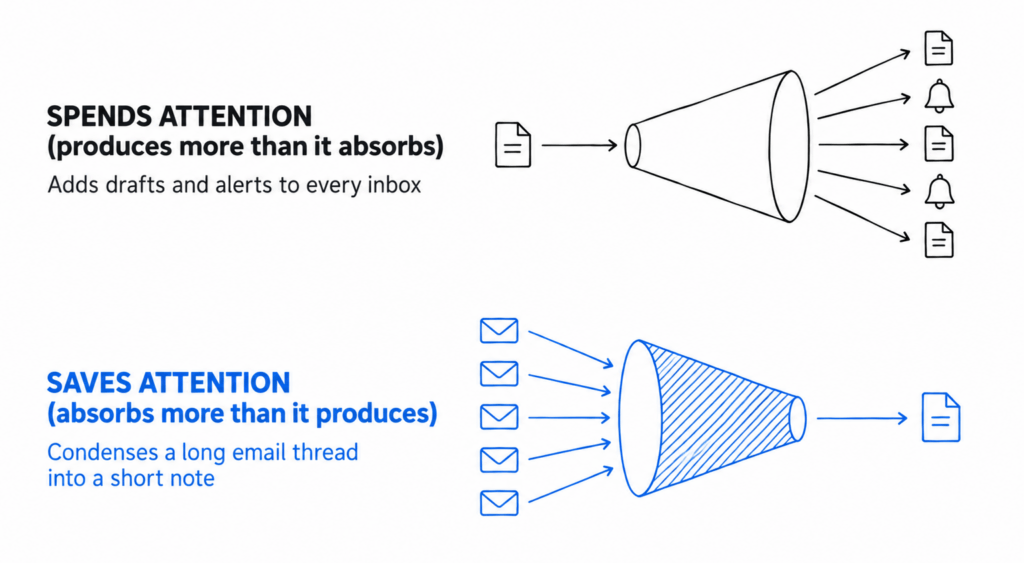
He also proposed a test for any new information system, whether a computer or a new organizational unit. It reduces the demand on the rest of the organization’s attention only if it absorbs more information than it produces. In Simon’s words, only “if it listens and thinks more than it speaks”.
Attention and expertise belong on the management agenda
Attention and expertise can sound like wellbeing topics for HR. They are also operating assets. Attention is the capacity you buy with every salary, and expertise lets your people catch an AI error before a customer, an auditor, or a regulator does.
Expertise also takes years to rebuild. The people who will check your AI output in five years are learning their craft now, on the tasks you are automating today.
Regulation points the same way. Article 14 of the EU AI Act deals with human oversight of high-risk AI systems. It requires it to be provided so the people overseeing it can stay aware of automation bias: the tendency to rely, or over-rely, on a system’s output automatically. Oversight written into a procedure works only when people have the time and the skill to disagree with the machine.
Run five checks before you scale an AI tool
The aim is to keep speed while protecting the capacities that make it safe. The five checks below fit any AI tool, from a writing assistant to a document-processing workflow.
Five checks for every AI tool
1. Measure quality alongside speed.
Track error rates, rework, and review time alongside the time saved. A pilot that reports speed alone measures half the result.
2. Test the team without the tool.
Ask whether the team could still do the task well for a week without AI. If the answer is no, schedule regular work without AI on the skills you can least afford to lose.
3. Name the checker.
Decide who verifies the output, against which standard, and how much of their time it takes. Verification is work, and it needs a place in the plan.
4. Apply Simon’s test.
Compare what the tool absorbs with what it produces. A tool that condenses a long email thread into a short note saves attention. A tool that adds drafts and alerts to every inbox spends it.
5. Agree who owns the handover.
Settle who answers for the quality of AI-assisted work before it reaches a colleague. The receiver should never be the first person to read it closely.
Run the checks again after six months of use. Skill loss and inbox load build up gradually, and in the Polish study the drop was already measurable within three months of the AI’s arrival.
Count both sides of the ledger
In Polish endoscopy centers, the cost of AI showed up in doctors’ work without it. It surfaced because researchers measured that work.
Your company will see the time AI saves without any effort. The attention it consumes and the expertise it may wear down stay invisible until you decide to measure them. Measure both, and you keep the speed and the judgment that makes it safe.
Count the hours AI saves, and count the attention it spends.
Is AI making your team better as well as faster?
If AI tools are already part of your team’s work, the next useful question is where they raise quality and where they cost attention and expertise. The AI Compass Audit is a four-week, fixed-fee assessment. By the end, you’ll know which AI pilot is worth starting, with which success criteria, and what the risks are. If you would first like to talk the question through, you can start with a free 30-minute consultation.
Sources
Dell’Acqua, F., et al. (2026). Navigating the Jagged Technological Frontier: Field Experimental Evidence of the Effects of Artificial Intelligence on Knowledge Worker Productivity and Quality. Read article →
EU AI Act Service Desk. (2024). Article 14: Human Oversight. Read article →
Harvard Business Review. (2025). AI-Generated “Workslop” Is Destroying Productivity. Read article →
Lee, H. P. H., et al. (2025). The Impact of Generative AI on Critical Thinking. Read article →
METR. (2025). Measuring the Impact of Early-2025 AI on Experienced Open-Source Developer Productivity. Read article →
Microsoft. (2025). New Microsoft Study Reveals the Rise of the “Infinite Workday”. Read article →
Simon, H. A. (1971). Designing Organizations for an Information-Rich World. Read article →
The Lancet Gastroenterology & Hepatology. (2025). Endoscopist Deskilling Risk After Exposure to Artificial Intelligence in Colonoscopy. Read article →

Csaba Fekszi
Csaba Fekszi is an IT expert with more than two decades of experience in data engineering, system architecture, and AI-driven process optimization. His work focuses on designing scalable solutions that deliver measurable business value.
Related posts


Why So Many AI Projects Stall — and How to Finally Move Beyond the Pilot Phase


A practical guide for CFOs and senior decision-makers at mid-sized companies
Are you sure AI is the right next step?
We help uncover the real opportunities, limitations, and realistic next steps.