
AI, ANI, and AGI
What We’re Actually Talking About
- AI Digest
Artificial intelligence is now everywhere — embedded in tools, products, and boardroom conversations. At the same time, it is the subject of increasingly extreme claims: some treat it as a simple productivity layer, others as an imminent autonomous force.
Fundamentally different concepts are being collapsed into a single term: “AI.” Until these are separated, any discussion about risk, capability, or strategy remains confused.
This article clarifies three distinct categories — AI, ANI, and AGI — what they mean in practice, and where current systems stand today.
AI as an Umbrella Term
“Artificial intelligence” is not a single capability. It is a label applied to a wide range of systems that do very different things.
In practical terms, AI refers to systems that:
- learn patterns from data,
- generate predictions,
- produce content,
- or support decision-making processes.
Recent advances have made these systems faster, cheaper, and widely accessible. As a result, AI now operates in areas that were previously considered human-only — language, visual interpretation, and even creative work.
Yet the fundamental nature of these systems has not changed at its core. They do not “understand” as humans do. Instead, they analyze patterns and produce outputs based on statistical relationships.
Calling all of this simply AI suggests a level of general capability that does not exist — and sets the stage for both overestimation and unnecessary fear.
ANI — The Real Name of Today’s AI
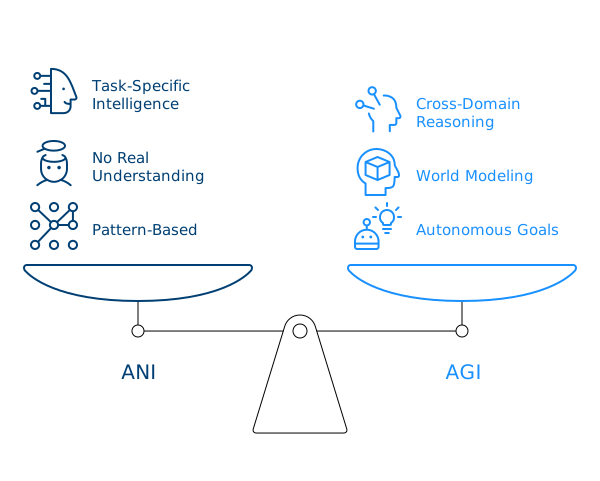
What most companies call AI today is, in reality, Artificial Narrow Intelligence (ANI).
These systems are not general-purpose thinkers. They are optimized tools, built to solve specific, well-defined problems — and they can be extremely effective within those boundaries.
An ANI system can generate fluent text, detect patterns in images, and make data-driven recommendations, but each of these capabilities operates in isolation rather than as part of a unified intelligence.
A language model does not understand what it writes. An image model does not grasp what it sees. A decision model does not comprehend the real-world consequences of its output.
This is a design limitation.
ANI systems lack intent, awareness, independent goal-setting, and the ability to transfer knowledge across domains; they do not think, but simply execute predefined or learned tasks.
If you treat ANI as general intelligence, you overtrust it. If you understand it as a narrow system, you can control, validate, and use it effectively.
Most current AI failures come from people assuming it is more than it actually is.
Where Do Today’s Humanoid Robots Fit
Humanoid robots dominate headlines. They create a strong illusion that we are approaching general intelligence.
Systems like Tesla’s Optimus, Figure AI’s robots, or Boston Dynamics platforms combine multiple narrow components:
- computer vision models,
- motion planning systems,
- control algorithms,
- and predefined task structures.
Each element is specialized. Even when these robots are paired with language models, the situation does not change. The system may follow instructions or respond conversationally, but it still operates within constrained parameters.
There is no unified understanding behind the behavior.
These robots do not form independent goals, do not maintain a consistent internal model of the world, and do not transfer knowledge flexibly across contexts; they execute coordinated tasks, and nothing more.
AGI — What It Would Actually Represent
Artificial General Intelligence is not a more advanced version of current AI. It is a different category entirely.
An AGI system would be capable of:
- transferring knowledge across domains,
- solving problems it has not been explicitly trained for,
- maintaining a coherent model of the world,
- and applying reasoning flexibly in unfamiliar situations.
This is the critical shift: not better performance, but different capability.
Today’s systems improve by scaling — more data, more compute, better outputs. AGI would not emerge from scale alone. It would require a structural breakthrough in how systems represent and use knowledge.
An AGI would understand context, causality, and consequences.
That is why common comparisons are misleading.
AGI is not:
- a more accurate chatbot,
- a faster model,
- or a system that performs many tasks “well enough.”
It is a system that can adapt, generalize, and reason across domains without task-specific retraining.
Where Are We on the Path Toward AGI
Current systems are powerful, but they are not close to achieving general intelligence.
Fluent language and convincing results are easy to mistake for genuine understanding; in reality, these systems operate without internal world models, causal reasoning, or independent goal formation.
They do not “know” anything. They predict.
The gap between appearance and capability is the core issue.
As models scale, they perform acceptably across more tasks. This creates the impression of generality. But performing many tasks is not the same as understanding them.
There is no unified intelligence behind the outputs — only increasingly effective pattern matching.
The result: systems that look general, but are not.
Any serious assessment must separate:
- behavioral resemblance (what it looks like), from
- cognitive capability (what it actually is).
Right now, that gap is still large. Much larger than public discourse suggests.
Why Does AGI Still Feel “Close”
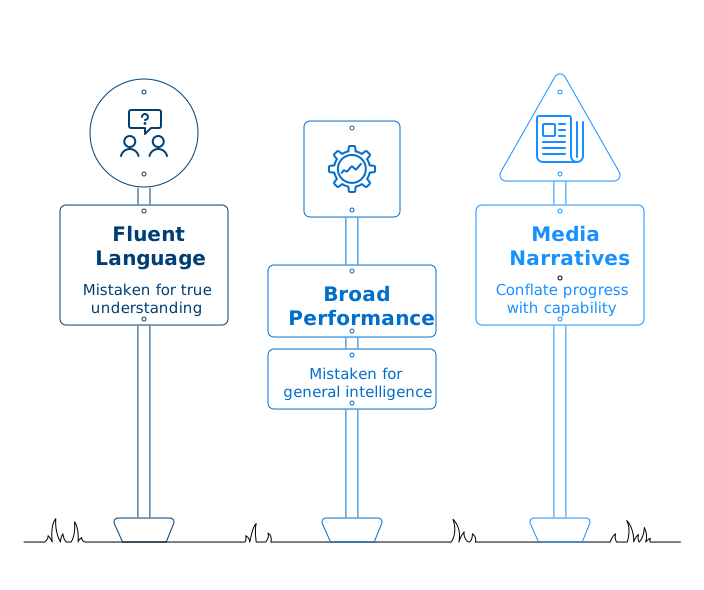
The perception that AGI is imminent is driven by how current systems present themselves. There are three underlying factors.
1. Language creates false signals
Humans equate fluent language with understanding. When a system produces coherent, structured responses, the default assumption is that it has intent, reasoning, and awareness.
That assumption is incorrect.
Language models simulate understanding.
2. Scale creates the illusion of generality
Larger systems perform adequately across a wide range of tasks. This “good enough everywhere” performance is often misinterpreted as general intelligence.
It is not.
3. Narratives amplify the perception
Public discourse mixes:
- scientific progress,
- business incentives,
- and media-driven narratives.
The result is predictable: overstatement.
AGI becomes a moving target rather than a clearly defined technical threshold.
Strip away the narrative, and the situation is straightforward.
The core capabilities required for AGI — causal reasoning, world modeling, and autonomous goal formation — are still missing.
The feeling that AGI is close is psychological.
Should We Be Afraid of AGI Today
Short answer: no.
AGI is not a risk. It does not exist in any operational form. Focusing on it now is a distraction.
The real risks come from systems that already exist — and are already deployed at scale. These risks are about usage.
Today’s AI systems can:
- influence decisions,
- shape information flows,
- and automate processes without full transparency.
If poorly designed or misapplied, this leads to tangible problems, including decisions based on biased or incomplete data, overreliance on automated outputs, insufficient human oversight, and unclear responsibility in critical processes.
Key Takeaways
This article separates three concepts that are routinely collapsed under a single term. A few key conclusions stand out:
- “AI” is a label, not a unified capability. Treating it as a single thing leads to both overestimation and unnecessary fear.
- Today’s AI is Artificial Narrow Intelligence. Current systems execute within defined boundaries. They do not think; they predict.
- Fluency is not understanding. Coherent language output does not imply intent, reasoning, or awareness behind it.
- Scale creates the illusion of generality. Performing well across many tasks is not the same as general intelligence.
- AGI is a different category, not a better version of current AI. The core capabilities it would require — causal reasoning, world modeling, autonomous goal formation — do not yet exist.
- The real risks are already here. Misapplied narrow AI is the challenge that demands attention now. AGI is a distraction from it.
Getting these distinctions right is the foundation for any serious conversation about deployment, oversight, and accountability.
Final Thoughts
Today’s AI already shapes decisions, filters information, and influences behavior at scale. AGI, if it arrives, will introduce an entirely new category of risk, but the immediate constraint is discipline.
The critical questions are straightforward: what decisions are automated, where human oversight is required, how outputs are validated, and who is accountable when systems fail. If these are not clearly defined, capability turns into a liability. AGI is not the immediate problem; existing systems are.
Sources
- AI & You. (2024). ANI, AGI, ASI: What are we talking about? Read article →
- DebateUS. (2024). Debating superintelligence: A beginner’s guide to ANI, AGI and artificial superintelligence. Read article →
- Monday Momentum. (2024). ANI vs AGI. Read article →
- Moveo AI. (2024). Types of AI. Read article →
- Tutorials Dojo. (2024). AGI vs ASI vs ANI: AI stages towards super intelligence. Read article →

Csaba Fekszi
Csaba Fekszi is an IT expert with more than two decades of experience in data engineering, system architecture, and AI-driven process optimization. His work focuses on designing scalable solutions that deliver measurable business value.
Related posts





Why So Many AI Projects Stall — and How to Finally Move Beyond the Pilot Phase
Are you sure AI is the right next step?
We help uncover the real opportunities, limitations, and realistic next steps.