
On-Premise or Cloud OCR
The Strategic Trade-Off That Shapes Data Security, Compliance, and Long-Term Control
- AI Technology
Choosing between on-premise and cloud-based OCR is no longer just an IT decision — it’s a broader strategic choice. OCR (short for Optical Character Recognition) is the technology that converts scanned or photographed text into data that a computer can process. And it’s not just a background tool anymore — it’s increasingly part of workflows handling highly sensitive information.
Cloud solutions are attractive for their speed and scalability, but on-premise OCR systems offer organizations complete control over their data, systems, and compliance. This level of control can be vital in industries with strict regulations, such as GDPR in Europe or HIPAA in the U.S., especially when managing high-risk data like personal information or medical records.
What This Article Is About
This article provides an Omnit analysis of what it truly means — strategically — for organizations to choose between on-premise and cloud-based OCR.
The article explores how each setup handles data security, ownership, and the risks of third-party exposure, as well as the compliance ripple effects under regulations such as GDPR and HIPAA. It also compares their performance, taking into account latency, reliance on stable networks, and suitable workloads. Furthermore, it assesses long-term costs and their influence on budgeting and financial planning. The article discusses how easily each model can be integrated into or customized for an existing enterprise system. Lastly, it examines broader trade-offs that could make one option more suitable than the other, depending on the organization’s needs. The goal is to provide you with more than just a side-by-side comparison; it’s about helping you understand why the differences truly matter — especially in environments with strict compliance or high document volumes.
The insights and percentages in this article originate from Omnit’s internal research and analysis. These figures reveal patterns observed in real-world OCR deployments, emphasizing where key strategic differences occur in practice and how organizations usually experience both on-premise and cloud-based solutions.
Why the Deployment Model Matters More Than Ever
OCR technology now performs many essential tasks across industries such as healthcare, finance, government, and ID verification. When organizations adopt these systems, they usually select between two primary options.
- On-premise OCR, where all data processing and related activities stay within the organization’s own IT environment.
- Cloud-based OCR, where documents are sent to an external provider’s infrastructure for processing.
That decision affects many aspects: who controls the data from beginning to end, how stable and predictable the performance is, how audits are carried out, and where the long-term costs ultimately add up.
Data Security and Control: The Core Differentiator
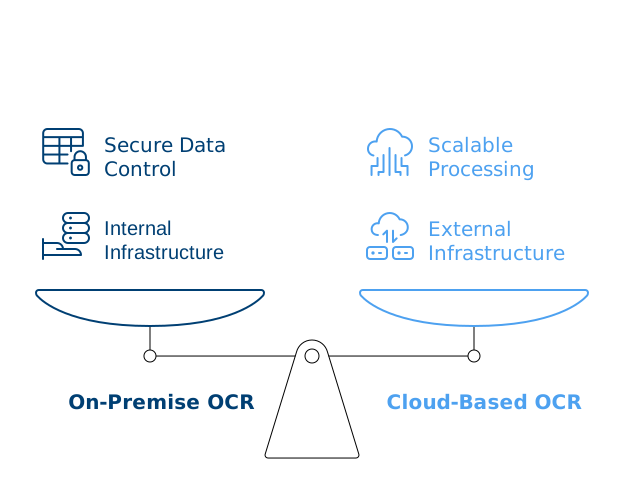
With on-premise OCR, everything stays within the organization’s secure network. All document processing takes place on internal servers, in accordance with the company’s protocols for access control, monitoring, data retention, and deletion. This ensures sensitive information, such as medical records, IDs, or financial documents, never leaves the premise.
Bottom line? You maintain complete control — true data sovereignty.
The inherent risks of Cloud OCR involve transmitting raw or processed data to an external provider. Even with encrypted transfers and certified environments, unavoidable dangers still exist:
- the possibility that the provider staff could access the data,
- shared infrastructure (multi-tenancy),
- data potentially crossing borders,
- and a larger attack surface during upload/download windows.
These risks persist, even with certifications. You’re essentially substituting direct control with dependence on a vendor.
The Practical Trade-Off?
- Cloud OCR is excellent for simplicity and quick deployment.
- On-premise OCR offers better control and security. When handling sensitive workloads, that control often outweighs convenience.
Compliance: When Regulation Dictates Architecture
In many industries, strict rules regulate how personal and confidential data are managed, with major regulations like GDPR, which specifies how personal data in the EU must be processed, stored, and protected, and HIPAA, which safeguards the confidentiality and security of healthcare data in the U.S. Since OCR systems often handle this sensitive information, their deployment — whether on-premise or in the cloud — directly affects an organization’s compliance.
On-Premise OCR: A Natural Fit for Regulatory Requirements
Using on-premise OCR simplifies much of the regulatory compliance because no documents are sent outside the organization, the entire data processing chain is fully auditable, there is no dependence on a vendor’s internal practices, and retention or deletion policies stay completely under your control. As a result, this transparency makes audits — whether internal or performed by external regulators — much easier.
Cloud OCR: Compliance Depends on the Vendor’s Promises
Meanwhile, cloud platforms may be certified and secure. Still, they put the responsibility on the organization to prove exactly where the data is located and how it moves, how strictly provider access is restricted, whether rules like “keep data in the EU” are actually enforced, and whether deletion truly means deletion. The main point is that just because a vendor claims compliance doesn’t mean you have the same level of control or traceability that regulators expect.
Performance and Latency: Predictability vs. Variability
Predictable Performance On-Premise
When everything runs locally, you’re not reliant on internet speed or outages, which provides lower and more consistent latency — essential for time-sensitive tasks like checking in hospital patients or verifying someone’s ID at the front desk. There are no external variables, just stable performance.
Cloud-Based Performance Variability
With cloud OCR, speed can vary — sometimes quite a lot — due to factors like your internet connection, the provider’s available resources, shared infrastructure traffic, and the time it takes to upload and download files. It can be fast — just not always consistently.
Matching Workloads to the Right Setup
If you need high-performance solutions, on-premise solutions are probably the best choice. For large, flexible batch jobs, the cloud’s variability is usually acceptable. If you’re using both, a hybrid setup can work, but it requires careful coordination to succeed.
Cost Structure: Immediate Savings vs. Long-Term Predictability
Cloud OCR: Low Upfront Cost, but Long-Term Uncertainty
Cloud OCR is affordable to start because it doesn’t require servers or maintenance. However, over time, costs can rise due to factors such as per-page processing fees, changes in subscription plans, extra charges for data storage and transfer, and vendor lock-in, making switching providers expensive and complex. As document volumes grow, these long-term costs might exceed initial expectations.
On-Premise OCR: Higher Initial Investment, More Predictable Long-Term Costs
On-premise OCR requires a larger upfront investment, but costs tend to level off afterward. There are no usage-based fees, making annual budget planning easier, and the model provides greater cost efficiency for managing significant or ongoing document loads. For organizations with consistent OCR needs, that long-term predictability often outweighs the short-term savings of cloud options.
Integration and Customization: Depth vs. Speed
On-Premise: Designed for Complex Enterprise Setups
Since everything functions internally, on-premise OCR can seamlessly integrate with existing document management systems, legacy software still in use, internal data pipelines, and workflows that never connect to the internet. As a result, security policies and automation can be precisely customized without external limitations.
Cloud OCR: Quick, but with Some Limitations
Cloud OCR is ideal for a quick start, as standardized APIs allow for rapid adoption. However, there are trade-offs: workflows often need to follow the provider’s rules, strict, customized security setups might not be available, and connecting to older systems may require middleware to bridge gaps. Essentially, you trade detailed, customized control for speed and simplicity.
Comparative Summary
- Data Control:
- On-premise: You retain complete control — your data remains within your infrastructure.
- Cloud: Some control is given up as a third party manages the data.
- Compliance:
- On-premise: More suitable for strict regulations like GDPR and HIPAA.
- Cloud: Relies on provider certifications and trust in their processes.
- Performance:
- On-premise: Reliable and steady — no surprises.
- Cloud: Performance can vary depending on your network and provider load.
- Cost:
- On-premise: Costs more upfront but stays predictable over time.
- Cloud: Easy to start, inexpensive, but costs may rise as usage grows.
- Integration:
- On-premise: Highly customizable, suitable for complex systems.
- Cloud: Faster to deploy but offers less room for deep customization.
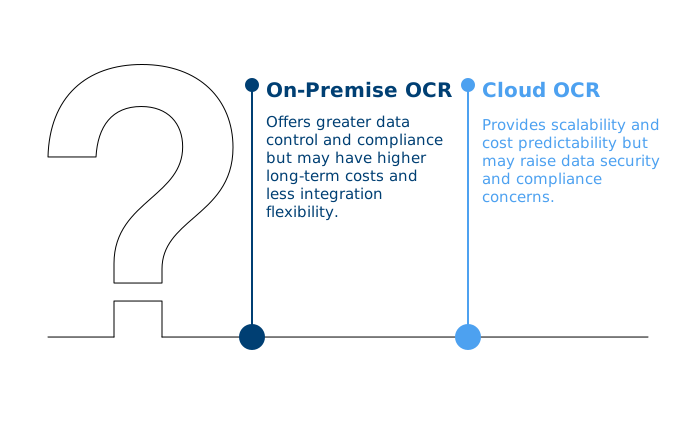
In short, if you’re handling regulated data or large volumes, on-premise often makes more strategic sense. However, if speed and short-term flexibility matter more, the cloud might be the better option.
Key Takeaways
- On-premise OCR provides organizations with complete control over their data — something that’s especially important when handling sensitive or heavily regulated information.
- Cloud OCR, meanwhile, is excellent for speed and rapid scaling, but it involves trade-offs: risks of data exposure and greater dependence on your vendor.
- When it comes to compliance — especially with strict frameworks like GDPR and HIPAA — on-premise is usually the safer, more compliant option for industries with strict governance requirements.
- In terms of performance, on-premise solutions are generally more reliable. Cloud, although often fast, can experience latency fluctuations due to network conditions.
- Costs also vary: cloud might be cheaper at first, but as document volumes increase, those expenses can become less predictable. On-premise OCR has a higher initial cost, but it’s easier to plan for over the long term.
- And regarding integration? On-premise has the advantage — it’s designed to fit into complex enterprise environments and legacy systems in ways cloud often can’t.
- Ultimately, your OCR setup not only determines how documents are read but also affects your organization’s risk profile, compliance position, and strategic flexibility.
A Final Word
Choosing between on-premise and cloud OCR isn’t just about ticking a box on a tech checklist — it’s a more significant, strategic choice involving control, risk, and how your data operations evolve. Cloud options provide speed and flexibility, but they also require trusting someone else’s infrastructure, processes, and long-term stability.
On the other hand, going on-premise usually involves more upfront effort and cost — but it provides something the cloud can’t quite match: full control. Complete data ownership. And a compliance approach based on your standards, not someone else’s fine print.
For teams handling sensitive or heavily regulated data, that truly matters. It’s not just about what’s faster or more modern now; it’s about what keeps you secure and in control moving forward.
- So it’s worth stepping back and asking: Where should your data actually reside to give you complete control?
- How much flexibility do your compliance rules really allow?
- And looking ahead, which setup keeps you in charge—rather than being dependent on someone else’s updates or restrictions?
Making a good decision here gives you time to pause and reflect. So, here’s the real question:
- Are you selecting an OCR model because it’s simply convenient now, or because it truly offers the level of control your organization will require in the future?
That answer will decide if OCR becomes a true strategic advantage or just another hidden risk.

Lajos Fehér
Lajos Fehér is an IT expert with nearly 30 years of experience in database development, particularly Oracle-based systems, as well as in data migration projects and the design of systems requiring high availability and scalability. In recent years, his work has expanded to include AI-based solutions, with a focus on building systems that deliver measurable business value.
Related posts