
Cloud or On-Premise AI
More Than Just an IT Choice
- AI Technology
Choosing between cloud and on-premise AI is a long-term business decision. How your company decides to deploy AI will directly affect cost stability, data control, compliance risks, and how quickly the technology can deliver real value.
From our experience here at Omnit, we know that for many businesses, the challenge is determining which setup best fits their data sensitivity, day-to-day operations, and future growth.
Cloud platforms offer speed and flexibility, while on-premise solutions give you more control and tighter security. But here’s the catch: the trade-offs between them often don’t show up until after you’ve made your choice.
This Omnit article breaks down what each model looks like in practice, when each one makes the most sense, and how business leaders can cut through the hype to make decisions based on priorities.
What You Will Learn
If You’re Reading This Article, You’ll Learn:
- Why choosing cloud or on-premise AI is a strategic business decision, not just an IT preference
- How cloud and on-premise AI differ in terms of cost structure, control, scalability, and risk
- When cloud AI makes the most sense — and when its trade-offs start to show
- Why on-premise AI offers greater data control, compliance alignment, and predictability
- The operational and organizational challenges that come with running AI in-house
- How to evaluate AI architecture choices based on data sensitivity, maturity, and long-term goals
- Why many organizations are moving toward hybrid AI strategies instead of choosing one side
- How leadership teams can make AI deployment decisions grounded in real priorities, not hype
By the end of this article, you’ll be better equipped to choose an AI architecture that fits how your business actually works today — and where it’s headed tomorrow.
The goal isn’t to push you into the cloud. And it’s definitely not to convince you to build a GPU bunker in the basement.
The goal is to give you enough clarity to understand the real trade-offs behind cloud and on-premise AI — before those trade-offs show up in your costs, compliance audits, or operational headaches.
Think of this article as an AI architecture reality check: so you can make informed decisions based on control, risk, and long-term value — rather than shiny diagrams, vendor promises, or “everyone else is doing it” logic.
Understanding the Two Models Before Comparing Them
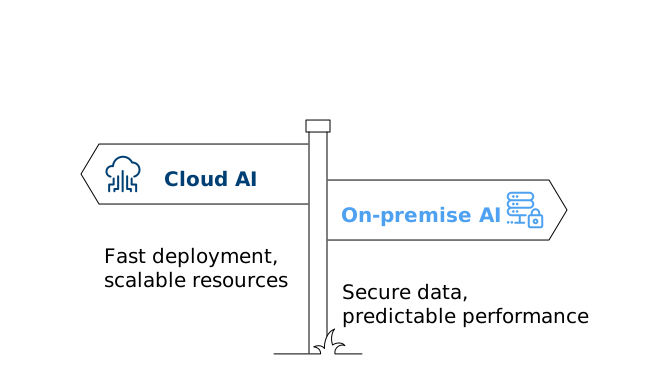
What Do We Actually Mean by Cloud AI
Cloud AI refers to running artificial intelligence on infrastructure owned and managed by an external provider. The models, computing power, storage, and related tools are accessed online — usually via a subscription or pay-as-you-go model.
In practice, this often means using platforms like:
- AWS SageMaker,
- Microsoft Azure AI,
- Google Vertex AI.
Instead of buying and managing their own hardware, companies use AI as a service. The provider handles all the heavy lifting: maintaining the infrastructure, scaling it up or down as needed, and keeping everything up to date.
From a business standpoint, Cloud AI converts what used to be a sizeable upfront investment into a more manageable operating cost. That’s a major plus for companies that want to experiment or move quickly without locking into long-term infrastructure commitments.
But here’s the trade-off: while it’s convenient, Cloud AI also means that key parts of your AI pipeline — such as data handling, model training, or storage — are no longer entirely under your control. That becomes a significant consideration when AI moves from testing phases into core business operations.
Why Many Companies Start with Cloud AI
Cloud AI is often the quickest path from idea to real-world solution. For companies just starting to explore AI, getting something up and running quickly — with minimal upfront effort — usually matters more than fine-tuning for the long term.
The lower entry cost, built-in tools, and ease of experimentation make it an obvious starting point.
Fast Time to Value
With cloud platforms, teams can get started in days — or even hours. There’s no waiting for GPU procurement, no need to overhaul infrastructure, and no drawn-out approval process for hardware spend.
It’s plug-and-play — ideal for moving quickly.
Flexible Scalability
Cloud AI lets you scale computing power up or down as needed. That flexibility is a big win for pilot projects, seasonal spikes, or any situation where it’s still unclear how much AI horsepower you’ll need.
You pay only for what you use — and you can adjust as you go.
Access to Continuously Improving Technology
Cloud providers are constantly updating their AI tools, models, and platforms. That means your team automatically benefits from the latest improvements — without having to plan, manage, or execute the upgrades.
You stay up to date without the extra work.
Lower Initial Risk
With a pay-as-you-go setup, there’s no significant upfront investment. If a project doesn’t pan out or deliver the value you hoped for, you can stop — without being stuck with expensive, unused infrastructure.
For decision-makers, that lower barrier makes Cloud AI a safer bet for getting started. It’s one of the main reasons so many organizations take their first steps into AI through Cloud AI.
The Trade-Offs That Appear as Cloud AI Scales
What feels like a perfect fit during early AI experiments can start to show cracks as the scale increases. When cloud-based AI shifts from small pilots to everyday operations, some of the limitations that weren’t obvious at first come into focus.
Data Security and Data Residency Concerns
Cost Predictability Over Time
With cloud AI, your data is processed outside your own infrastructure — which can be a dealbreaker in specific industries. If you’re in a highly regulated space or bound by strict contracts, this setup might limit which datasets you’re allowed to use — or even whether cloud AI is an option at all.
Pay-as-you-go pricing feels great at first — but costs can ramp up quickly. Especially when you’re working with:
- large models,
- high volumes of inference.
Without solid tracking in place, cloud AI spending can quickly become unpredictable — and challenging to manage over the long term.
Reduced Control Over the AI Stack
When you rely on a cloud provider, you’re also tied to their:
- platform design,
- service uptime,
- pricing decisions,
- product roadmap.
That level of dependency might be acceptable for non-critical projects — but once AI becomes central to your business, it can start to feel risky.
Latency and Performance Limits
If your application requires real-time responses or processes large amounts of data, network latency can start to affect reliability and the overall user experience.
That doesn’t mean Cloud AI is a bad choice — it just means the trade-offs become more apparent as AI shifts from experimental to operational. When AI becomes a core part of how your business runs, it’s worth revisiting those early cloud-first decisions.
What Do We Mean by On-Premise AI
On-premise AI means everything runs within your organization’s own infrastructure. You own the servers, storage, and networking gear — and you manage both model training and inference directly.
In practice, this usually looks like:
- GPU-powered servers in a private data center,
- high-performance computing (HPC) clusters,
- internally hosted large language models (LLMs).
Unlike cloud-based setups, nothing is processed off-site unless you specifically design it that way. All your data, models, and operations remain within your own walls.
From a business perspective, this isn’t a subscription or pay-as-you-go model — it’s a capital investment. That means more upfront planning, more internal expertise, and greater ownership across the board.
But in return, you gain absolute control.
On-premise AI is often the right fit when data sensitivity, compliance needs, or deep system integration matter more than speed or flexibility.
Why Organizations Choose On-Premise AI
On-premise AI is the go-to when control matters more than speed. For many companies — especially those in regulated industries or handling sensitive data — control isn’t just nice to have. It’s non-negotiable.
Full Data Ownership and Governance
With on-premise AI, all your data stays within your own infrastructure. That means less exposure to external risks — and it makes internal governance much simpler to manage and enforce.
Stronger Compliance Alignment
Sectors such as finance, healthcare, and government operate under strict regulatory requirements. With on-premise AI, it’s much easier to show exactly where data is processed and stored and who has access — making compliance much more straightforward.
Predictable Long-Term Cost Structure
Once the upfront hardware costs are covered, ongoing expenses are much more stable. That kind of cost predictability is a major plus for AI workloads that run continuously and are critical to the business.
Deep Customization and Integration
On-premise environments can be fully tailored to your existing systems, workflows, and security standards. That means AI can be tightly integrated into the core of your operations — not just added on top.
Low Latency for Critical Systems
If your AI is powering real-time decisions or needs to run near local operations, on-premise deployment keeps things fast — no waiting on the network.
From a strategic perspective, on-premise AI may take longer to set up, but it offers long-term stability and better control over risk, which often matters more in the long run.
The Operational Challenges of On-Premise AI
With on-premise AI, you gain control — but you also take full responsibility. It’s not something you can treat as a side project. If you go this route, you need to be ready to manage AI as a core part of your infrastructure, with all the planning and upkeep that entails.
High Upfront Investment
Internal Expertise Requirements
Running on-premise AI isn’t just about having the proper hardware — you also need the right people. It takes skills in:
- MLOps,
- system monitoring,
- model lifecycle management,
- security upkeep.
Without that internal know-how, things can quickly break down — performance drops, reliability suffers, and risks increase.
Limited Flexibility in Scaling
If you need to scale on-premise AI, it’s not as simple as flipping a switch — you have to buy, install, and configure new hardware.
That makes the process slower and much less flexible than cloud scaling, especially if demand suddenly spikes and you need extra capacity quickly.
Longer Implementation Timelines
Getting an on-premise AI environment up and running isn’t quick. Between design, procurement, and stabilization, it can take months. That makes it a tough fit for rapid experimentation or short-term projects.
But that doesn’t mean on-premise AI is the wrong choice — it just means it’s a strategic move, not a quick fix.
Cloud AI vs. On-Premise AI: A Decision-Oriented Comparison
The real question isn’t which option is “better” — it’s which one best fits your business needs, risk tolerance, and operational readiness.
Here’s a side-by-side comparison to help clarify the trade-offs:
| Dimension | Cloud AI | On-Premise AI |
|---|---|---|
| Time to start | Very fast | Slower setup |
| Cost structure | Flexible, usage-based (OPEX) | High upfront investment (CAPEX) |
| Cost predictability | Lower at scale | More stable after deployment |
| Data control | Limited | Full |
| Scalability | Virtually unlimited | Tied to available hardware |
| Customization | Constrained by platform rules | Fully customizable |
| Latency | Can be higher due to the network | Minimal, runs locally |
| Compliance fit | Depends on provider & region | Strong fit for highly regulated industries |
| Operational burden | Mostly handled by provider | Fully managed in-house |
This comparison is most helpful after a pilot phase — once you’ve seen how AI actually behaves in your environment and what the real usage patterns look like.
How Decision-Makers Should Evaluate Cloud vs. On-Premise AI
Before locking into cloud or on-premise, leadership teams should step back and align on a few key questions:
- What kind of data are we working with — and how sensitive is it?
- How vital is speed versus control?
- Are we experimenting or scaling a critical effort?
- Do we have the internal expertise to manage AI infrastructure?
- What’s our risk tolerance for compliance, cost, and vendor dependency?
The answers to these questions don’t just point to a “better” option — they help surface what actually fits how your business operates today (and where it’s headed tomorrow).
Emerging Patterns: Why Many Organizations Choose Hybrid AI Strategies
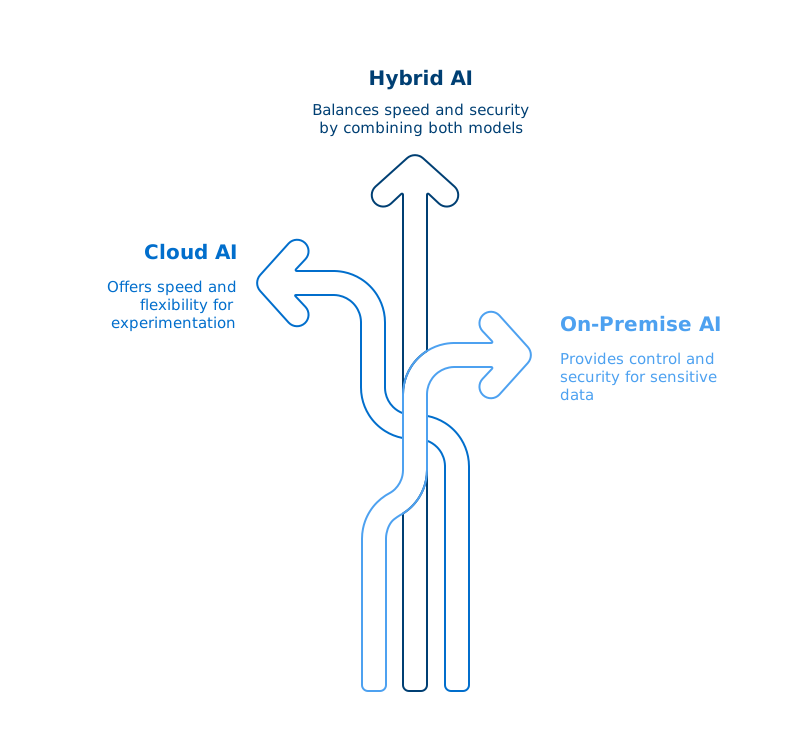
The “cloud vs. on-premise” debate is giving way to a more flexible approach: hybrid AI strategies. Rather than picking one side, many organizations are blending both — using the cloud for speed and scalability and keeping sensitive workloads on-premise for control and risk management.
It’s less about choosing a camp than about finding the right balance.
Hybrid AI Architectures
A typical hybrid setup is as follows:
- Train models in the cloud, where you can tap into massive compute power as needed.
- Run inference on-premise, where data sensitivity and low latency are critical.
This approach helps reduce cloud costs while keeping your most sensitive, business-critical operations entirely under your control.
Private and Internal LLMs
More companies are starting to host large language models on-premises. Why? It comes down to three key reasons: protecting sensitive data, safeguarding intellectual property, and ensuring models behave predictably — especially in business-critical situations.
Edge AI for Low-Latency Environments
More AI models are now running right where the data is — on factory floors, inside devices, or within local systems. Why? Because in these settings, even slight network delays aren’t acceptable. Real-time performance requires local processing.
Regulatory Pressure Shaping Architecture
As AI regulations tighten, more organizations are seeking setups that clearly track data flows and explain how models behave. It’s no longer just about performance — it’s about being able to audit, document, and prove control.
That’s why flexibility in your AI architecture isn’t just a tech preference anymore — it’s becoming a competitive edge.
Key Takeaways of the Article
- Choosing between cloud and on-premise AI is a strategic business decision, not just a technical one. It directly impacts cost structure, risk exposure, compliance, and long-term operational stability.
- Cloud AI offers speed, flexibility, and a low barrier to entry, making it ideal for experimentation, pilot projects, and fast time-to-value.
- On-premise AI provides greater control, stronger data governance, and more predictable long-term costs, especially in regulated industries or when handling sensitive data.
- The real trade-offs of cloud AI often emerge at scale, including cost predictability, data residency concerns, and vendor dependency.
- On-premise AI is not a quick fix but a strategic investment, requiring higher upfront costs, internal expertise, and longer implementation timelines.
- Many organizations are adopting hybrid AI architectures, combining cloud flexibility with on-premise control to balance speed, security, and scalability.
- The right choice depends less on technology and more on business realities: data sensitivity, operational criticality, internal capabilities, and risk tolerance.
- The biggest mistake isn’t choosing the “wrong” architecture — it’s deciding too early or based on hype instead of real usage and business needs.
Final Thoughts: Choose Architecture Based on Control, Not Hype
Cloud AI and on-premise AI aren’t rivals — they’re tools, and more precisely, strategic tools. Each one solves a different set of problems, and at the same time, each one brings its own risks if used in the wrong context.
Cloud AI is great for moving fast, testing ideas, and tapping into the latest innovations. At the same time, on-premise AI is built for control, predictability, and peace of mind — especially when regulations and sensitive data are involved.
The mistake many companies make, however, is choosing too early or based on hype rather than real, operational needs. The truth is that AI architecture should evolve, just as your use cases, your team’s capabilities, and your risk tolerance do.
For most organizations, the future won’t be one or the other. Instead, it’ll be bright, intentional combinations of both, built around what the business actually needs.
So before locking into any AI architecture, it’s worth asking a straightforward question: what do we need to optimize for right now — speed, control, or long-term stability? Answer that honestly, and you’ll have your best starting point.

Lajos Fehér
Lajos Fehér is an IT expert with nearly 30 years of experience in database development, particularly Oracle-based systems, as well as in data migration projects and the design of systems requiring high availability and scalability. In recent years, his work has expanded to include AI-based solutions, with a focus on building systems that deliver measurable business value.
Related posts



Turning Ambition into Real, Scalable Results