
Understanding ROI in AI Projects
Looking Beyond the Numbers
- AI In Business
AI projects often fail not because of technology issues, but due to a misunderstanding of ROI.
When companies discuss return on investment (ROI) in AI, they often focus mainly on cost savings. Based on our fifteen years of experience, we believe reducing costs is important — but it’s only one part of a much bigger picture. Omnit’s perspective is that real ROI in AI includes not just measurable financial benefits but also strategic advantages that set a business up for future success.
This article examines how organizations can maximize their ROI from AI projects.
What You Will Learn
- Why AI projects often fail to deliver ROI — even when the technology works
- Why focusing only on cost savings gives an incomplete (and misleading) picture of AI value
- The different dimensions of ROI, including productivity, growth, risk reduction, and customer experience
- How to set baselines and metrics that actually prove impact
- How to align AI initiatives with real business objectives, not experimentation for its own sake
- Why AI ROI appears in waves over time, not all at once
- How pilots, phased rollouts, and scaling decisions influence long-term returns
- How to evaluate AI success as a strategic investment, not just a spreadsheet calculation
By the end of this article, you’ll understand how to measure AI’s real impact — and why the most valuable returns often don’t show up immediately.
The goal isn’t to turn you into a financial controller — or to make you obsess over ROI formulas in Excel at midnight. And no, we’re not here to convince you that AI magically pays for itself by next quarter.
The goal is to help you look beyond the obvious numbers and recognize how AI creates value over time — by changing how work gets done, how decisions are made, and how businesses compete.
Think of this article as a wider lens for ROI: so when someone asks, “Is this AI project worth it?”, you can answer with more than just cost savings—and with far more confidence.
The Many Faces of ROI
To see the whole picture, you must look beyond the balance sheet. AI can add value in multiple ways. For this to happen, it also needs to be high quality. This is where partner companies like Omnit come into play.
With an improved model, you can begin to observe the effects on the following areas:
- Achieving cost efficiency through concrete savings by automating tasks that once took hours and thousands of dollars.
- Boosted productivity through quicker processes and smarter decision-making.
- Revenue growth driven by AI-powered products and pricing strategies.
- Minimizing risk through fraud detection and compliance.
- Enhanced customer experience with personalized service and real-time support.
- Gaining a competitive edge by building capabilities that rivals struggle to copy.
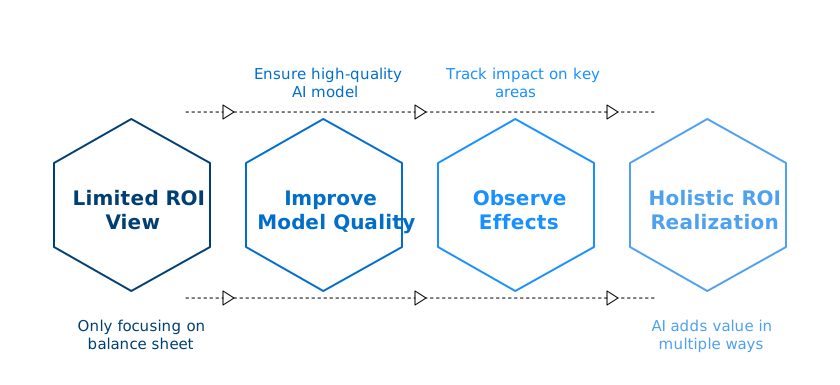
During early planning, determine how you will measure these outcomes!Launching a support chatbot, for instance, might lower staff costs — but if customer satisfaction improves as well, that contributes to the ROI story. Focusing only on short-term savings causes you to miss where AI truly shines: its long-term impact.
Building Baselines and Metrics
A solid ROI plan starts with understanding your baseline. Without baselines, you can’t show what has changed. Setting baselines is crucial; they serve as your initial snapshot.
Examples of a baseline may include:
- average response times,
- human error rates,
- annual downtime hours,
- customer loyalty scores.
The establishment of this baseline can be achieved through thorough analysis or by consulting an external company, such as Omnit, for example.
Selecting the right metrics is equally important. Accurate measurement affects both internal operations and observable business outcomes, such as:
- efficiency through less manual work,
- quality with fewer errors,
- revenue via higher conversions,
- customer experience with greater satisfaction and loyalty.
Consistency matters. We recommend:
- using short-term reviews (monthly or quarterly) to identify early trends and,
- conducting more in-depth annual reviews to validate whether gains are sustained.
Connecting AI to Business Goals
AI projects succeed when they align with business strategy, rather than being seen as flashy experiments. Always prioritize strategy over shiny objects.
Ask: Which goal does this project support? Cost reduction, growth, or risk management?
Projects without alignment often fizzle out.
On the contrary, well-organized plans and clear workflows in the project can turn things around for the better.
For example, consider McKinsey’s State of AI 2025 report, which found that organizations that redesign workflows around AI and track clear KPIs see significantly higher EBIT (earnings before interest and taxes) impact than those that only use AI to automate tasks. In other words, AI initiatives that enhance how work is done — not just how much it costs — tend to generate more substantial operating profits and a long-term competitive edge.
Each initiative requires clear ownership from both the business side and IT to define success and track its impact. That’s how AI shifts from “interesting” to essential.
The Time Horizon of AI ROI
Unlike traditional software, AI requires time to develop.
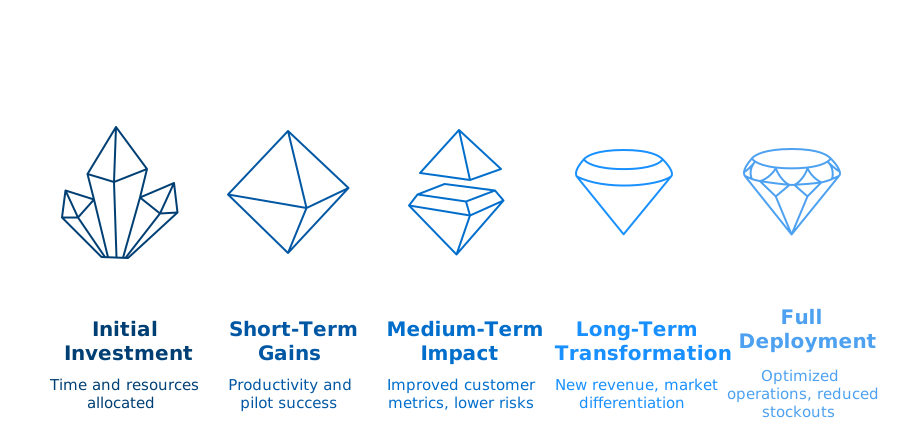
AI benefits appear in waves:
- Short-term (0–12 months): increases in productivity and successful pilot programs.
- Medium term (12–24 months): improved customer metrics and lower risks.
- Long-term (24–36+ months): transformation, new revenue streams, and market differentiation.
The rollout should be phased:
- Start with a pilot in a low-risk area.
- Expand through a limited rollout by team or region.
- Scale to full deployment, with clear go/no-go checkpoints.
This phased approach reduces risk, controls spending, supports adoption, and builds trust in your company by showcasing early wins that secure leadership approval.
Take the example of a retailer introducing AI forecasting:
- Pilot: one product line in one region.
- Expansion: five lines across two regions, tracking accuracy, and stock levels.
- Scale: company-wide rollout, measuring ROI through reduced stockouts and optimized working capital.
Key Takeaways of the Article
- AI ROI isn’t one-dimensional. It’s not just about cutting costs — it boosts productivity, drives growth, reduces risk, improves the customer experience, and enhances competitiveness.
- Start with baselines, or you’ll be flying blind. You can’t track progress if you don’t know where you started — solid metrics create a solid foundation.
- Tie AI projects to real goals, not hype. Projects aligned with business priorities deliver results. “Cool tech” often fizzles.
- Don’t go all-in overnight. Pilots, limited rollouts, and phased scaling aren’t just safer — they also build trust and refine impact.
- Play the long game. True transformation takes time. AI doesn’t reach full potential overnight — but when it does, the impact is significant.
The Final Word
ROI isn’t just a number you plug into a spreadsheet — it’s the story of how technology transforms the way a business operates. It’s about working smarter, growing faster, avoiding risks you didn’t anticipate, and possibly unlocking doors you didn’t realize were there.
The companies that truly see results? We at Omnit know that they are the ones who set clear starting points, connect every project to something the business already values, and grow intentionally — not just quickly. They’re not just chasing numbers — they’re transforming how the company operates.
So here’s the real question: Are you treating AI like a side project… or as a serious tool for long-term advantage? Because that choice — how you plan, how you measure, and how you lead—makes all the difference.
Next time you ask about AI’s ROI, try this: What will it cost you not to change?
If you found this article interesting or if you want to explore the subject in more depth with us, you can contact us below.

Csaba Fekszi
Csaba Fekszi is an IT expert with more than two decades of experience in data engineering, system architecture, and AI-driven process optimization. His work focuses on designing scalable solutions that deliver measurable business value.
Related posts