
How to automate document handling with AI
Intelligent Document Processing (IDP)
- AI In Business
Intelligent Document Processing (IDP) is not just a solution, it’s a transformative force poised to redefine how traditional business documents are handled. It can convert documents from static and unstructured to dynamic and easily processable at scale.
By automating this process, IDP saves considerable time and resources while significantly reducing human error, offering a new level of efficiency and accuracy for businesses and inspiring excitement about its potential.
At Omnit, we have made this field our expertise, and in this article, we will guide you through the steps, processes, and various components of IDP.
What You Will Learn
If You’re Reading This Article, You’ll Learn:
- What Intelligent Document Processing (IDP) is and how it goes beyond traditional OCR and basic automation
- How IDP uses AI technologies like NLP, computer vision, and machine learning to understand both document content and layout
- The end-to-end IDP workflow, from document ingestion to validation and system integration
- The core capabilities of a modern IDP platform, including classification, data extraction, RAG-based search, and compliance checks
- Real-world use cases such as invoice processing, contract analysis, and form handling
- The business impact of IDP — improved scalability, accuracy, efficiency, and data-driven insights
Don’t worry — by the end of this article, you won’t be expected to build an IDP system from scratch. But you’ll have a clear understanding of how IDP transforms unstructured documents into strategic, actionable assets and how organizations like Omnit design and deliver tailored IDP solutions. And you’ll know enough to use IDP confidently and sound smart while doing it.
But What Exactly is IDP?
IDP is more than just a basic AI-supported module; it’s a sophisticated system that utilizes advanced techniques, including natural language processing, computer vision, and machine learning, to automate business document management.
This innovative approach enables IDP to classify, extract, and verify information from unstructured sources. It transforms this into organized, reliable data that seamlessly integrates into enterprise systems. The robust AI at the core of IDP makes it a vital tool for business transformation and builds confidence in its capabilities.
IDP examines both content and layout, enabling it to process a wide variety of document types. These include invoices, purchase orders, contracts, forms, and more. This flexibility makes IDP a versatile solution for different business needs.
How IDP Works
How does IDP actually work? It’s like a well-oiled machine, running through a structured, automated process that converts unstructured content into actionable, validated data.
Each stage utilizes artificial intelligence techniques to ensure that documents are not only digitized but also understood and trusted for future use.
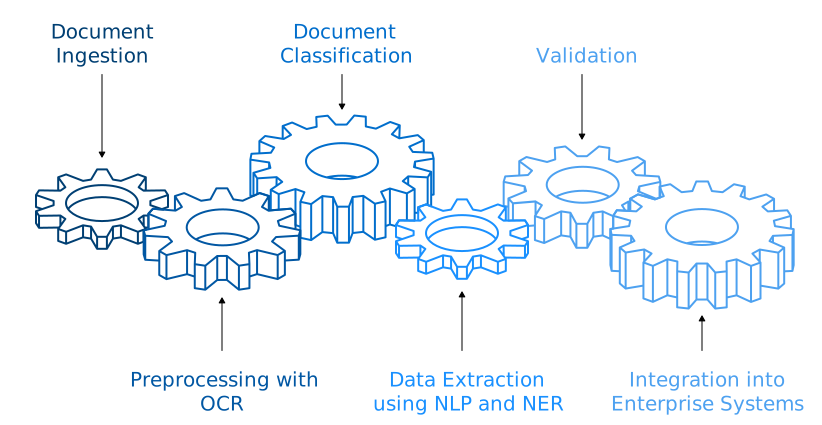
Ingestion
The system begins by collecting documents from various sources, including email attachments, scanners, shared drives, and enterprise applications. These documents are then stored in a central repository for processing and management, marking the beginning of the IDP journey.
Preprocessing
To ensure consistency, files are normalized and enhanced. Preprocessing involves image correction, de-skewing, and noise reduction. Then, Optical Character Recognition (OCR) is applied to convert scanned images into machine-readable text.
Classification
AI models identify the type of document — such as invoice, purchase order, contract, or form — using multimodal analysis that evaluates both text and visual layout features. This improves accuracy compared to traditional text-only methods.
Data Extraction
Natural Language Processing (NLP) and Named Entity Recognition (NER) techniques identify and extract relevant fields such as names, dates, invoice numbers, and totals. Table recognition and key-value pairing further improve field-level accuracy.
Validation
Extracted data is validated against business logic, compliance rules, and external data sources to verify accuracy and integrity. This step guarantees completeness, consistency, and correctness before integration.
Integration
The final structured data is automatically sent to enterprise systems, such as ERP, CRM, workflow automation platforms, or analytics tools — enabling smooth downstream processing.
By automating these steps, IDP replaces manual document handling with a scalable, intelligent pipeline. This not only cuts operational costs, reduces errors, and shortens turnaround times but also builds confidence in its ability to serve a wide range of industries and business needs.
Omnit can develop, customize, and train an IDP system tailored to your specific industry or business needs, making it a flexible and adaptable solution for your document processing challenges.
Key Capabilities
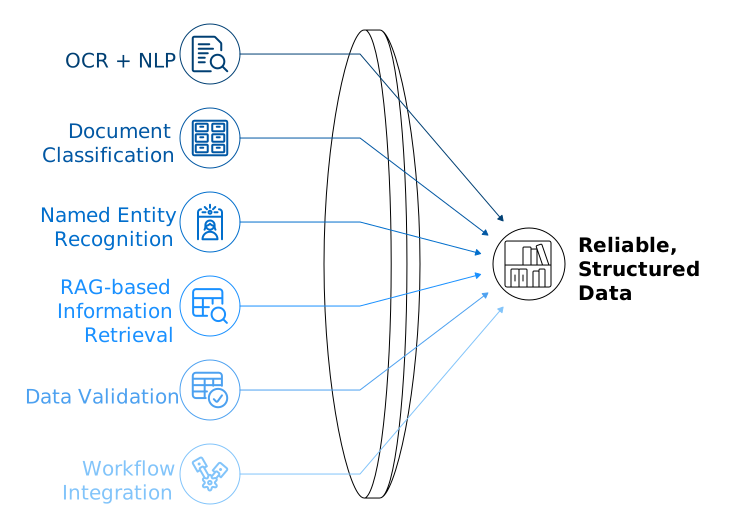
Intelligent Document Processing is a collection of integrated services that collectively facilitate end-to-end automation of document-focused workflows.
These services collaborate to transform unstructured content into organized, actionable data.
OCR Enhanced with Natural Language Processing (NLP)
Traditional Optical Character Recognition (OCR) mainly converts images or scanned documents into plain text. When combined with NLP, OCR becomes significantly more effective, able to understand language, context, and meaning.
This enables the system to identify not only characters but also their intent and significance within the document.
Document Classification
This service identifies the type and structure of incoming documents — such as invoices, contracts, or forms — even when they arrive in mixed or multi-page batches.
By using multimodal AI, which analyzes both textual and visual layout features, classification becomes more accurate and resilient to variations in format.
Named Entity Recognition (NER)
NER identifies and extracts important data points such as names, dates, monetary amounts, and domain-specific entities (e.g., policy numbers, legal clauses).
Custom NER models can be trained for industry-specific terminology, thereby enhancing accuracy in sectors such as insurance, healthcare, or finance.
Information Retrieval via Retrieval-Augmented Generation (RAG)
Our RAG solution combines neural search with generative AI. This allows users to query large collections of documents and get accurate, source-backed answers.
This approach is ideal for:
- Legal discovery and compliance audits.
- Customer support cases.
- Any situation where precise, referenceable responses are essential.
Data Validation and Compliance Enforcement
Intelligent Document Processing (IDP) uses AI and business rules to verify data by cross-referencing information with databases. The system ensures high quality through several key steps:
- It identifies inconsistencies and errors automatically.
- It maintains compliance using audit trails and data masking.
- It learns from human feedback to boost accuracy and dependability over time.
This service of IDP ensures integrity, accuracy, and compliance — vital for industries governed by strict regulations (e.g., banking, healthcare, public sector).
Workflow Automation and System Integration
Structured data can be automatically directed to downstream systems like Enterprise Resource Planning (ERP), Customer Relationship Management (CRM), or case management platforms. This supports end-to-end process automation — from payment processing to claims handling — reducing human intervention and speeding up decision-making.
These services together form the foundation of a modern IDP platform — turning static documents into smart assets that enhance operational efficiency, improve data accuracy, and enable scalable automation.
Everyday Use Cases of IDP
These are just a few examples of what IDP is capable of, based on our Omnit’s past work and delivered products.
Invoice Processing
An invoice received in an email inbox is automatically identified and then routed through a classification process. OCR and NLP collaborate to extract key details, including the vendor name, total amount, and payment due date.
Validation rules then verify for issues like duplicate invoices or missing fields. If everything passes the checks, the structured data is directly uploaded into the ERP system for payment approval, removing the need for manual entry.
Contract Review
A scanned contract is uploaded into the system and classified as a legal document. From there, NER models extract key details such as the involved parties, effective dates, and specific obligations.
Using Retrieval-Augmented Generation (RAG), legal teams can search through thousands of contracts to find relevant clauses or compare risk profiles — without manually reading every page.
Form Handling
For standardized documents like insurance claims or government forms, IDP efficiently processes batches. It recognizes the form type, extracts key fields such as policy numbers or claimant details, and verifies that data in real-time. After verification, the results are automatically sent to the claims or case management system for further review and follow-up.
In each of these use cases, feedback loops help the system become smarter over time. It learns from user corrections and adapts to changes in document formats or business rules — constantly improving both accuracy and efficiency.
The Impact on Your Business
Based on previous projects we have completed, we have determined that IDP excels in bringing impact in the following areas:
- Scalability: With IDP, you can process thousands of documents daily without expanding your team. What used to take hours of manual work now happens automatically and dependably.
- Accuracy: Automated validation significantly lessens the risk of human error. This results in fewer mistakes in financial entries, more consistent compliance reporting, and generally smoother operations.
- Efficiency: IDP speeds up workflows by automating repetitive, low-value tasks like data entry or document sorting, allowing employees to focus more on higher-impact work.
- Searchability: RAG-enabled search turns static archives into searchable knowledge bases. You can ask questions in natural language and get context-aware answers directly pulled from your document collection.
- Insight: The information in PDFs, scanned forms, or handwritten notes transforms into structured data — ready for analysis, forecasting, or strategic decision-making.
By transforming unstructured content into actionable data, IDP does more than automate — it elevates. Documents move from operational burdens to strategic assets.
Key Takeaways
- Intelligent Document Processing (IDP) simplifies and automates handling unstructured documents throughout the enterprise.
- It combines OCR, Natural Language Processing (NLP), machine learning, and computer vision into a single, intelligent workflow.
- Core capabilities include document classification, entity extraction, RAG-based information retrieval, data validation, and workflow automation.
- These services work together to build end-to-end automation pipelines for use cases like invoice processing, contract analysis, and form handling.
- IDP provides scalability, accuracy, and operational efficiency while turning previously inaccessible data into actionable business insights.
A Final Word on IDP
Intelligent Document Processing converts static, unstructured files into organized, dependable data. By integrating AI-powered services into a unified workflow, it reduces manual effort, enhances data accuracy, and speeds up decision-making.
For organizations we’ve worked with, the result is clear: faster operations, reduced costs, and more innovative use of the information they already possess.
If you find this article helpful or are interested in an IDP system for your own team or organization, contact us.

Csaba Fekszi
Csaba Fekszi is an IT expert with more than two decades of experience in data engineering, system architecture, and AI-driven process optimization. His work focuses on designing scalable solutions that deliver measurable business value.
Related posts





Accuracy, Architectures, and the Real-World Factors That Still Limit Performance
