
Common Pitfalls to Avoid in an AI Pilot
Why So Many AI Projects Stall — and How to Finally Move Beyond the Pilot Phase
- AI In Business
Based on our experience at Omnit, we know that AI offers efficiency, insight, and new avenues for innovation. However, for many organizations, these goals never advance beyond the pilot phase. Projects get stuck, confidence declines, and momentum slows down.
The problem isn’t just the technology — it’s how the project is managed. Most AI projects fail because they don’t have clear goals, strong foundations, or proper ownership to drive them forward.
This guide explores the most common obstacles that prevent AI from scaling, why they happen, and what sets successful adopters apart from those who keep experimenting.
What You Will Learn
If You’re Reading This Guide, You’ll Learn:
- Why so many AI pilots get stuck and never make it to production
- The most common pitfalls that cause AI initiatives to stall or quietly disappear
- How misalignment with business objectives undermines leadership support
- Why narrow ROI thinking hides AI’s real value
- The importance of strong data, process, and technology foundations
- How to design AI pilots that are small, measurable, and scalable
- When to scale — and when not to
- Why people, communication, and change management matter just as much as models
- How continuous measurement keeps AI relevant long after the pilot phase
By the end, you’ll know how to spot early warning signs, avoid common mistakes, and move AI initiatives beyond experimentation into real business impact.
The goal isn’t to scare you away from AI pilots — or to make you paranoid every time someone says “let’s test an idea.” And it’s definitely not to turn you into a full-time AI babysitter.
The goal is to help you recognize the traps before you fall into them, so your pilots don’t end up as impressive demos that nobody uses six months later.
Think of this guide as a reality check with a safety net: enough insight to design pilots that survive, scale, and actually earn their place in the business — without endless experiments, lost momentum, or awkward “so… what happened to that AI project?” conversations.
A Lack of Alignment with Business Objectives
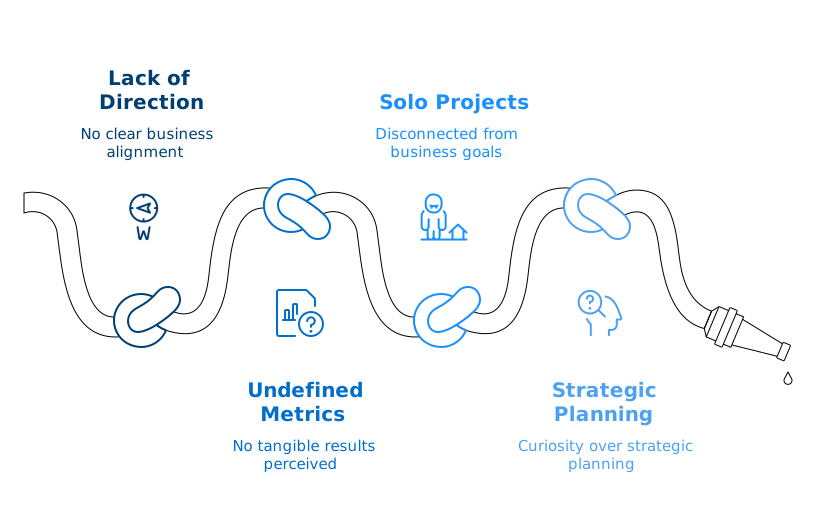
Many AI pilots begin with enthusiasm but lack a clear sense of direction. They often work solo, disconnected from business goals such as growth, efficiency, or risk reduction.
Projects often start out of curiosity rather than strategic planning. Success metrics are either undefined or not aligned with the business case, and leadership perceives no tangible results — only costs.
To prevent this, we suggest linking each pilot to a clear goal, such as reducing costs, boosting quality, accelerating processes, or improving customer experience. Business and IT should share accountability for success, seeing pilots as strategic investments rather than merely technical experiments.
Narrow ROI Thinking
When AI’s value is evaluated solely based on cost savings, its full potential is overlooked. Organizations fail to recognize broader effects like increased productivity, revenue growth, or risk mitigation — and leadership concludes that AI “doesn’t pay off.”
ROI is often defined too narrowly, focusing only on immediate financial metrics. Non-financial value, such as customer satisfaction, decision speed, and resilience, remains unmeasured, resulting in premature cancellations.
Successful projects measure both direct and indirect value:
- efficiency and cost reduction,
- revenue growth from better insights,
- quality and safety improvements,
- risk avoidance and compliance gains.
This broader perspective maintains executive backing and shows AI’s true business importance.
Treating AI as a Side Project
Many pilots work in innovation or IT labs, away from the main business activities. They can produce insights, but often fail to get adopted. Once initial excitement wanes, the project quietly ends.
This results in pilots often staying as technical demonstrations because business units lack a stake in success. Lessons aren’t shared across the organization, and the initiative never develops further.
AI should be a business initiative with shared ownership. Operational teams need to be involved from design through rollout, and success should be measured in business outcomes, not just technical completion.
Skipping the Foundations
AI cannot succeed without strong data, transparent processes, and reliable systems — yet many teams move forward anyway — the result: inconsistent results, broken integrations, and unreliable predictions.
Common mistakes include building models on messy or incomplete data, ignoring undocumented workflows, and launching pilots without verifying infrastructure readiness.
Foundational preparation is crucial. Organizations should map actual processes to identify gaps, evaluate data quality and accessibility, and confirm that systems can communicate effectively through APIs or IoT integration. Without this foundation, pilots tend to stall well before scaling.
Poor Pilot Design
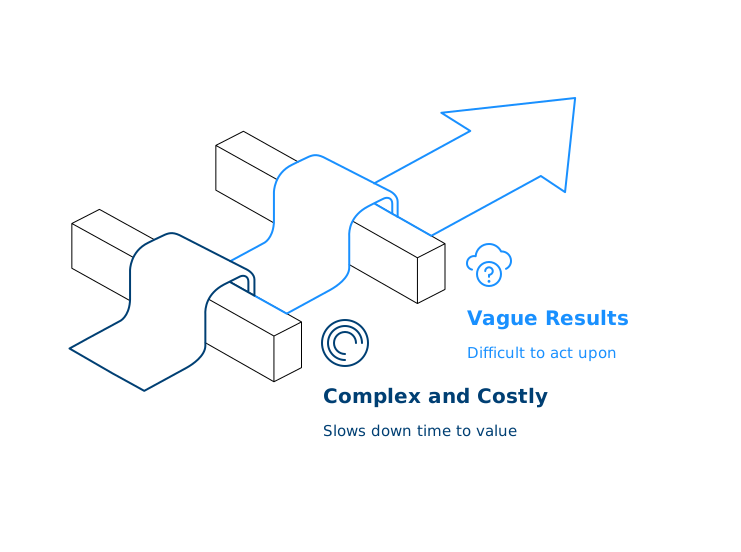
Many pilots aim to showcase technology rather than address a business problem. They often become complex, costly, and slow — and when results finally come, they are too vague to act on.
Successful pilots are small, specific, and measurable. They focus on one workflow and define clear success metrics, such as:
- time saved,
- error reduction,
- throughput or capacity increase.
Sharing early outcomes builds credibility and sets the stage for broader adoption.
Scaling Too Early or Without Validation
One of the most harmful traps is scaling too early. When a small pilot shows promise, leadership often pushes for a company-wide rollout. The infrastructure isn’t prepared, users aren’t trained, and the results often fall apart due to complexity.
Before expanding, teams should ask:
- Are results consistent across teams and conditions?
- Can systems handle the data load and integrations required?
- Are employees equipped and motivated to use the solution?
Scaling should be deliberate and phased — pilot, rollout, scale — with validation at each stage.
Ignoring People and Change Management
Even the best technology fails when people resist it. If employees don’t see how AI benefits them — or fear it will replace their jobs — adoption stalls.
Lack of communication, minimal training, and fear of losing jobs are silent obstacles.
Companies should communicate benefits early, include end users in testing and feedback, and offer ongoing education to boost digital confidence. When employees see AI as an enabler rather than a threat, adoption speeds up.
Absence of Continuous Measurement
Once a pilot goes live, many organizations cease monitoring performance. Data pipelines degrade, models drift, and results decline quietly.
Continuous monitoring of key metrics — error rates, uptime, productivity, cost — is essential. Models need to be retrained with new data, and results should be reviewed regularly.
Monitoring guarantees that performance remains relevant and dependable well beyond the pilot’s conclusion.
Mismanaging the Time Horizon
AI transformation doesn’t happen overnight. When leaders expect instant ROI, patience often runs thin before true value emerges.
Clear time horizons help maintain focus:
- Short term (0–12 months): early wins such as workflow automation and reduced manual work.
- Medium term (12–24 months): operational improvements and efficiency gains.
- Long term (24–36+ months): strategic transformation and new revenue streams.
Designing KPIs for each phase keeps stakeholders aligned and expectations realistic.
Undefined Success Criteria
When success isn’t clearly defined, scaling decisions tend to be driven by emotions rather than data. Teams depend on enthusiasm instead of evidence, leading to confusion and waste.
Before any pilot starts, measurable goals need to be set — such as cost reduction targets, accuracy thresholds, or efficiency improvements. Clear go/no-go criteria prevent uncontrolled expansion and make sure each rollout provides genuine value.
Key Takeaways of the Article
- AI pilots fail mainly due to poor alignment, missing foundations, or limited ownership.
- ROI must be viewed broadly — efficiency, growth, customer experience, and risk reduction.
- Shared accountability between business and IT is essential.
- Scaling should be gradual, data-driven, and validated at every stage.
- Continuous measurement and human engagement sustain results long term.
The Final Word
Escaping the pilot trap requires strategic alignment, solid data foundations, and trusted collaboration across teams. The cost of failure isn’t just lost investment — it’s missed opportunities.
Organizations that learn, adapt, and scale systematically are the ones that turn AI from a promising trial into a lasting competitive advantage.
If you need guidance for your project or organization on an AI project or pilot, or if you want to further explore the topic, contact us.

Csaba Fekszi
Csaba Fekszi is an IT expert with more than two decades of experience in data engineering, system architecture, and AI-driven process optimization. His work focuses on designing scalable solutions that deliver measurable business value.
Related posts




Turning Ambition into Real, Scalable Results

The Strategic Trade-Off That Shapes Data Security, Compliance, and Long-Term Control