
Artificial Intelligence Explained
Why ChatGPT Is Not the Same as AI
- AI In Business
AI is frequently reduced to whatever tool is most visible at the moment — today, that usually means ChatGPT. That shorthand is convenient, but for organizations, it can quietly distort how AI-related decisions are made.
This article explains how AI is structured in layers, what differentiates those layers in practice, and why understanding these differences is critical when making technology and business decisions — not just following the latest AI trend.
What You Will Learn
If You’re Reading This Article, You’ll Learn:
- Why AI is much broader than ChatGPT, even though ChatGPT is the most visible example
- How AI is structured in distinct technological layers, from rule-based systems to generative AI
- The differences between Artificial Intelligence, Machine Learning, Deep Learning, Transformers, and Large Language Models (LLMs)
- How modern text-based AI systems actually work — and why they don’t “understand” language
- What role hardware (GPUs) played in making today’s AI breakthroughs possible
- Why generative AI is only the top layer of a deeper AI stack
- How confusing these layers can lead to poor business and technology decisions
- Why choosing the right kind of AI matters more than chasing the most popular one
By the end of the article, you’ll have a clearer mental model of what AI really is — and what it definitely is not.
The goal isn’t to turn you into an AI engineer. And it’s definitely not to make you argue on LinkedIn about which chatbot is smarter.
The goal is to give you just enough clarity to stop thinking “AI = ChatGPT” and start asking better questions — like which type of AI actually fits this problem?
Think of this article as an AI map: not deep enough to get lost in equations, but detailed enough to avoid confusing a single tool with an entire field — and making expensive decisions based on that confusion.
Why Many People Think AI = ChatGPT
For many people, ChatGPT was the first time AI felt real. Not theoretical or tucked away in a product feature — just something you could open, use, and talk to directly.
Sure, AI-powered systems have been around for years, including recommendation engines, spam filters, and route planners. But those systems worked quietly behind the scenes. They solved problems — but didn’t talk back.
ChatGPT transformed that experience. It spoke in plain language, remembered context, and handled a wide range of tasks through a single interface. No coding, no setup — type a question and get a solid answer.
With all the media hype, it didn’t take long for ChatGPT to become the face of AI, not just an example of it but a symbol of what AI is. So it’s no surprise that people started to equate “artificial intelligence” with one specific thing: a chatbot that talks like a human.
It’s a perfectly understandable view — but also a limited one. ChatGPT is impressive and highly visible, yet it’s still just one thin slice of a much broader, more complex AI ecosystem.
AI Is a Much Broader Concept
Artificial intelligence didn’t just pop into existence with ChatGPT, and it isn’t limited to systems that can hold a conversation. At its core, AI is a broad umbrella — it encompasses any system that can perform tasks we usually associate with human intelligence, such as reasoning, pattern spotting, or supporting decision-making.
The roots of AI go back a long way. The first AI systems appeared in the 1950s. They were rule-based — meaning they followed strict, hand-written logic and didn’t learn from data, as modern systems do.
Despite their limitations, they solved real-world problems — and some of their solutions are still in use today.
A few classic examples:
- chess programs like IBM’s Deep Blue,
- expert systems used in medical diagnostics,
- route-planning tools and optimization algorithms.
These early systems didn’t generate text or “understand” language the way ChatGPT does, but they still fall solidly within the AI category.
How Text-Processing AI Systems Work
Modern text-based AI doesn’t actually understand language the way people do. It’s built on math, not meaning.
These systems don’t reason or think with intent. Instead, they process text by calculating probabilities.
Large language models are trained on vast amounts of written content. What they really learn are patterns — how words, phrases, and sentence structures tend to occur together. When they generate a response, they’re predicting what’s most likely to come next based on those patterns.
Under the hood, it’s all numbers — billions of them. Most of the work is done through floating-point math, running at breakneck speeds. That’s why these models require serious computing power and energy to function.
Technically, a regular computer processor could handle these calculations. But at the scale we’re talking about, they’re just not fast or efficient enough. That’s where GPUs come in — graphics processing units. They’re designed to run many calculations in parallel, which makes them perfect for training and running today’s AI models.
This explains two key points:
- First, why are advanced AI systems so resource-hungry?
- And second, why we didn’t see tools like ChatGPT take off until the proper computing infrastructure caught up?
What Enabled the Rapid Spread of AI Systems
The core algorithms behind today’s AI aren’t new. They’ve been around for decades. What really changed wasn’t the theory — it was the hardware.
Interestingly, one of the most significant breakthroughs didn’t even come from AI research. It came from cryptocurrency mining.
Back in the late 2000s and early 2010s, Bitcoin mining drove huge demand for machines capable of massive parallel computation. Miners needed far more processing power than the gaming or graphics world had typically required.
That demand pushed hardware to evolve. Graphics cards (GPUs) became much more powerful, with more memory and a greater focus on sustained, high-volume calculations — not just on pretty visuals. At the same time, motherboards that could support multiple GPUs became more common.
The result? High-performance computing was no longer limited to top-tier research labs. Suddenly, AI developers could build serious GPU-powered systems without a million-dollar budget.
That shift turned years of AI research into something that could scale and be used in the real world.
By the time ChatGPT launched publicly in late 2022, the pieces were already in place. The technology had matured — the only thing left was a user-friendly interface to showcase it.
The Main Technological Layers Within AI
AI isn’t just one piece of tech — it’s a stack of systems, with each layer building on the one below it.
Understanding these layers helps clarify what different types of AI can (and can’t) do. It also makes it much easier to select the right kind of solution for whatever business challenge you’re facing.
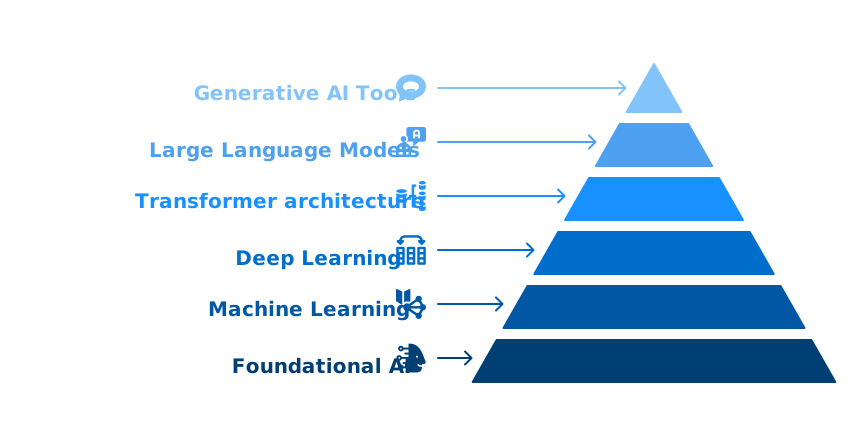
Machine Learning, Neural Networks, and Deep Learning
Machine learning is a branch of AI that represents a shift away from rule-based systems that follow hard-coded logic. Unlike those systems, machine learning models learn from data and identify patterns that would be almost impossible to define by hand.
The goal is to help make better decisions. These systems analyze past examples to classify items, make predictions, or flag patterns. As a result, machine learning is commonly used in areas where large volumes of data need to be evaluated consistently and at scale.
Some common uses you’ve probably seen in action include:
- filtering out spam emails,
- powering recommendation engines (like Netflix or Amazon),
- assessing credit risk, basic image recognition.
However, as machine learning problems became more complex, simpler models began to reach their limits. This is where neural networks come into the picture.
Neural networks sit right between classical machine learning and deep learning. They’re not a separate category of AI — but they play a critical structural role in how modern AI systems work. At a high level, a neural network is a model inspired by the human brain. It’s built from interconnected units (called neurons) that pass signals to each other, adjusting their connections based on data. Over time, the network learns which signals matter and which don’t.
Early machine learning models could handle relatively simple patterns. By contrast, neural networks expanded that capability. They made it possible to model more complex, non-linear relationships — things that are hard or impossible to express with traditional rules or simpler statistical methods. This is why neural networks became such an important stepping stone in AI development.
In practice, neural networks are used when the problem goes beyond clear-cut logic. For example:
- recognizing handwritten digits,
- identifying objects in images,
- detecting patterns in speech or audio,
- finding subtle correlations in large datasets.
That said, not all neural networks are “deep.” A model with one or two layers is still a neural network — but it doesn’t yet qualify as deep learning. That distinction matters.
Deep learning is essentially what happens when neural networks become much larger and more layered. Multiple stacked layers allow the system to learn increasingly abstract representations — from raw data at the bottom to high-level concepts at the top. So if machine learning is about learning from data, neural networks are one of the key ways that learning is implemented — and deep learning is what emerges when those networks scale up.
Understanding this layer helps explain why modern AI feels so powerful. It’s not magic, and it’s not sudden intelligence. It’s the result of neural network techniques being pushed to a scale that wasn’t possible before the correct data and hardware were available.
But there’s a catch: deep learning requires a lot of data and a lot of computing power to work well. Once those pieces came together in the 2010s, deep learning began driving some of the most significant breakthroughs in AI.
You’ll see it behind things like:
- speech and voice recognition,
- automatic language translation,
- how autonomous systems “see” and interpret the world around them.
What made deep learning a game-changer is that it enabled machines to work with unstructured data — such as images, audio, and natural language — at scale.
Transformer Architecture and Large Language Models
A significant turning point in AI occurred in 2017, when the transformer architecture was introduced.
This new approach completely changed how machines handle language.
Before transformers, neural networks processed text one word at a time, in order. Transformers introduced self-attention — a method that lets the model look at every word in a sentence at once and determine which ones matter most in context. That made large-scale language processing both faster and much more accurate.
Large Language Models (LLMs) are built on this architecture. They’re trained on vast amounts of text and optimized to predict what’s most likely to come next in a sentence or conversation.
Thanks to that, LLMs can:
- follow written instructions,
- generate full, coherent text,
- summarize long documents
- answer questions in natural-sounding language.
But here’s the key point: they don’t understand what they’re saying.
LLMs lack intent, awareness, or reasoning. Everything they produce is based solely on statistical patterns.
The output might sound thoughtful or even insightful — but it’s all just prediction.
ChatGPT, Claude, and Gemini are all examples of LLMs in action, accessible through user-facing tools.
Generative AI and Its Scope
Generative AI is a system designed to create new content — not just analyze what’s already there.
That’s a significant difference. While traditional machine learning focuses on tasks such as classifying data, making predictions, or optimizing outcomes, generative models generate entirely new outputs based on what they’ve learned.
They’re not limited to a single type of content. Generative AI appears across a variety of formats, including:
- text – with large language models like ChatGPT,
- images – through tools that generate visuals from prompts,
- audio – like voice synthesis or music generation,
- video – using models that create or edit moving visuals,
- code – via AI coding assistants that help write software.
Technically, generative AI isn’t a distinct branch of AI. It’s more of an application layer — built on top of deep learning and often powered by transformer-based models.
Because these tools are so interactive and easy to try, they’ve become the focal point of most conversations about AI.
But it’s worth remembering: generative AI is just one slice of a much larger and more diverse AI landscape.
The Conceptual Hierarchy of AI Technologies
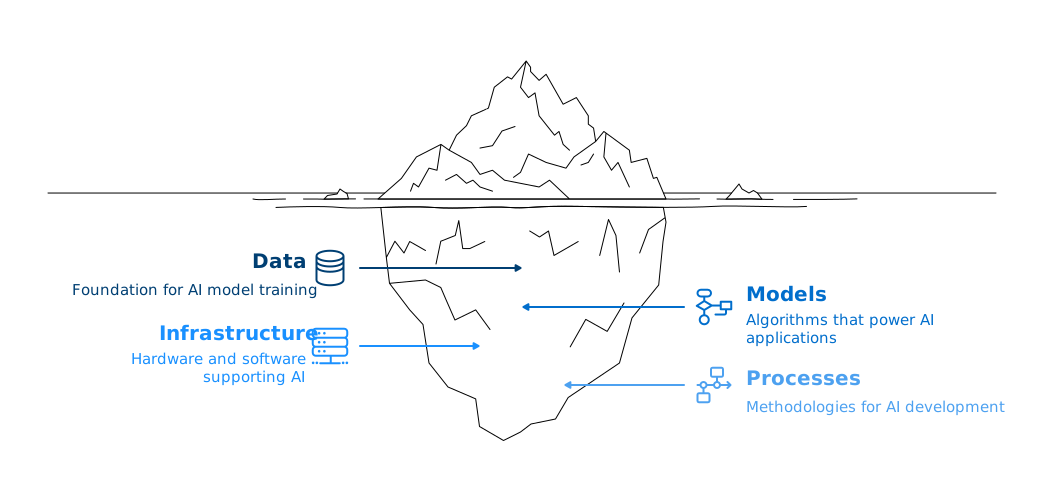
People often use AI-related terms interchangeably, but they actually refer to distinct layers within a larger system.
If you zoom out and look at it from broadest to most specific, here’s how the hierarchy breaks down:
- Artificial Intelligence – the top-level category that includes all systems performing tasks that involve human-like intelligence.
- Machine Learning – AI systems that learn from data rather than running on fixed rules.
- Deep Learning – a subset of machine learning that uses multi-layered neural networks to capture more complex patterns.
- Transformer Models – a specific deep learning architecture that’s especially good at processing language and sequences.
- Large Language Models (LLMs) – transformers trained on massive amounts of text data to predict and generate human-like language.
- Generative AI Applications – the tools built on top of LLMs (or other generative models), such as ChatGPT, that users interact with directly.
This layered structure helps explain why generative AI is getting so much attention — it sits at the center, where complexity, visibility, and usability converge.
Understanding how these pieces fit gives you a clearer picture of what AI can actually do — and helps avoid oversimplified conversations, especially when making technical or business decisions.
Why These Distinctions Matter
In everyday conversations, people often mix up AI terms — and while that’s fine in casual talk, it can cause real problems when it comes to tech and business decisions.
Different layers of AI do other things. A rule-based system, a machine learning model, and a large language model each have distinct needs — whether it’s data, infrastructure, cost, or risk. Treating them as the same often leads to mismatched expectations and, honestly, a lot of failed projects.
This matters even more in corporate settings. When leaders say they want to “bring in AI,” the real question isn’t whether they should — it’s which kind of AI actually fits the job. That choice affects everything from how hard it is to implement to how it’s governed to the long-term value it delivers.
The hype around generative AI has only added to the confusion. Because tools like ChatGPT are so visible and easy to try, many teams assume “AI” automatically means chatbots or content generators. But the truth is, many business problems are better solved with simpler, more focused tools.
Being clear about the differences helps everyone make more intelligent choices. It keeps strategy grounded in real business goals, not just trends or assumptions.
Key Takeaways
- ChatGPT is not “AI” itself, but a generative AI application built on large language models.
- Artificial Intelligence is a broad umbrella, covering many different systems — from rule-based logic to machine learning and deep learning.
- Machine Learning enables systems to learn from data, rather than relying on fixed rules.
- Neural networks and deep learning made it possible to handle complex, unstructured data like text, images, and audio.
- Transformer architectures revolutionized language processing and enabled modern large language models.
- Large Language Models predict text based on probability, not understanding, intent, or truth.
- Generative AI sits at the top of the AI stack, making it visible and accessible — but also easy to overestimate.
- Confusing AI layers leads to misaligned expectations, poor tool selection, and failed projects.
- Clear distinctions help organizations choose the right technology for the right problem, instead of following hype.
To Sum Things Up
AI has come a long way, evolving through distinct layers over time. From early rule-based systems to machine learning, deep learning, transformer models, and now generative applications — each step has pushed the boundaries of what machines can do.
Right now, generative AI is getting most of the spotlight because it’s visible, interactive, and easy to try. But in the grand scheme of AI, it’s just the innermost layer of a much larger, deeper structure.
For organizations, that perspective matters. Understanding the differences among various AI approaches helps set realistic expectations, match the right technology to the correct problems, and avoid costly missteps.
Looking ahead, AI will only become more complex — and more powerful. We’ll likely see more multimodal systems that can handle text, images, audio, and video at once.
But one thing won’t change: the need for clarity. It’s not just about whether AI is used — it’s about knowing what kind of AI and why.

Csaba Fekszi
Csaba Fekszi is an IT expert with more than two decades of experience in data engineering, system architecture, and AI-driven process optimization. His work focuses on designing scalable solutions that deliver measurable business value.
Related posts





Turning Ambition into Real, Scalable Results


Accuracy, Architectures, and the Real-World Factors That Still Limit Performance
