
AI Search as a Knowledge Access Layer
Turning Organizational Knowledge into Confident Decisions
- AI In Business
A familiar situation: A question comes in. Time is limited. The answer carries risk, responsibility, or financial impact.
There is no room for uncertainty — and no time to search through folders, documents, or email threads. What do you do in this case?
This is the moment where traditional search breaks down. What is needed is not more information, but a way to turn existing knowledge into a clear, reliable answer at the exact moment a decision must be made.
This is the role of AI Search. It transforms existing organizational information into decision-ready answers, supported by evidence and traceable to trusted sources. Rather than initiating a search process, AI Search provides a direct answer — grounded in context, not keywords.
In doing so, AI Search introduces a structural shift in how organizations access knowledge. The emphasis moves from results to answers, from keyword matching to meaning, and from isolated documents to assembled context. Knowledge no longer has to be pieced together manually; it becomes accessible, interpretable, and usable when it matters most.
AI Search Is Not Just a Better Search Bar
AI Search functions as an intelligent access layer to organizational knowledge. Its purpose is to turn existing information into clear, reliable answers exactly when a decision needs to be made.
Instead of forcing users to search through documents, AI Search:
- understands questions in natural language,
- analyzes relevant internal sources,
- delivers a direct answer,
- and clearly shows where that answer comes from.
The goal is not to retrieve information faster. The goal is to make knowledge immediately usable — without guesswork, interpretation, or loss of confidence.
Why Traditional Enterprise Search Fails Decision-Making
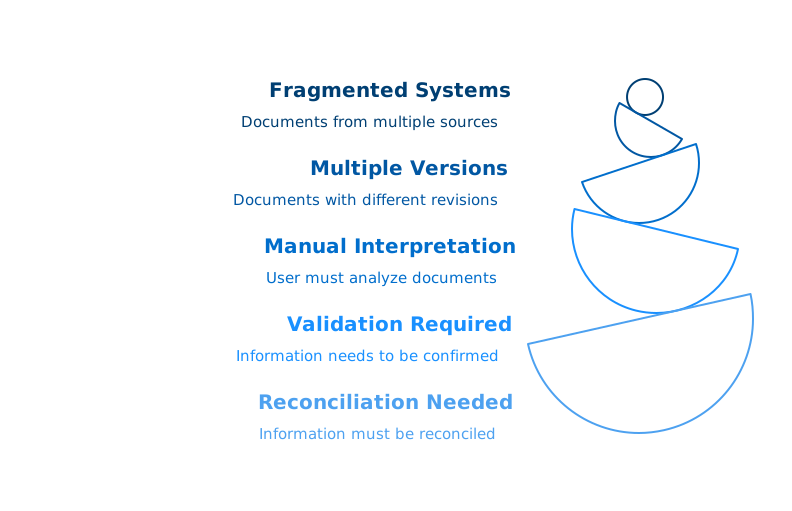
Traditional enterprise search systems were built around documents rather than decisions, leaving users to assemble meaning on their own when questions arise.
Information is scattered across systems. Documents are long, inconsistently structured, and often exist in multiple versions. Critical context lives outside systems, in people’s heads or in past conversations that were never properly captured.
As a result, users rarely receive a clear answer. Instead, they are presented with lists of documents they must interpret, validate, and reconcile independently.
This creates recurring problems:
- searching takes time and interrupts decision-making,
- results lack context and are hard to interpret,
- conflicting versions undermine confidence,
- responsibility remains with the individual, not the system.
The consequence is not just inefficiency. Over time, people stop trusting internal information and rely instead on assumptions, memory, or informal confirmation.
How AI Search Changes the Model Entirely
AI Search introduces a structural shift in how organizations access knowledge.
The emphasis moves from results to answers, from keywords to meaning, and from isolated documents to assembled context.
By delivering interpreted, context-aware responses grounded in approved internal sources, the system removes the burden of manual synthesis and makes knowledge directly actionable in real time. Instead of returning long lists of files, AI Search assembles meaning upfront.
Knowledge is no longer buried in folders. It becomes accessible, understandable, and actionable at the point of need.
Most importantly, AI Search restores confidence. Decisions are based on clear answers with visible sources — not on partial information or manual validation.
The Core Components of a Reliable AI Search System
A well-designed AI Search solution is built from tightly connected components that ensure answers are fast, reliable, and explainable.
1. Trusted Knowledge Sources
AI Search operates on approved internal content: documents, policies, past decisions, and records. It does not rely on the open internet or uncontrolled sources.
2. Meaning-Based Understanding
Instead of matching keywords, the system interprets intent, concepts, and relationships. Users can ask real questions — the way they would under time pressure.
3. An Interpreting AI Layer
The AI generates answers strictly from available internal knowledge. It does not invent information or speculate.
4. Clear Answers with Traceability
Every answer shows its sources: documents, sections, and references. This makes answers reviewable, defensible, and trustworthy.
5. Role-Aware Access
Users only see information they are authorized to access. Answers respect roles, context, and permissions without exposing sensitive content.
What AI Search Feels Like in Practice
A familiar situation: A question comes in. Time is limited. The answer carries risk, responsibility, or financial impact.
There is no room for uncertainty — and no time to search through folders, documents, or email threads.
AI Search does not initiate a search process. It provides a direct answer, supported by evidence.
Instead of asking, “Where might this information be?”, the user can focus on, “What does this mean for the decision I need to make?”
Decisions are no longer based on assumptions or partial knowledge. They are based on trusted organizational knowledge — available exactly when it matters.
Where AI Search Is Used in Practice
Across organizations, AI Search tends to appear in a small number of recurring usage patterns. These uses differ by function, but they share the same underlying requirement: fast, defensible access to organizational knowledge at decision time.
1. Risk and Governance Decision Support
AI Search is used to connect risk data, models, historical decisions, and documentation into a coherent narrative. It enables leaders to answer complex, cross-cutting questions under board, audit, or regulatory pressure — without manual consolidation.
2. Claims and Case-Based Decision Making
In insurance and similar environments, AI Search supports consistent, explainable decisions by surfacing relevant policies, precedents, and fraud indicators during case handling. The focus is speed with defensibility, not automation.
3. Customer and Contact Center Operations
AI Search provides agents with clear, consistent answers during live interactions, reducing hesitation, escalation, and inconsistency. Knowledge is delivered in context, aligned with policy and compliance requirements.
4. Investment and Research Decision Support
In asset management and research-heavy environments, AI Search connects historical analysis, assumptions, and governance context. This enables faster judgment, better reuse of insight, and clearer explanation of decisions under scrutiny.
These uses are not isolated scenarios. They represent different manifestations of the same capability: turning fragmented organizational knowledge into decision-ready answers.
What Defines a Strong AI Search Solution
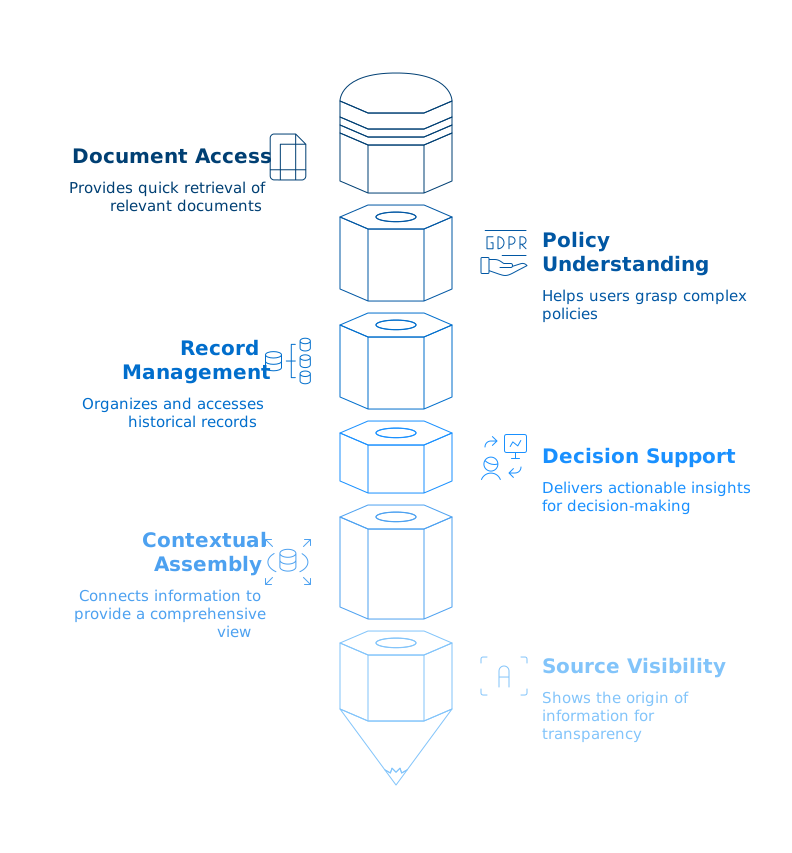
A successful AI Search system is defined less by its model and more by how reliably it supports real decisions.
Key characteristics include:
- meaning-based understanding,
- answer-first delivery,
- transparent source references,
- a shared organizational knowledge layer,
- fast response times,
- scalability as the organization grows.
These determine whether AI Search becomes trusted infrastructure — or just another tool people bypass.
Implementing AI Search Is an Organizational Decision
Implementing AI Search is not just a technology choice. It is an organizational one.
While the underlying AI matters, long-term success depends on how well the system is embedded into governance, content ownership, and daily workflows.
Key considerations include:
- source quality over model sophistication,
- version control and content freshness,
- consistent access control and governance,
- explainability as a trust builder,
- and the recognition that human judgment remains essential.
AI Search supports decisions. It does not replace accountability.
Organizations that treat AI Search as shared infrastructure, not a standalone tool, see sustained value.
Search Ends When the System Answers
AI Search functions as infrastructure rather than a standalone application, enabling organizations to use the knowledge they already possess.
The information exists. The documents are written. The experience and decisions are recorded. What has been missing is timely, reliable access.
AI Search closes this gap by turning scattered information into usable knowledge and uncertainty into confidence — supporting human judgment with clarity and evidence.
The knowledge was never the problem. Access was.

Csaba Fekszi
Csaba Fekszi is an IT expert with more than two decades of experience in data engineering, system architecture, and AI-driven process optimization. His work focuses on designing scalable solutions that deliver measurable business value.