
The Key Steps to a Successful AI Implementation
Turning Ambition into Real, Scalable Results
- AI In Business
AI promises efficiency, deeper insights, and new opportunities. But for many companies, that potential is still just out of reach. Based on our experience at Omnit with implementing AI modules and managing AI-focused projects, we know that turning goals into tangible results takes more than just vision.
This guide walks you through the practical steps every organization needs to take, not just to explore AI, but to prepare for it, test it effectively, and scale it with impact.
What You Will Learn
- How to move from AI ambition to real, measurable business results
- The key steps of a successful AI implementation, from strategy to scale
- How to define clear, business-driven AI goals (without chasing hype)
- Why understanding your processes and data is critical before automation
- How to identify high-value AI use cases that actually make a difference
- The right way to pilot, measure, and scale AI solutions
- How to integrate AI into daily operations — not as a side project, but as a capability
- Why AI implementation is a continuous improvement journey, not a one-time task
By the end, you’ll know what to do, what to avoid, and how to build AI initiatives that deliver lasting impact.
The goal isn’t to turn you into an AI researcher, data scientist, or buzzword collector. And no — you won’t be expected to train neural networks at 2 a.m.
The goal is to give you just enough practical understanding to approach AI implementation confidently, ask the right questions, make informed decisions, and avoid expensive “AI-for-the-sake-of-AI” projects.
Think of this guide as your AI implementation common sense — so you can move forward thoughtfully, realistically, and with results you can actually measure.
The Key Steps of a Successful AI Implementation
Define Clear Business Goals
Every successful AI project starts with one thing: a clear, specific goal. Not “let’s do AI,” but something concrete — cutting costs, speeding up a process, handling more volume, reducing errors, or improving customer experience.
To define a clear business goal, a leadership workshop, for example, helps align everyone. Teams discuss what truly matters to the business, while technology experts outline what’s realistically achievable — whether through off-the-shelf cloud tools or custom development.
It is crucial always to remember that AI advances rapidly. What was cutting-edge a few months ago might already be outdated. Setting clear goals — and assigning ownership — keeps your strategy focused on business value, not hype.
Map and Understand Your Processes
Before choosing tools or solutions for your project, take time to understand how processes truly work — not just how they are documented to work.
Conversations, interviews, group workshops, and process documentation reviews help create an accurate “as-is” map. Once workflows are clear, bottlenecks and inefficiencies become apparent.
Identify areas of friction:
- Where do tasks experience slowdowns?
- Which steps depend heavily on manual effort?
- Where do mistakes occur or customers get frustrated?
- What steps increase costs without providing value?
Mapping your areas of friction reveals where AI can genuinely have an impact — and which areas of the business are prepared for automation.
Assess Your Data Foundations
AI’s intelligence depends on the quality of its data. If the data is messy, incomplete, or unreliable, then the results will be affected.
Before building any model or automation, review how the organization collects and manages data. Check ERP systems, MES platforms, spreadsheets, sensors, machine logs, web analytics, and customer service reports. Find out what’s missing and how easily accessible the data really is.
Ask three essential questions:
- Is the data clean and structured?
- Is it available in real time?
- Does it capture the whole process, or are there blind spots?
If gaps appear, update your measurement tools — add IoT sensors, cameras, or production-level data collection. The goal isn’t more data, but better, consistent data that AI can use effectively.
Reliable data connects current operations with future AI potential.
Review Your Technology and Capabilities
Without the proper tech setup, even the best AI ideas fall short. A great concept won’t succeed without adequate infrastructure.
Begin with a complete inventory of your digital environment: ERP systems, CAD/CAM platforms, production and warehouse management software, business tools, and document systems.
Then pose the critical questions:
- Do these systems communicate well?
- Are machines connected to central systems via IoT or other integrations?
- Is the infrastructure cloud-based, hybrid, or on-premises — and can it scale?
Technology is only part of the story. People matter just as much. Assess whether teams feel confident using digital tools and understand how automation fits into their daily work. Adopting AI requires a mindset shift, not just a system upgrade.
A clear understanding of your tech stack and your team’s digital fluency reveals where to focus investments next — and ensures AI integrates seamlessly into business operations, not as an add-on.
Identify Where AI Can Add Real Value
Once processes and data are mapped, the next logical question is straightforward: where can AI make a measurable impact?
Watch for signs of opportunity:
- Repetitive, rule-based tasks suitable for automation.
- Large data or image sets are ideal for machine learning pattern detection.
- High error or defect rates that trigger predictive quality control.
- Heavy administrative or documentation tasks are well-suited for NLP tools.
- Costly machine downtime that predictive maintenance can prevent.
Determine which processes can be supported by AI (with humans leading) and which could be fully autonomous (with systems taking over). Match each use case to the appropriate solution — either a plug-and-play service or a custom model.
Consider legal and governance requirements early. Building AI correctly the first time helps avoid compliance issues later.
The priority is clear: concentrate on the areas where AI genuinely makes a difference, not on trendy use cases.
Set the Right Priorities
Not every AI idea warrants immediate focus. The main point is to prioritize high-value, low-complexity initiatives first.
Create a value – cost matrix to evaluate potential projects. Plot them based on expected benefit and effort needed. This highlights quick wins and helps determine which initiatives should go on a longer-term roadmap.
Define time horizons.
- Short-term (3–6 months): quick, low-risk pilots with measurable results.
- Midterm (6–18 months): bigger projects that expand on initial successes.
- Long-term (18+ months): transformational work that reshapes the business.
Pick two or three realistic pilots — such as automated quoting, camera-based quality control, or predictive maintenance for key equipment. Focus keeps your AI strategy credible and value-driven.
Launch Pilot Projects
Once priorities are established, it’s time to test ideas in action.
Start small. Focus on learning rather than perfection. Each pilot should replicate a real-world process on a limited scale — such as one shift, one line, or one department.
Track outcomes like:
- hours saved through reduced manual work,
- fewer defects or process errors,
- faster cycle times or higher output.
The purpose of a pilot is to prove: that the use case works, adds value, and aligns with how people already work.
Share your findings — both successes and failures. Record lessons learned and share them with teams. Early wins help build trust and gain momentum for wider use.
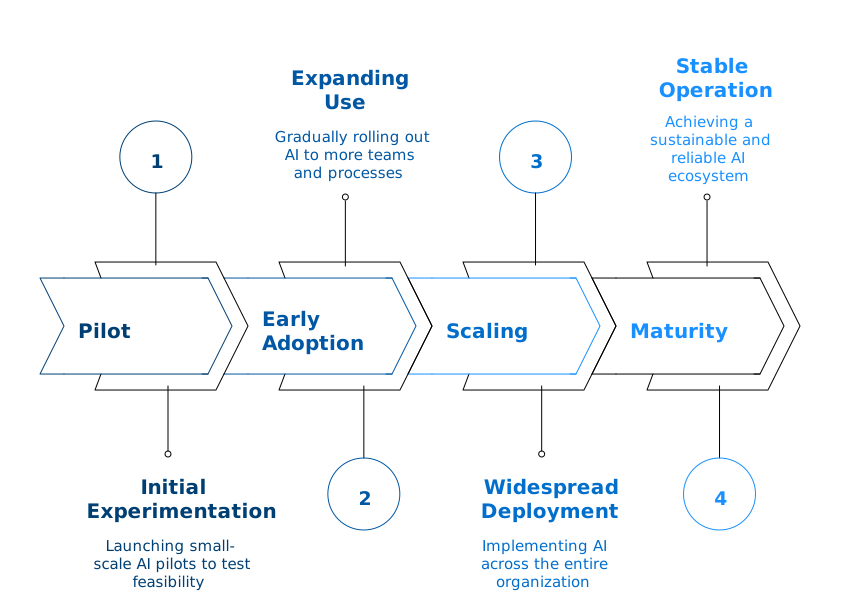
Scale and Integrate
A successful pilot is just the start. The true impact happens when you transform isolated success into a company-wide, integrated capability.
Begin by expanding what was successful: deploy the solution to additional machines, shifts, or locations. Standardize procedures and connect the solution with essential systems like ERP or MES so AI becomes integrated into daily workflows.
Then the next step should be to focus on people. Train your employees, gather feedback, and continually refine the process.
Scaling should be gradual and measured — fast enough to maintain momentum, slow enough to preserve stability. When AI is fully integrated, it ceases to be just a project and becomes part of how the organization thinks and functions.
Keep Improving — AI Implementation Is Never Finished
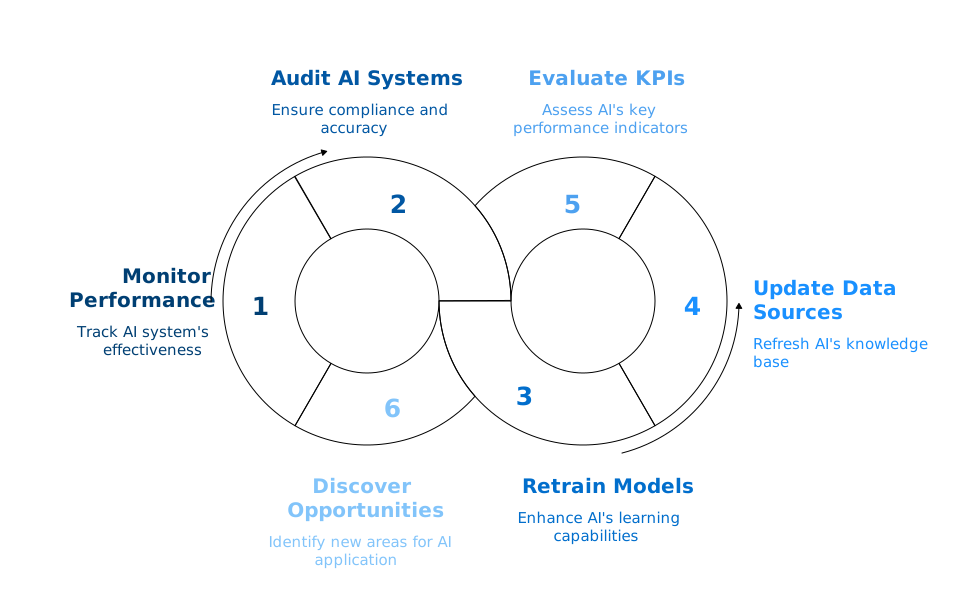
Implementation isn’t the finish line — it’s the beginning of a continuous cycle of learning and improvement.
AI systems need maintenance and updates as the business changes. Plan regular audits, retrain models, and refresh data sources — monitor KPIs like cost savings, productivity improvements, and error reduction.
Each iteration enhances performance and uncovers new opportunities: improved forecasting, quicker decisions, and emerging use cases.
Companies successful with AI integrate this discipline into their culture. Continuous improvement becomes part of their core identity.
Key Takeaways of the Article
- Start with clarity, not technology — align goals with business needs.
- Map processes before automating them.
- Build on reliable, accessible data.
- Assess both systems and skills before implementation.
- Choose high-value use cases where AI adds measurable results.
- Pilot, measure, and learn before scaling.
- Integrate gradually and support people through training.
- Treat AI as an ongoing journey of evolution and improvement.
The Final Word
Real success relies on clear goals, accurate data, engaged teams, and a commitment to continuous learning.
Think of AI not just as a single project, but as a journey. Each mapped workflow, pilot, and refined model moves your organization closer to being faster, more innovative, and more resilient.
If you are interested in the subject in more depth, or need a company that can lead you through an implementation like this, one that can provide you with custom AI modules, feel free to contact us.

Csaba Fekszi
Csaba Fekszi is an IT expert with more than two decades of experience in data engineering, system architecture, and AI-driven process optimization. His work focuses on designing scalable solutions that deliver measurable business value.
Related posts