
AI Data Privacy Risks
What Enterprise Leaders Need to Understand Before Scaling
- AI In Business
From our experience at Omnit, we know that for companies, AI data security isn’t just a back-end concern. It’s a governance issue — one that affects compliance, trust, and the ability to keep the business running. Decisions about where data is processed, how long it’s kept, and whether it can be pulled or reused from a model carry profound legal and financial implications.
AI systems are already in use at data companies that have spent years locking down sensitive data, including customer information, financial records, legal documents, and internal know-how. But the most significant risk is not that AI might make a mistake. It’s that sensitive data could quietly slip out of the organization without anyone realizing it.
This article examines where data privacy issues arise in AI systems, how cloud-based models can exacerbate them, and the specific controls companies need in place before scaling up their AI use.
What You Will Learn
If You’re Reading This Article, You’ll Learn:
- Why AI data privacy is a governance issue, not just a technical one
- Where data privacy and security risks typically arise in AI systems
- How cloud-based and multi-tenant AI models can increase exposure
- What prompt leakage, output leakage, and unintended model training really mean in practice
- How RAG systems expand both AI capabilities and security risks
- The most common attack vectors against AI systems, including prompt injection and jailbreaks
- What enterprises need to verify before trusting an AI provider with sensitive data
- How private, on-premise, and hybrid AI setups can reduce risk
- The technical and organizational safeguards required before scaling AI safely
By the end of this article, you’ll understand how AI data can quietly escape — and what leaders need to do to stop it.
The goal isn’t to make you afraid of AI. And it’s definitely not to convince you to unplug everything and go back to spreadsheets.
The goal is to help you see where control can slip— often without anyone noticing — and how to keep AI working for your business instead of quietly leaking its most valuable data.
Think of this article as your AI security radar: not to slow innovation, but to make sure you know exactly where your data is, who can access it, and what your AI systems are allowed to do with it — before you scale and before something goes wrong.
Why Data Security Matters So Much in AI Systems
When it comes to security, everything changes once AI enters the picture. AI systems are actively working with data, processing, reshaping, and combining it in new ways.
In traditional IT setups, sensitive data typically remains in databases, with access tightly managed. But in AI workflows, that same data is often sent out as input, processed temporarily by external tools, and used to generate outputs. Each of those steps is a moment when control can slip.
The risk increases significantly when AI systems handle sensitive inputs such as personal or legally protected data, confidential business information, or internal files that were never intended to leave the company.
When you bring in cloud-based AI, those risks multiply. Data might move through external infrastructure, be logged for performance reasons, or even fall under laws from another country. And in shared environments where many organizations use the same models, the likelihood of data leaks or cross-over increases even further.
This is why AI data security can’t be left to IT alone. It affects compliance, legal agreements, and a company’s ability to demonstrate it remains in control of its data.
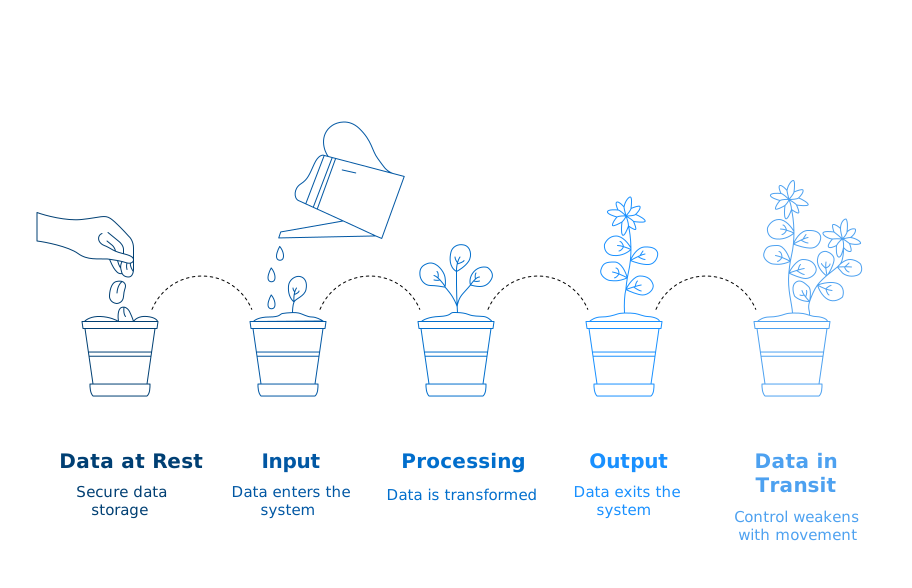
Core Data Privacy and Security Risks in AI Systems
AI-related data risks rarely announce themselves. They tend to emerge gradually, woven into everyday workflows and routine use, where existing security practices aren’t always designed to detect them.
In the next section, we explore how managing these risks begins with understanding where exposure typically enters the system.
Input-Level Data Leakage (Prompt Leakage)
It’s become common for employees to drop sensitive information directly into AI prompts without a second thought. This can include:
- personal data,
- financial records,
- legal or HR docs,
- source code,
- customer details.
From a security standpoint, this is a significant concern: once data is entered, it may be logged, stored temporarily, or processed in ways the company cannot fully monitor or control. While this may seem harmless at first, the risk of exposure is very real.
Data Flow to External AI Providers
When companies use cloud-based AI, their data no longer stays confined to internal systems and may move through a provider’s infrastructure, be stored temporarily, appear in audit or debugging logs, or even end up in a different legal jurisdiction.
This raises critical but often unanswered questions for business leaders: where the data is processed, what portions are retained, who can access that residual data, and when — and how — it is ultimately deleted.
Without clear answers, compliance becomes highly uncertain.
Unintended Inclusion in Model Training
If an AI provider does not clearly rule out using user data for training or fine-tuning, company information can quickly become embedded in the model itself and, in rare but severe cases, be reproduced through its outputs.
From a risk management perspective, this is unacceptable since it directly violates core data protection principles, including purpose limitation and strict confidentiality.
Output-Level Data Leakage
Sometimes, large language models give back more than you’d expect — or want. That might include:
- answers that are way too detailed,
- content that echoes past inputs,
- info that seems pulled from some memory-like behavior.
The risk increases in shared, multi-tenant environments — where keeping data isolated is crucial but not always foolproof.
Attack Vectors and System-Level Risks
Not all AI data security issues stem from mistakes. Some of the most dangerous ones are intentionally driven by people trying to manipulate the system.
These attacks exploit a core trait of AI models: they’re built to follow instructions — even when those instructions violate their own safety rules.
Prompt Injection and Jailbreak Attacks
Prompt injection focuses on tricking the model into performing actions it’s not supposed to take. Attackers use a range of techniques, from blunt commands like “ignore previous rules” to sneaky instructions buried in documents or web pages. Other methods include attempts to sidestep internal policy checks or to access other users’ data in shared systems.
For companies using internal knowledge bases or RAG setups, this represents a serious vulnerability. A single well-crafted prompt can cause a model to disclose information it was never intended to access. Because traditional security tools often fail to detect this behavior, mitigating the risk requires AI-specific defenses rather than conventional controls.
RAG Systems: Expanded Access, Expanded Risk
Retrieval-Augmented Generation (RAG) enables AI to draw on internal documents to generate answers, which is why we advise treating this kind of access as a high-level privilege. Without strong safeguards in place, RAG setups can inadvertently leak documents a user shouldn’t be able to view, sensitive content pulled from small chunks, confidential files that slip into responses, or restricted material fetched because of poor indexing.
Basically, the more the system can “see,” the more it might unintentionally — or intentionally — reveal.
Multi-Tenant Model Isolation Risks
In cloud setups, it’s common for different organizations to use the same core AI models. It’s worth noting that a shared foundation introduces additional risks, including access boundaries that aren’t correctly configured, metadata leaking between tenants, weak or missing sandbox protections, and false assumptions about how well things are actually isolated.
Enterprises can’t assume isolation is in place — they need to verify it actively.
How Enterprises Can Mitigate AI Data Security Risks
AI-related data risks aren’t something your company has to accept. They usually arise because key decisions weren’t made, responsibilities weren’t clear, or protections weren’t robust enough.
You can treat AI as a system to be governed — rather than merely a tool to plug in — and it can significantly reduce risk without putting the brakes on innovation.
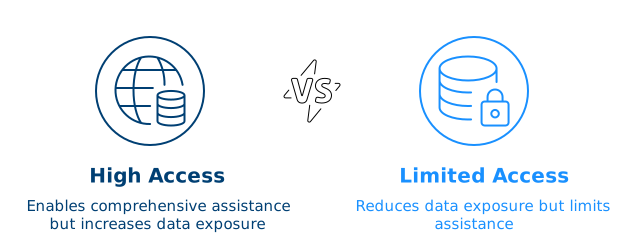
Choose the Right AI Service Provider
Not every AI provider handles data the same way — and when it comes to enterprise use, that matters far more than how well the model performs.
Things to look for:
- explicit promises that your data won’t be used for training,
- little to no long-term storage of prompts or responses,
- flexible data residency, like EU-based processing options,
- strong access controls, detailed logging, and audit support,
- third-party compliance certifications.
Most consumer-level AI tools lack these safeguards. That’s why they’re not suitable for handling sensitive corporate data.
Private and On-Premise AI as a Strategic Alternative
For organizations with strict compliance, data location, or confidentiality rules, running AI in a private environment is often the most secure option.
This setup guarantees that data stays entirely within the company’s infrastructure, that access and permissions remain under your control, that audit trails and compliance checks can be enforced effectively, and that both fine-tuning and RAG take place entirely on internal systems.
You’ll see this approach frequently in banking, government, healthcare, and other highly regulated industries.
Technical and Organizational Safeguards
Tech alone isn’t enough to keep AI secure. Absolute protection for your company comes from combining strong technical controls with clear internal policies.
Here’s what that can look like:
- Data Loss Prevention (DLP) before AI input: Sensitive information is automatically flagged and blocked before it ever reaches the model.
- Role-based prompting and zero-trust AI: Users have access only to the data they’re cleared to see — and the AI’s responses are limited to match those permissions.
- Prompt and output auditing: Every prompt and reply can be logged, showing who accessed what and when for full accountability.
- Secure RAG architectures: Think document-level permissions, chunk-level controls, output filtering, and encryption for databases and embeddings.
- Anonymization and pseudonymization: Where appropriate, models should use tokens or fake identifiers instead of real user or business data.
Key Takeaways
- AI data privacy is a governance issue, not just a technical one.Leadership decisions around AI directly affect compliance, trust, and operational risk.
- AI creates new data exposure points across input, processing, and output.Sensitive information can leak quietly if controls aren’t designed for AI workflows.
- Cloud and multi-tenant AI models increase privacy and control risks.Data residency, retention, and isolation must be verified — not assumed.
- RAG and advanced AI capabilities expand both value and attack surface.Without strong permissions and filtering, internal data can be exposed unintentionally.
- Traditional security tools are not enough for AI systems.Prompt injection, jailbreaks, and misuse require AI-specific safeguards.
- Enterprises that combine strong governance with technical controls can scale AI safely.Visibility, accountability, and clear ownership are the foundations of secure AI adoption.
Why This All Matters for Your Company
You are right to be concerned — about leaks of sensitive data, compliance violations, or critical internal knowledge ending up in places no one can trace or explain. These are real risks.
To recapitulate our article, AI systems handle data in ways traditional governance frameworks weren’t designed to handle.
Without proper safeguards, organizations face serious consequences, including:
- violating GDPR or industry-specific regulations,
- exposing confidential business info,
- being unable to prove how the data was handled,
- reputational fallout when something goes wrong, and no one can explain it,
- losing trust with customers and partners.
The most considerable risk with AI is the lack of visibility.
If your company can’t account for where data went, who saw it, or what the model did with it, it’s not truly in control, even if nothing bad has occurred yet.
That’s why we at Omnit advise that AI data security needs to be addressed at the leadership level since it is a governance issue.
The key point is that companies that put strong policies, technical safeguards, and real accountability in place can scale AI with confidence.
Those that don’t? They’ll eventually scramble to clean up under pressure.

Lajos Fehér
Lajos Fehér is an IT expert with nearly 30 years of experience in database development, particularly Oracle-based systems, as well as in data migration projects and the design of systems requiring high availability and scalability. In recent years, his work has expanded to include AI-based solutions, with a focus on building systems that deliver measurable business value.