What are Deepfakes
And Why the Problem surrounding them is Often Misunderstood
- AI Digest
A video in which a well-known executive appears to say something they never actually said. A photo that places someone in a situation that never happened.
In the past, these manipulations were relatively easy to detect or required substantial technical expertise to produce convincingly. As a result, their impact was often limited.
Today, deepfake content has rapidly emerged as one of the main threats to digital trust.
This article looks at why deepfakes have become a growing regulatory concern and what makes them particularly difficult to address with existing legal tools.
What Deepfake Technology Means
The term deepfake refers to AI-generated or AI-manipulated images, videos, or audio recordings that depict real people in situations that did not occur.
Technically speaking, these systems do not introduce an entirely new category of manipulation. Digital editing has existed for a long time.
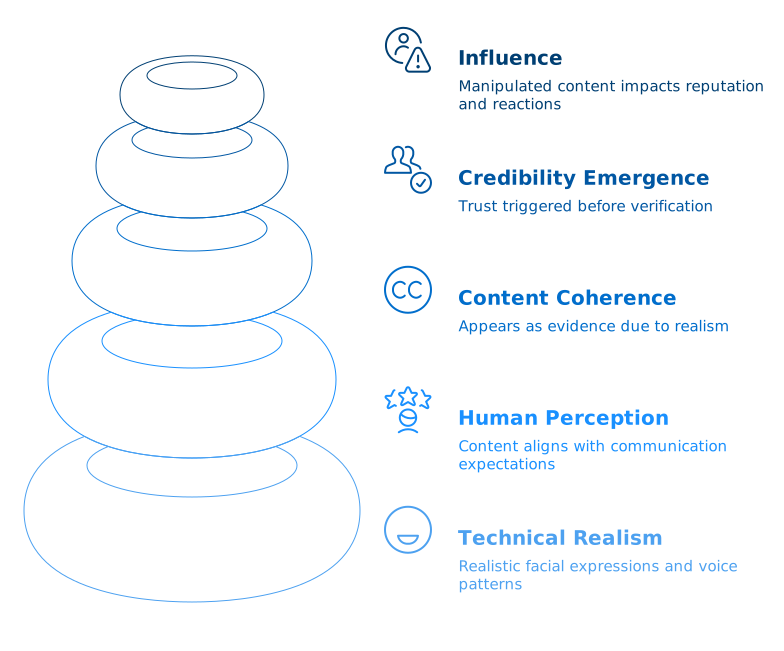
The difference lies in coherence and realism.
Deepfake systems can replicate facial expressions, voice patterns, and movements in ways that closely match how people naturally communicate. When these elements align, the result often feels convincing even when viewers know it may not be authentic.
This perceptual effect is what makes deepfakes particularly powerful—and particularly problematic.
Why Deepfakes Can Cause Disproportionate Harm
The damage caused by deepfakes rarely depends on the content’s technical sophistication. In many cases, even a relatively simple manipulation can have serious consequences. The real impact comes from context and credibility.
When a manipulated image or video appears realistic, people tend to treat it as evidence. Even a single piece of content can therefore:
- damage someone’s professional or personal reputation,
- violate privacy or personality rights,
- trigger political or social tension,
- cause long-term psychological or financial harm.
One particularly harmful category involves non-consensual intimate deepfakes. In these cases, a person’s face is inserted into explicit content without their consent.
The victims usually have little control over how the material spreads. By the time legal action or platform moderation takes effect, the content may already have been widely shared.
This highlights a structural challenge: reactive responses often come too late.
Once credibility has been undermined or reputational damage has occurred, removing the content cannot fully undo the harm.
Why Deepfakes Are Difficult to Regulate
Regulating deepfakes is challenging because the issue spans multiple legal fields. It sits at the intersection of several areas of law, including:
- data protection,
- personality and privacy rights,
- criminal law,
- platform regulation,
- and, in some cases, freedom of expression.
Each of these areas approaches the problem from a different perspective. That makes it harder to create clear and consistent rules.
Deepfakes also introduce practical enforcement challenges:
- They can be produced quickly, often with widely available tools.
- They can spread across multiple platforms within minutes.
- And they frequently cross national borders, making jurisdiction unclear.
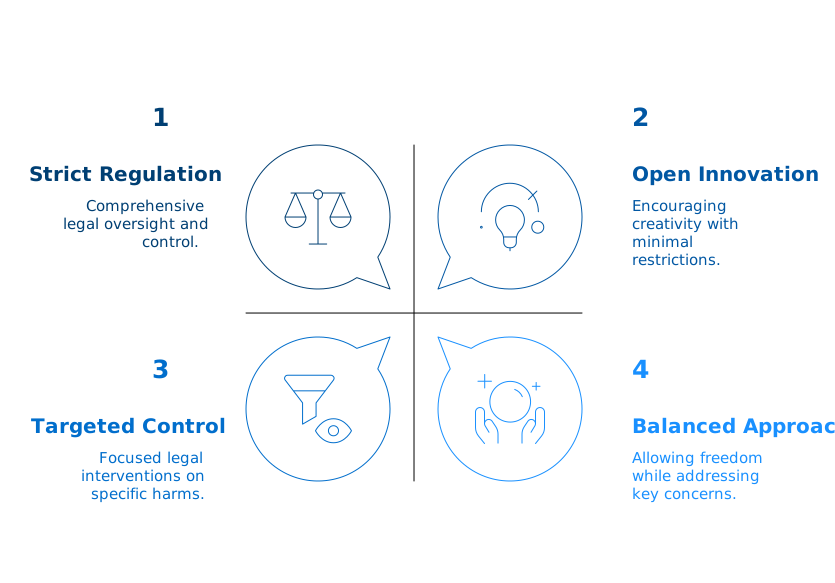
If the regulation is too weak, victims have little protection. If it is too broad, it risks restricting legitimate expression, satire, or creative uses of AI.
For this reason, many governments initially approached the issue cautiously. The risk was obvious, but defining proportionate legal responses proved much more complicated than it first appeared.
What Types of Solutions Are Emerging
Recent policy discussions suggest that no single legal tool will solve the deepfake problem. Instead, regulators are moving toward a combination of approaches.
Three directions are becoming increasingly visible.
Criminalization in specific cases
Some countries have started to criminalize certain types of deepfake content.
The focus is usually on non-consensual intimate deepfakes or cases where someone’s identity is used in a way that causes clear personal harm. In these situations, the act of creating the content itself may be considered illegal, not only its distribution.
This approach treats deepfakes primarily as a form of abuse or rights violation, rather than a purely technological issue.
Platform responsibility and prevention
Another emerging approach focuses on the role of platforms and AI developers.
Instead of reacting only after harmful content appears, regulators are increasingly asking whether risks were predictable and preventable. This may include expectations such as:
- stronger moderation systems,
- faster removal mechanisms,
- safeguards in generative AI tools,
- clearer accountability for platforms that host manipulated content.
The emphasis shifts from individual pieces of content to the design and management of digital systems.
Transparency and labeling of AI-generated content
A third direction involves making synthetic media identifiable.
Some proposals require AI-generated content to be labeled, watermarked, or technically traceable. The idea is not necessarily to ban synthetic media, but to ensure that audiences can recognize when content has been artificially generated.
This approach aims to protect trust in digital information without restricting legitimate uses of AI in media, entertainment, or communication.
Taken together, these measures reflect a broader realization: Deepfakes are not only a content problem, but a systemic one.
The question is therefore not just how to punish misuse, but how to design technological and regulatory environments that reduce the risk in the first place.
KeyBusiness Takeaways
Deepfakes are not entirely new forms of digital manipulation, but their realism and accessibility significantly amplify their impact on trust and credibility.
The harm caused by deepfakes depends more on credibility and context than on technical sophistication. Even simple manipulations can have serious reputational or social consequences.
Reactive responses are often too late. Once manipulated content spreads and credibility is undermined, removing the material rarely reverses the damage.
Regulation is inherently complex. Deepfakes sit at the intersection of privacy law, criminal law, platform governance, and freedom of expression.
No single solution is sufficient. Emerging responses combine targeted criminalization, stronger platform responsibility, and transparency requirements for AI-generated content.
Ultimately, the deepfake debate is about maintaining trust in digital information as synthetic media becomes increasingly realistic and easy to produce.
Closing Thought — What This Shift Signals
The recent legal steps around deepfakes are not isolated reactions. They reflect a broader shift in regulators’ thinking about AI.
For a long time, digital technologies were treated primarily as neutral tools. Responsibility was placed almost entirely on the user who misused them.
That assumption is starting to change.
Regulators are increasingly asking different questions:
- What risks were foreseeable?
- How were systems designed?
- And who should be responsible for preventing predictable harm?
Seen from this perspective, the debate around deepfakes is not only about synthetic media.
It is about something more fundamental: how societies adapt their legal and institutional frameworks to technologies that can convincingly imitate reality.
Deepfakes simply make this challenge visible.
The real issue is learning how to maintain trust, accountability, and credibility in an environment where the line between authentic and artificial content is becoming increasingly difficult to detect.

Csaba Fekszi
Csaba Fekszi is an IT expert with more than two decades of experience in data engineering, system architecture, and AI-driven process optimization. His work focuses on designing scalable solutions that deliver measurable business value.