
When Activity Recognition Meets Reality
What an Early Video Analysis Pilot Revealed About Operational Insight
- AI Business Use Case
In many operational settings, companies track results — but they have limited insight into how those results are achieved.
Manual activities, small process variations, and human interactions often remain invisible in traditional data systems, yet these micro-level actions can strongly influence operational performance.
This case study explores an early-stage pilot that tested whether AI-based video analysis could help make manual activities observable.
The Starting Point: Making Manual Work Visible
In many operational settings, a large share of work still happens through manual activities. Operators move between tasks, interact with equipment, and make small adjustments based on experience. While these actions are essential to the process, they rarely appear in traditional operational data systems.
Most companies can measure outputs — production volumes, cycle times, or machine performance — but the human actions behind these outcomes often remain unobserved. As a result, organizations may struggle to understand where inefficiencies originate, how workflows actually unfold in practice, or which activities consume the most time.
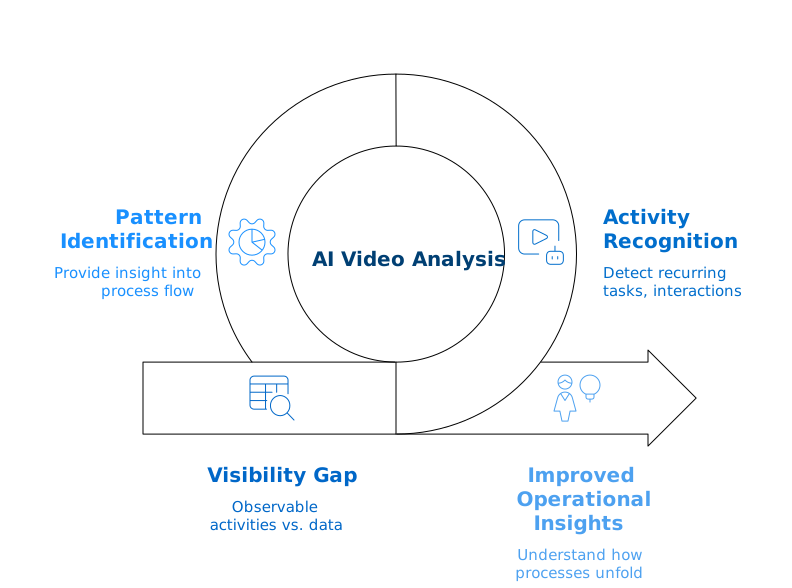
Recent advances in computer vision and machine learning suggest a possible way to bridge this gap. If video data can be analyzed reliably, it could help identify patterns of activity, detect repeated workflows, and provide a more detailed picture of how processes operate on the ground.
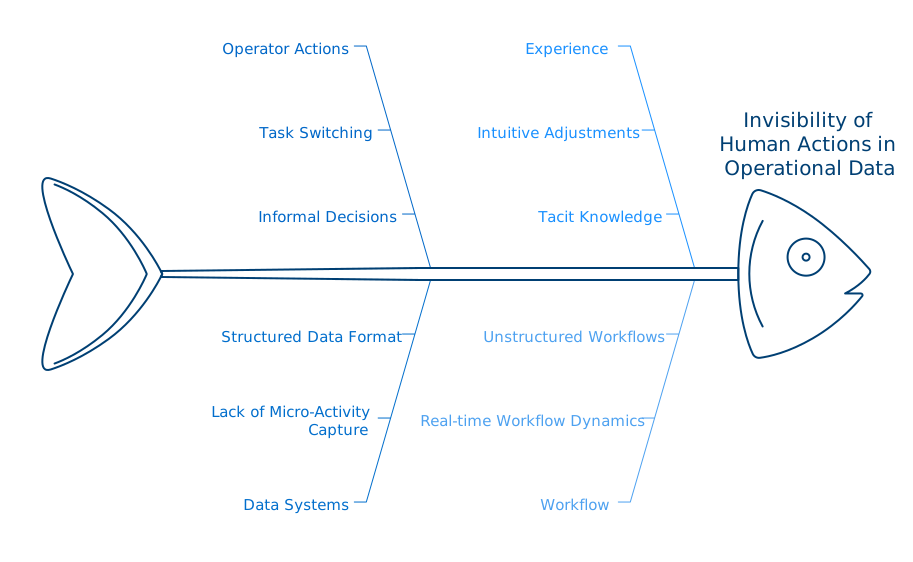
The pilot project explored whether AI-based activity recognition could contribute to this kind of operational visibility. Instead of focusing on theoretical capabilities, the goal was to test the technology in a realistic environment and evaluate the level of insight that can actually be extracted from video data.
The Pilot Setup: Testing Activity Recognition in Practice
To explore the potential of AI-based activity recognition, a pilot project was conducted using recorded video footage from an operational environment. The goal was to evaluate whether machine learning models could reliably identify and differentiate between distinct human activities captured in the footage.
The system analyzed video frames to detect visual patterns associated with specific actions. These patterns included movements, interactions with objects, and spatial relationships within the environment. By learning from labeled examples, the model attempted to recognize when particular activities occurred during the recorded workflow.
Rather than focusing on perfect automation, the pilot aimed to understand how reliably these activities could be detected under real-world conditions. This included evaluating how factors such as camera angles, environmental complexity, and overlapping movements influence recognition performance.
The experimental setup, therefore, served two purposes:
- testing the technical feasibility of activity recognition,
- and assessing how useful the resulting insights might be for operational analysis.
What the Pilot Revealed: Key Observations
The pilot provided a practical view of how activity recognition performs on real operational footage. Rather than producing a simple yes-or-no answer about feasibility, the experiment revealed several patterns that help clarify when the technology can deliver meaningful insights.
One important observation was that activity recognition performs best when actions are clearly distinguishable in the visual environment. Tasks involving distinct movements or interactions with specific objects were easier for the model to identify. In contrast, activities with subtle differences or overlapping movements proved more challenging to separate reliably.
Environmental factors also played a significant role. Camera positioning, lighting conditions, and the complexity of the surrounding workspace all influenced recognition performance. Small variations in these factors could significantly affect how consistently the system detects activities.
At the same time, the pilot demonstrated that even partial recognition can provide useful information. Identifying recurring patterns of activity — such as frequently repeated tasks or typical workflow sequences — can already contribute to a better understanding of operational processes.
Taken together, the results suggest that AI-based video analysis can support operational insight, particularly in environments where activities are visually distinct and consistently performed. In such settings, activity recognition may help reveal patterns that would otherwise remain difficult to observe through traditional data sources.
Key Takeaways for Organizations
The pilot results suggest that AI-based video analysis can provide valuable operational insight — but its effectiveness depends strongly on the specific context in which it is applied.
- One key takeaway is that activity recognition performs best in environments where workflows are structured and visually consistent. When tasks follow clear sequences and involve distinguishable movements or interactions, the technology can more reliably identify patterns in the recorded footage.
- Organizations should therefore view video-based activity recognition less as a universal solution and more as a targeted analytical tool. Its value is particularly evident in settings where manual processes play a critical role yet remain difficult to measure with conventional data sources.
- Another important consideration is the role of the environmental setup. Camera placement, lighting conditions, and the level of activity overlap can significantly influence recognition performance. Careful planning of the observation environment can therefore improve the quality of the insights generated by the system.
- Finally, the pilot highlights that the most meaningful outcomes often come not from perfectly detecting every action, but from revealing broader patterns of work. Even partial visibility into recurring activities can help organizations better understand how processes unfold in practice and where opportunities for improvement may exist.
Conclusion: Understanding Where Video-Based AI Creates Value
AI-based video analysis can make manual activities more visible and help organizations better understand how work unfolds in practice.
The pilot shows that its value depends strongly on context: when activities are visually distinct and the environment is well configured, activity recognition can reveal meaningful operational patterns.
Rather than aiming for perfect detection everywhere, organizations can gain the most value by applying the technology selectively — in situations where even partial visibility into workflows can support better operational decisions.

Lajos Fehér
Lajos Fehér is an IT expert with nearly 30 years of experience in database development, particularly Oracle-based systems, as well as in data migration projects and the design of systems requiring high availability and scalability. In recent years, his work has expanded to include AI-based solutions, with a focus on building systems that deliver measurable business value.
Related posts

A Business Use Case of Visual Verification in Operational Monitoring

Why So Many AI Projects Stall — and How to Finally Move Beyond the Pilot Phase