
From Observation to Operational Evidence
A Business Use Case of Visual Verification in Operational Monitoring
- AI Business Use Case
When operational decisions rely on reported data, reality can quietly drift out of sight. In environments where physical processes run continuously, even small gaps between records and reality can accumulate into systemic blind spots.
This business use case examines how visual verification can make everyday operations a reliable source of evidence without disrupting existing workflows.
The Situation
The organization operated complex material-handling processes, supported by conveyor belts and on-site personnel. Operational performance, staffing levels, and throughput were primarily assessed using declared inputs and manually recorded data.
In theory, verification was possible. In practice, it was not scalable.
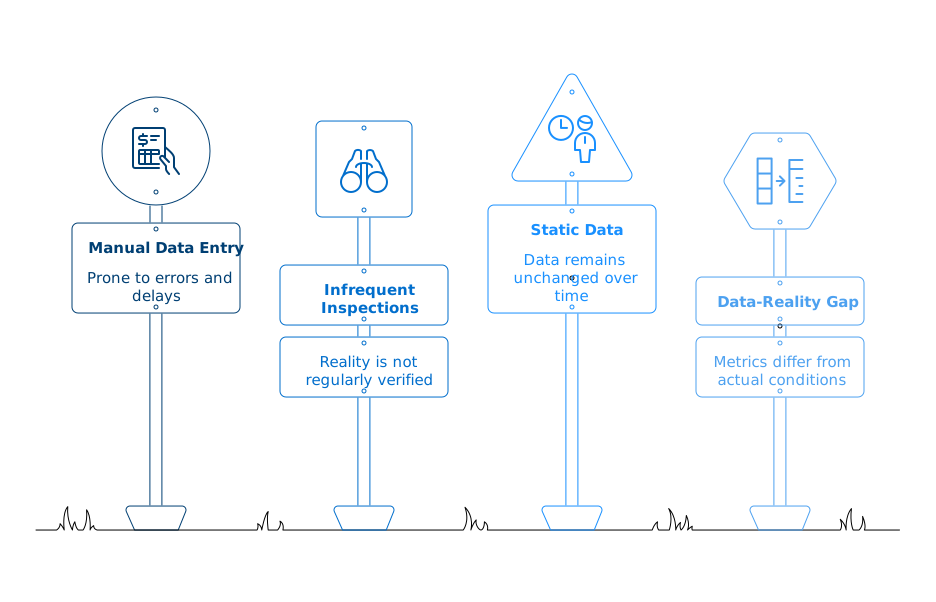
Manual checks were time-consuming and costly, so they were performed only sporadically—often in response to suspicion rather than as part of routine operations. Once data was entered into systems, it tended to remain unchanged for long periods, regardless of what actually happened on the ground.
Everyone involved understood the risks this created. However, as long as deviations were perceived as isolated exceptions rather than recurring patterns, the system continued to function.
The core challenge was the absence of continuous, objective visibility into day-to-day operations.
The Tension
Over time, confidence in the reported data began to erode.
Operational teams began noticing recurring inconsistencies between what reports indicated and what they observed in practice. Conveyor utilization appeared uneven. Staffing levels did not consistently align with the observed workload. Specific shifts were consistently over- or under-resourced, yet these patterns were rarely reflected in the metrics.
Isolated spot checks provided partial reassurance but also raised uncomfortable questions. If discrepancies were confirmed in some cases, how many others went unnoticed?
The organization found itself in a familiar yet risky position. Decisions continued to be made, budgets allocated, and performance evaluated—yet the link between recorded data and physical reality became increasingly uncertain.
This uncertainty created internal friction. Operational teams questioned the reports’ accuracy, while management struggled to determine whether the deviations were anecdotal or systemic. Without objective evidence, discussions relied heavily on assumptions, experience, and intuition.
The issue was no longer theoretical. The lack of reliable verification had begun to erode trust in the data itself.
The Real Problem
At first glance, the situation appeared to be a data quality issue. Numbers were inconsistent, reports were questioned, and some processes seemed unreliable.
A closer look revealed a different reality. The organization had records, defined processes, and experienced professionals who made informed decisions. The problem was not missing data, broken systems, or a lack of discipline.
What was missing was objective, continuous verification.
As long as physical reality could only be checked through manual intervention, verification remained episodic and reactive. By the time discrepancies were identified, their effects had often already propagated into planning, staffing, and performance evaluation.
This created a structural limitation: decisions were inevitably grounded in assumptions rather than evidence. Not because reality was ignored, but because there was no scalable way to express it.
Without a mechanism to continuously observe and validate what was happening on and around the conveyor belts, even well-intentioned decisions carried hidden risk. Over time, these minor uncertainties accumulated and quietly eroded confidence in the system.
The Turning Point
The breakthrough did not come from adding more controls or increasing manual oversight. Instead, the organization reframed the question.
Rather than asking how to verify more frequently or inspect more efficiently, a different perspective emerged: how could verification become part of everyday operations without slowing them down?
The answer was already present in the environment. Conveyor belts were continuously moving. Work areas were already visible. Cameras were already in place for operational and safety purposes.
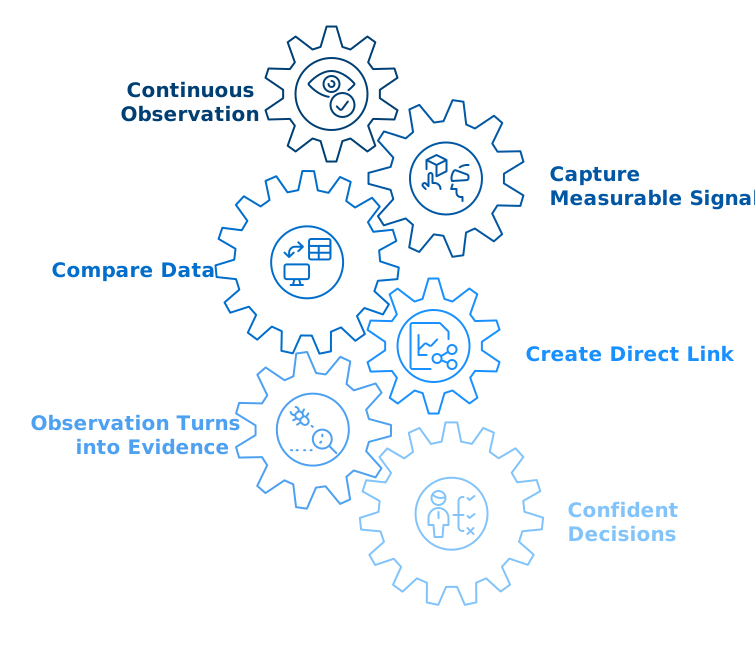
The shift was subtle yet decisive—from periodic inspection to continuous observation.
The objective was not surveillance, enforcement, or the replacement of human judgment. It was alignment: establishing a direct, objective link between physical reality and operational data.
By treating visual information not as raw footage but as a measurable signal, reality itself could begin to validate assumptions in real time. Observation became evidence, and verification no longer depended on exceptional effort. This mindset shift laid the foundation for rebuilding trust in data through visibility rather than stricter rules.
What Didn’t Work Immediately
Early implementation quickly adjusted initial expectations.
Reality proved more complex than anticipated. Conveyor belts were rarely uniform. Materials overlapped. Lighting conditions varied throughout the day. Human movement was less predictable than static process descriptions suggested.
As a result, early outputs were not always consistent. Some edge cases required manual review, and in certain situations, the effort required to interpret results seemed disproportionate to the immediate value gained.
There was a clear temptation to oversimplify or overpromise, but the organization consciously avoided it. Instead, the focus shifted to learning. Algorithms were refined, parameters adjusted, and operational feedback incorporated into the interpretation.
Most importantly, expectations were reset. Visual verification was framed as a decision-support tool rather than an automated judge. Its purpose was to reduce uncertainty, not eliminate human responsibility. This approach preserved trust and allowed the solution to mature in real-world conditions.
What Changed Over Time
As the system matured, its impact became increasingly consistent and measurable.
Continuous observation made previously invisible patterns apparent. Conveyor utilization trends stabilized. Staffing data began to reflect actual on-site conditions rather than assumptions. Deviations were identified earlier, often before they escalated into operational or planning issues.
Over time, several shifts became apparent:
- The accuracy of activity and utilization insights improved steadily.
- Manual verification needs have decreased significantly.
- Internal discussions shifted from isolated anecdotes to shared, observable facts.
Instead of relying on occasional inspections, the organization gained ongoing situational awareness. Conversations that once led to debate could now be grounded in evidence. Uncertainty did not disappear, but it became manageable.
Most importantly, confidence in the data began to return—not because the system claimed perfection, but because its outputs could be continuously compared with reality. Verification became routine rather than exceptional, and trust evolved from an assumption into something earned.
The Lesson Learned
The experience revealed a critical insight.
Organizations do not lose control because they lack data. They lose control when reality offers no practical way to challenge assumptions.
In this case, systems and processes were in place, and people acted in good faith. Yet without continuous verification, even well-structured operations drifted from what was actually happening. Once verification became part of everyday operations, data stopped being theoretical. It became observable, testable, and actionable.
The result was not rigid control, but better decision-making. Not absolute certainty, but a measurable reduction in blind spots.
Final Insight
Perfect visibility is neither realistic nor necessary. What organizations need is enough reality in the system to keep assumptions honest.
When observation is embedded in everyday operations, trust no longer depends on belief or manual effort. It becomes a byproduct of transparency. Data regains its role as a reliable foundation for decisions because it can always be checked against what actually happens.
This is where visual verification delivers lasting value: not by replacing judgment, but by grounding it in evidence.

Lajos Fehér
Lajos Fehér is an IT expert with nearly 30 years of experience in database development, particularly Oracle-based systems, as well as in data migration projects and the design of systems requiring high availability and scalability. In recent years, his work has expanded to include AI-based solutions, with a focus on building systems that deliver measurable business value.
Related posts


Turning Ambition into Real, Scalable Results