
From Video to Insight
Where Video Analysis Creates Operational Value
- AI Business Use Case
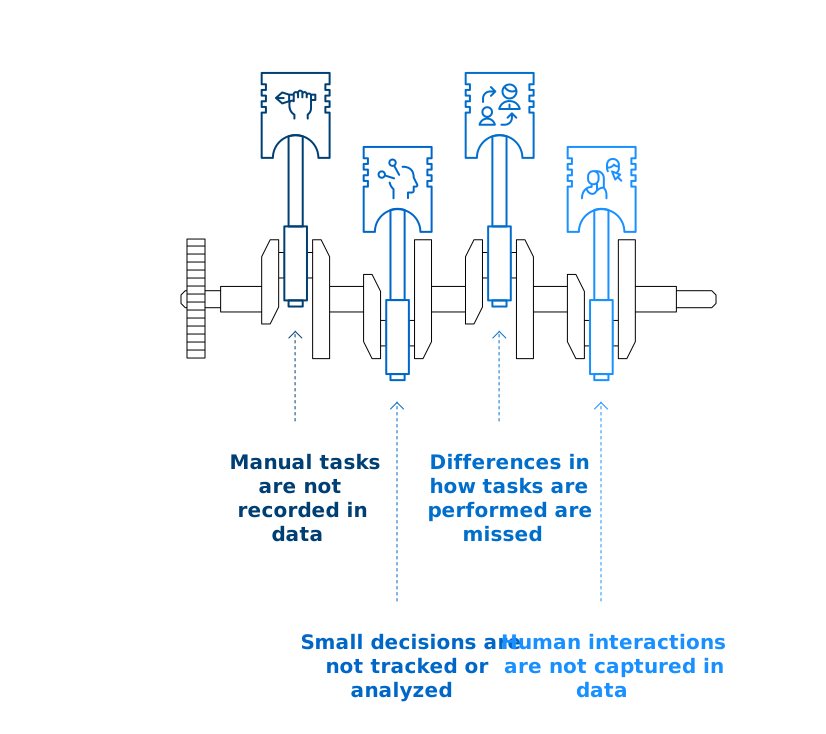
Most organizations operate with a blind spot: they measure outcomes but don’t see what actually happens within the process.
Activities are carried out, decisions are made, and work progresses — yet this layer largely remains unseen. Consequently, inefficiencies continue, problems are identified too late, and decisions depend more on assumptions than on evidence.
This article explains how image and video analysis make these hidden operational patterns visible — and where this approach creates real business value.
Capturing footage is not the same as turning it into actionable insight
Cameras are everywhere. Most organizations already capture large amounts of visual data as part of their daily operations — from production floors to logistics environments.
But capturing footage is not the same as understanding what is happening.
In practice, visual data is treated as passive evidence: It is stored, archived, and occasionally reviewed when something goes wrong. By that point, the opportunity to act has already passed.
What actually happens inside processes — manual activities, sequences of actions, small variations in execution — remains largely invisible. Not because it cannot be seen, but because it cannot be systematically interpreted at scale.
And this has direct consequences:
- inefficiencies remain hidden,
- deviations are noticed too late,
- performance differences are explained after the fact, not during execution,
- decisions rely on assumptions instead of observed reality.
This gap is especially critical in environments where work is physical and activity-driven.
For example, in the pilot context, the focus was not on outcomes but on hands performing operations and whether those operations could be recognized and distinguished in video. This is the layer where real process understanding either exists or breaks down.
Without a consistent way to interpret this level of detail, organizations are effectively managing operations with partial visibility.
What visual analysis entails
The value of image and video analysis is often misunderstood.
Instead of storing footage and relying on manual review, systems can interpret what is happening in the scene — consistently and at scale.
In practice, this means identifying elements such as:
- objects (tools, materials, assets),
- people and their presence,
- movement and interaction,
- sequences of actions over time.
In the pilot, this was applied at a very specific level: hands performing operations, and the recognition of those operations as distinct activities.
This distinction matters.
Because operational insight rarely depends on a single event. It depends on understanding how actions unfold over time:
- which steps follow each other,
- where variation occurs,
- how consistently tasks are executed.
This is where video — not static images — becomes essential.
An image captures a moment. A video captures behavior.
And behavior is what defines processes.
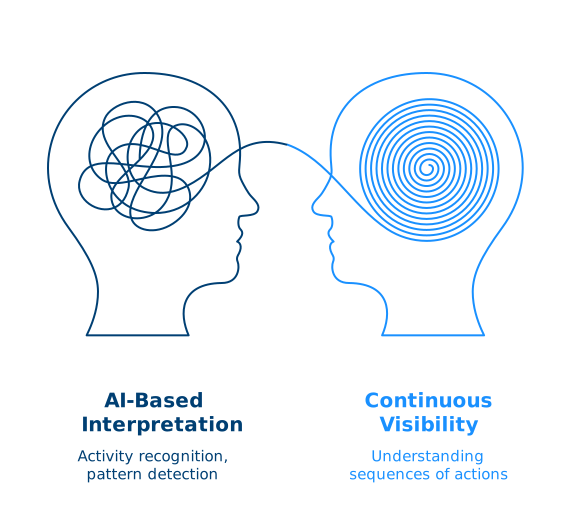
By structuring this behavior into recognizable patterns, visual analysis makes something previously intangible measurable. This is the shift:
- from recording reality → to interpreting it,
- from isolated observations → to continuous visibility,
- from assumptions → to evidence-based understanding.
And this is where the first real business value appears — in making operational activity visible in a consistent, analyzable way.
Where it works
This is where most discussions go wrong.
The question is usually framed as: “How accurate is the model?” That’s the wrong question.
The real question is: Under what conditions does this become reliable enough to matter?
The pilot made this explicit.
Performance did not fail randomly. It varied systematically based on context.
The system worked well when:
- camera position was consistent,
- both hands were clearly visible,
- activities followed predictable, repeatable patterns,
- visual differences between actions were distinct.
Under these conditions, even simplified activity categories could be recognized with meaningful reliability.
But when these conditions broke, performance dropped — fast. And that leads to a non-negotiable conclusion: There is no universal performance. There is only context-specific reliability. That is exactly why average accuracy is misleading.
An “80% accurate” system tells you nothing unless you know: 80% where, under what conditions, and for which types of activities. The practical implication is straightforward:
- you don’t deploy this everywhere,
- you don’t aim for perfect recognition,
- you identify where the signal is strong enough — and focus there.
In other words: Value comes from selecting the scenarios where it already works well enough.
What this makes possible
Once the expectations are corrected, the value becomes concrete. This changes how organizations approach visual data.
- Instead of asking: “Can we monitor everything?”
- They start asking: “Where does visibility actually improve decisions?”
And that shift has a direct operational impact:
- less time spent on manual observation,
- faster identification of relevant events,
- clearer understanding of how processes actually unfold,
- reduced reliance on assumptions and post-hoc explanations.
Importantly, the system need not cover the entire process. It only needs to cover the parts that matter most and can be observed reliably.
That is enough to:
- reduce uncertainty,
- highlight patterns,
- support better interventions.
This is why even a constrained pilot delivers value. Because it removes guesswork in specific, high-impact areas.
And once those areas are understood, scaling becomes a controlled, evidence-based decision.
Key Takeaways
This case highlights that video analysis is not about capturing more data, but about making existing reality interpretable at scale.
A few key conclusions stand out:
Capturing footage does not create insight. Without structured interpretation, visual data remains passive evidence rather than an operational input.
The real value lies in behavior, not in static events. Understanding how actions unfold over time is what enables meaningful process insight.
There is no universal model performance. Reliability is always context-dependent, shaped by environment, visibility, and task structure.
Average accuracy is misleading without context. What matters is where and under which conditions the system performs reliably enough to support decisions.
Value comes from selective deployment. The goal is not full coverage, but identifying where visibility already creates measurable impact.
Even partial visibility is enough to reduce uncertainty. Recognizing recurring patterns can already improve understanding and decision-making.
These insights suggest that successful applications of video analysis are not driven by technical perfection, but by aligning expectations with where the technology already works well enough to matter.
Final insight
The value is clarity about where accuracy matters. Activity recognition fails when expectations are wrong.
If you expect a system to understand every activity, in every condition, with consistent precision, it will disappoint you. If you design it to reveal where visibility is possible and useful, it becomes a decision tool.
That is the core lesson.
- The question is no longer: “Does this work?”
- It is: “Where does this work well enough to change how we make decisions?”
Organizations that answer this early build systems that are grounded in reality.

Csaba Fekszi
Csaba Fekszi is an IT expert with more than two decades of experience in data engineering, system architecture, and AI-driven process optimization. His work focuses on designing scalable solutions that deliver measurable business value.
Related posts

Turning Organizational Knowledge into Confident Decisions

A Business Use Case of Visual Verification in Operational Monitoring

What an Early Video Analysis Pilot Revealed About Operational Insight