
When Every Claim Becomes a Reputation Risk
A Business Use Case of AI Search in Insurance Claims Management
- AI Business Use Case
Every claim decision carries financial, legal, and reputational consequences.
For operational leaders in the insurance sector, the pressure is constant: increase speed, control costs, detect fraud earlier — while keeping decisions fair and defensible. Yet in many organizations, the real bottleneck is fragmented knowledge.
This business use case shows how AI Search can support claims management by making policy rules, historical precedents, and fraud indicators accessible at the exact moment of decision — enabling faster handling without increasing operational or reputational risk.
The Business Context: When Claims Become a Strategic Risk Point
In a high-volume insurance environment, claims handling is under constant pressure. Customers expect fast resolutions. Regulators expect consistency and transparency. Leadership expects cost control and fraud detection.
Claims handlers move between systems, documents, and case files while the clock is ticking. Under SLA pressure, decisions rely heavily on experience and manual search.
Over time, the consequences become visible in daily operations. Similar cases are resolved differently. Escalation volumes rise. Turnaround times stretch beyond expectations. Fraud is identified, but only after it should have been, often after the financial impact has already materialized.
The organization continues to operate, but with less stability than before. Variability increases, pressure accumulates, and tolerance for mistakes narrows. Each quarter, the margin for error becomes smaller — and the cost of inconsistency becomes more visible.
The Core Problem: Knowledge Exists — But Not at Decision Time
The issue is the absence of clarity at the moment of decision.
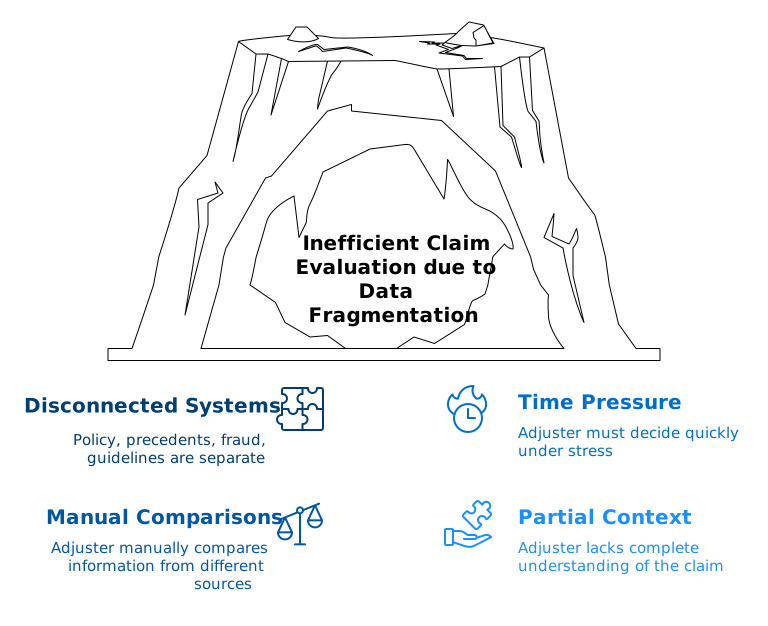
In most insurance organizations, critical knowledge already exists. Policies are written. Exceptions are documented. Fraud signals are defined. Past decisions are archived.
But they are:
- stored in separate systems,
- embedded in long, legalistic documents,
- difficult to compare with similar historical cases,
- disconnected from fraud context,
- dependent on manual search and individual experience.
When a claims adjuster must decide within minutes, fragmentation becomes risk.
The consequence is predictable:
- decisions take longer to validate,
- similar cases receive different outcomes,
- escalations increase,
- complaint volumes rise,
- fraud patterns are detected too late.
Over time, this becomes a governance and reputation issue.
The Strategic Decision: Support Speed Without Losing Control
In high-volume, high-stakes operations, full automation is rarely the objective. The strategic priority is to reduce uncertainty in the decision workflow.
The core business question becomes structural: How can decision velocity increase without amplifying complaints, fraud exposure, regulatory scrutiny, or legal risk?
The answer is structured accessibility.
An AI Search layer can be deployed across:
- policy and contractual documentation,
- internal operational guidelines,
- historical decision archives,
- fraud indicators and investigative notes.
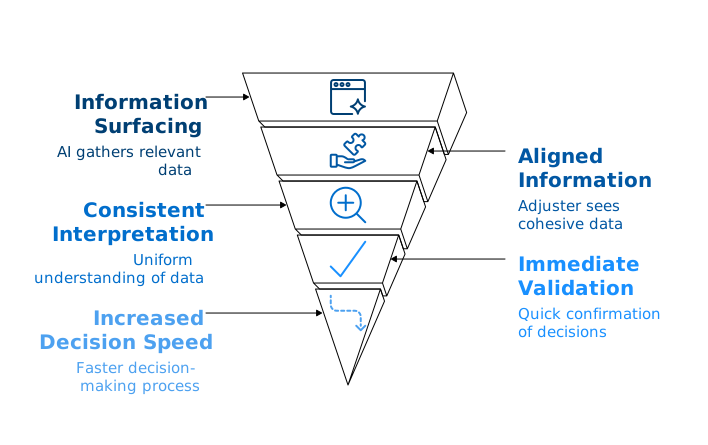
Its function is precise: deliver contextualized, referenced knowledge at the moment of decision. Instead of navigating fragmented systems, decision-makers gain immediate access to:
- applicable policy clauses,
- comparable historical cases,
- related exclusions and edge conditions,
- connected fraud signals.
All traceable. All explainable. Control remains human. The system reduces search friction, surfaces relevant context, and increases cross-team consistency.
The strategic shift is architectural: From fragmented information retrieval to structured decision support.
Implementation Reality: Visibility Before Velocity
In most environments, the first measurable impact of AI Search is transparency.
When knowledge becomes searchable across silos, inconsistencies surface:
- divergent interpretations between teams,
- incomplete documentation of precedents,
- inconsistent escalation logic,
- informal practices outside formal governance.
This represents a typical inflection point in transformation initiatives. A technical enablement effort evolves into a governance alignment exercise.
Successful adoption requires agreement on:
- interpretation standards,
- documentation discipline,
- precedent usage rules,
- escalation logic.
Once structural alignment is established, acceleration becomes sustainable. Speed follows structure.
Business Impact: From Reactive Handling to Controlled Execution
When knowledge becomes unified and accessible, measurable improvements typically follow:
- 25–35% reduction in turnaround time,
- lower escalation and complaint volumes,
- improved decision consistency,
- earlier identification of fraud indicators.
These outcomes are driven by clarity, strengthening them.
Decision-makers spend less time searching and validating documentation. They spend more time evaluating and communicating.
From a leadership perspective, oversight also improves. Management gains structured visibility into:
- recurring decision patterns,
- cost drivers across categories,
- fraud concentration areas,
- policy interpretation gaps.
Operations shift from reactive case handling to controlled execution. The improvement is not only in speed. It is governance stability.
Strategic Effect: Confidence Through Structured Access
Beyond performance metrics, the structural impact is confidence. For operational teams, confidence means:
- validated policy interpretation,
- alignment with comparable historical outcomes,
- explainable decisions.
Reduced uncertainty decreases defensive decision-making. For leadership, confidence means:
- consistency across teams,
- early visibility into emerging risks,
- improved control over cost volatility,
- reduced governance exposure.
AI Search standardizes access. When knowledge becomes available at decision time, speed and fairness reinforce each other. Compliance and efficiency no longer compete.
The operating model shifts from balancing risk and agility to manage both simultaneously.
Lessons Learned: Access Determines Control
This use case revealed a structural but often underestimated reality:
- Claims instability rarely originates from complex policies. It originates from fragmented access to them at decision time.
- Most insurers invest heavily in defining governance frameworks. Fewer invest in embedding them into daily workflows.
- AI Search did not replace human control. It strengthened it through contextual clarity. It did not accelerate decisions blindly. It made acceleration defensible.
- In high-volume claims environments, the real advantage is not more automation. It is structured, explainable access to knowledge.
Final Insight: Speed Only Protects Reputation When It Is Defensible
In high-stakes environments, acceleration alone does not create value. Organizations seek decisions that are:
- faster,
- consistent,
- traceable,
- defensible.
When knowledge is available at the exact moment of evaluation:
- complaints decrease,
- fraud is identified earlier,
- governance exposure declines,
- reputational stability improves.
Operations move from reactive firefighting to controlled execution. And in any regulated, high-impact environment, reputation is protected not by speed alone — but by explainable speed.
If you would like to explore how AI Search can support controlled acceleration in your claims operations, we are ready to continue the discussion.

Lajos Fehér
Lajos Fehér is an IT expert with nearly 30 years of experience in database development, particularly Oracle-based systems, as well as in data migration projects and the design of systems requiring high availability and scalability. In recent years, his work has expanded to include AI-based solutions, with a focus on building systems that deliver measurable business value.
Related posts

Turning Organizational Knowledge into Confident Decisions

A Business Use Case of Visual Verification in Operational Monitoring