
When Every Call Becomes a Moment of Truth
A Business Use Case of AI Search in Contact Center Operations
- AI Business Use Case
If you lead a contact center — or your company operates one — you already know this: performance breaks down because clarity is missing at the decisive moment.
In high-volume environments, fragmented information slows decisions, increases handling time, and quietly erodes customer trust. This Omnit business use case shows how AI Search enables real-time, compliant, and consistent answers during live customer interactions — and why decision-time knowledge access becomes a strategic priority for you as a leader or stakeholder.
Business Context: High Volume, Structural Complexity
It may be your case that in your organization, agents handle:
- multiple products and service tiers,
- thousands of daily interactions,
- strict Service Level Agreements (SLAs),
- increasing regulatory and compliance constraints.
On paper, everything looks structured. You have knowledge bases. Policies are documented. FAQs are updated. Complaint-handling rules are defined. Individually, these elements work. Collectively, they create friction. Your agents move between systems while customers wait. Answers vary by experience level or channel. Escalations slowly become a safety mechanism rather than a true exception.
You see it in your KPIs:
- average handling time increases,
- first call resolution declines,
- complaints rise.
Your organization is operating under structural pressure — and that pressure directly affects efficiency and trust.
The Core Problem
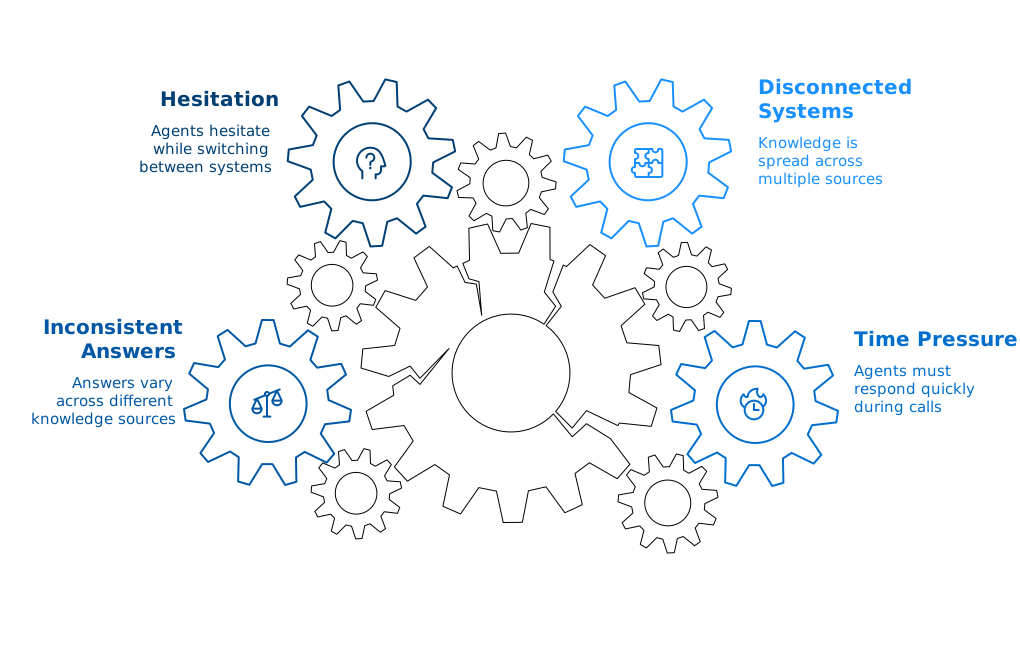
You already have the knowledge. It lives in document repositories, ticketing systems, legacy knowledge bases, compliance archives, and informal team practices that have evolved. None of these systems is wrong. Yet they are not unified.
Under pressure, your agents search across platforms while maintaining the flow of a live conversation. Customers notice pauses. They sense uncertainty.
And hesitation has consequences:
- longer handling times,
- inconsistent answers,
- defensive decision-making,
- rising operational costs.
Your agents are trained. Your processes are defined. Your expectations are clear. Yet hesitation remains — because your system is not optimized for clarity and efficiency at decisive moments.
At its core, this is an architectural problem.
The Strategic Objective
You face a structural dilemma. You must respond faster as volumes increase and expectations rise. At the same time, every answer must remain accurate, compliant, and defensible.
If you prioritize speed alone, you increase risk. If you prioritize control alone, you reduce agility. What you need is controlled acceleration.
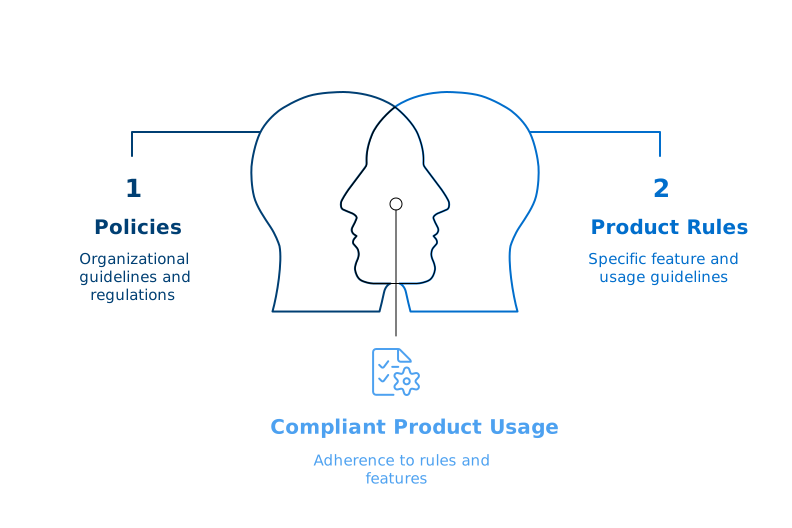
You need your agents to act quickly while maintaining consistency, compliance, and confidence in every interaction. That requires:
- faster access to validated knowledge,
- consistent answers across channels,
- reduced escalation dependency,
- measurable improvement in KPIs,
- full compliance traceability.
The Solution — AI Search as Your Decision-Support Layer
AI Search introduces a unified decision-support layer directly into your agent workflow. Instead of navigating multiple systems, your agents ask a question. Instead of guessing, they receive a referenced, policy-aligned answer.
AI Search connects:
- structured and unstructured documents,
- product descriptions and FAQs,
- internal policies and compliance rules,
- complaint handling procedures,
- archived case knowledge.
What you gain is:
- context-aware retrieval,
- consistent answers across teams,
- traceable references to source documents,
- reduced search time during live calls.
You reduce uncertainty exactly when it matters most, during the interaction.
Implementation Reality
Deploying AI Search does not automatically eliminate fragmentation. When you introduce unified search, inconsistencies become visible. You may discover:
- contradictory policy documents,
- outdated knowledge articles,
- duplicated content,
- informal practices not reflected in documentation.
AI Search exposes these structural weaknesses. To succeed, you must:
- harmonize documentation,
- clarify knowledge ownership,
- define governance rules,
- align compliance validation,
- support change management.
When your knowledge becomes consistent, AI Search becomes reliable. When it becomes reliable, adoption accelerates.
Measurable Business Impact
When your agents access validated knowledge at decision time, operational metrics shift. Organizations in similar environments typically observe:
- 20–35% reduction in Average Handling Time,
- measurable improvement in First Call Resolution,
- significant reduction in supervisor escalations.
You also see:
- faster onboarding,
- shorter ramp-up periods,
- fewer repeat contacts,
- reduced internal consultation during live calls.
Operational variability decreases. Performance becomes more predictable. Your contact center shifts from reactive firefighting to controlled performance management.
Strategic Impact: Replacing Hesitation with Confidence
The most important change is behavioral. Without decision-time clarity, agents hesitate. With unified AI-powered knowledge access, hesitation decreases.
Your agents operate with confidence because:
- answers are traceable,
- policies are aligned,
- responses are consistent,
- compliance context is visible.
For you as a leader, this creates structural stability. You enable greater operational speed while maintaining consistency, and you support growth without increasing risk at the same pace.
Final Insight
Your contact center performance is rarely limited by effort. The speed and certainty of decision-making constrain it. When hesitation enters the interaction, customers wait. When answers vary, trust erodes. When escalation becomes routine rather than exceptional, operational costs increase.
AI Search addresses this structural constraint by making your knowledge operational at the exact moment decisions are made.
If you are evaluating how AI Search could strengthen decision-making in your contact center, we would be glad to share practical next steps.

Lajos Fehér
Lajos Fehér is an IT expert with nearly 30 years of experience in database development, particularly Oracle-based systems, as well as in data migration projects and the design of systems requiring high availability and scalability. In recent years, his work has expanded to include AI-based solutions, with a focus on building systems that deliver measurable business value.
Related posts

Turning Organizational Knowledge into Confident Decisions

A Business Use Case of Visual Verification in Operational Monitoring