
When Information Overload Becomes an Investment Risk
A Business Use Case of AI Search in Asset Management
- AI Business Use Case
In asset management, clarity isn’t everywhere.
Chief Investment Officers and portfolio managers operate under constant pressure: volatile markets, demanding boards, and increasing regulatory scrutiny. Investment decisions must be explainable, defensible, and immediate.
In many investment organizations, research, historical assumptions, ESG context, and portfolio rationale live in separate systems and documentation layers.
The real risk is the inability to surface the full reasoning behind a decision when it matters most.
This business use case examines a structural pattern in asset management environments: how AI Search transforms fragmented investment knowledge into decision-ready intelligence — strengthening judgment without automating it.
Business Context: Data Maturity Without Decision Clarity
Modern asset management firms are rarely struggling with data availability.
- Internal research teams produce detailed analyses.
- External data providers supply market intelligence.
- Portfolio and risk systems generate structured reporting.
- ESG documentation meets regulatory standards.
Individually, each element functions well.
Collectively, however, they do not automatically form a unified investment narrative.
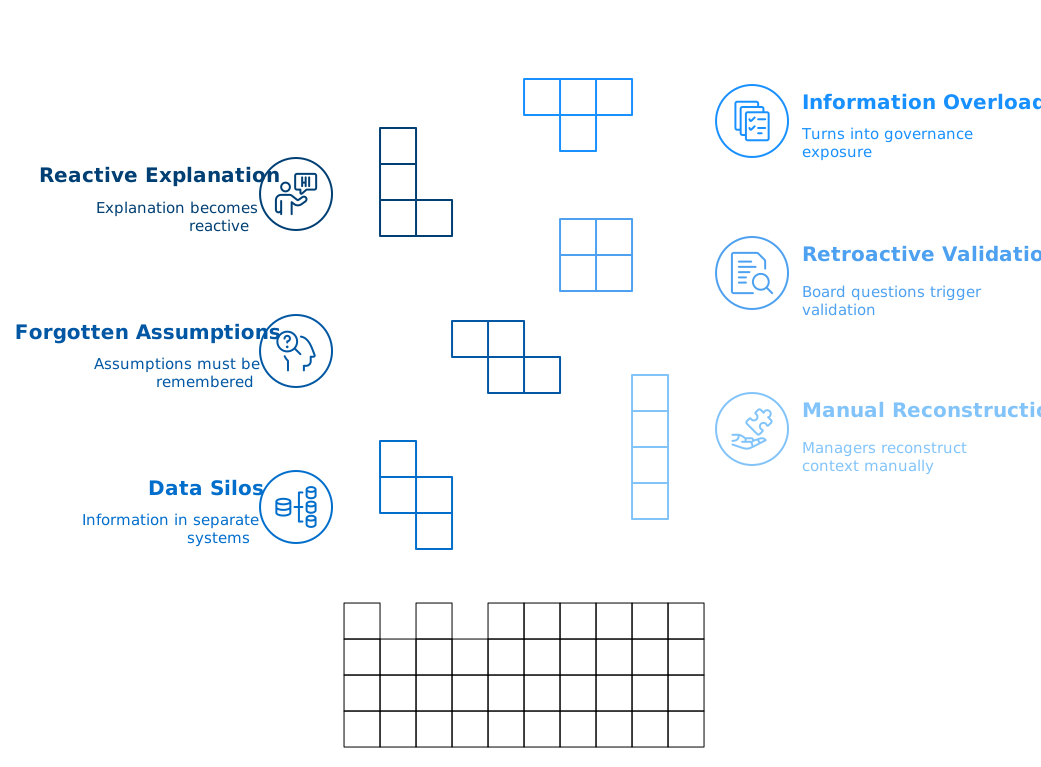
Portfolio managers often navigate multiple systems to reconstruct context. Analysts piece together historical assumptions manually. Investment committee materials are assembled under time pressure, relying heavily on personal memory and dispersed documentation.
Decisions are informed. But they are not instantly explainable.
For investment leadership, that gap is more than an operational inconvenience. It represents governance exposure.
The Strategic Risk: When Explanation Becomes Reactive
The structural tension rarely appears during stable markets. It surfaces under scrutiny.
A simple board-level question illustrates the risk: “Why was this allocation chosen — and what alternatives were considered?”
Performance metrics alone are insufficient. Leadership expects context, assumptions, scenario comparisons, and explicit risk trade-offs.
In fragmented environments, answering such questions often requires:
- revisiting archived research,
- reconnecting historical market assumptions,
- reconstructing the decision context months later,
- validating ESG and risk considerations retroactively.
Individual decisions may be defensible. But surfacing the full chain of reasoning quickly is difficult.
In volatile markets, time matters.
Delayed explanation creates hesitation. Hesitation weakens authority.
This is where information overload becomes investment risk, because insight is structurally trapped across systems.
The Strategic Objective: Strengthening Judgment, Not Replacing It
In high-volume, high-stakes operations, full automation is rarely the objective. The strategic priority is to reduce uncertainty in the decision workflow.
The objective in such environments is not to automate investment decisions. Asset managers are not seeking an AI that “selects better assets.” They seek institutional coherence.
The strategic question becomes: “How can every investment decision be backed by retrievable, structured, and explainable context — in real time?”
AI Search addresses this structural gap by creating a unified knowledge access layer across:
- internal research archives,
- portfolio history and allocation records,
- market analysis documentation,
- ESG and governance materials.
Instead of manually navigating systems, decision-makers can query across sources and receive consolidated, source-traceable responses.
This is a decision-support layer that strengthens human judgment by operationalizing institutional knowledge.
Technology is the enabler. Decision confidence is the outcome.
Organizational Reality: AI Reveals Structural Discipline
AI Search typically exposes structural inconsistencies:
- undocumented historical assumptions,
- inconsistent research formats across teams,
- ESG considerations not clearly linked to portfolio decisions,
- risk commentary stored separately from allocation rationale.
The limitation is a knowledge discipline. AI does not create clarity. It makes clarity — or its absence — visible.
Successful adoption, therefore, requires:
- documentation standardization,
- tagging and taxonomy alignment,
- defined knowledge ownership,
- governance validation processes.
AI amplifies structured thinking. Without structure, it amplifies fragmentation.
Business Impact: Reduced Decision Friction
Across asset management environments, measurable impact appears first in time efficiency.
Research preparation cycles shorten significantly. Historical assumptions become retrievable within seconds instead of hours. Reuse of prior analysis increases. Investment theses can be revisited and stress-tested without reconstruction from scratch.
Board and investment committee discussions shift in tone.
Instead of reconstructing past reasoning, leadership focuses on a forward-looking strategy. Questions are answered with traceable references. Confidence in the investment narrative increases — particularly under volatile market conditions.
Decision friction disappears.
Strategic Shift: From Data-Rich to Judgment-Ready
The deeper impact is cognitive.
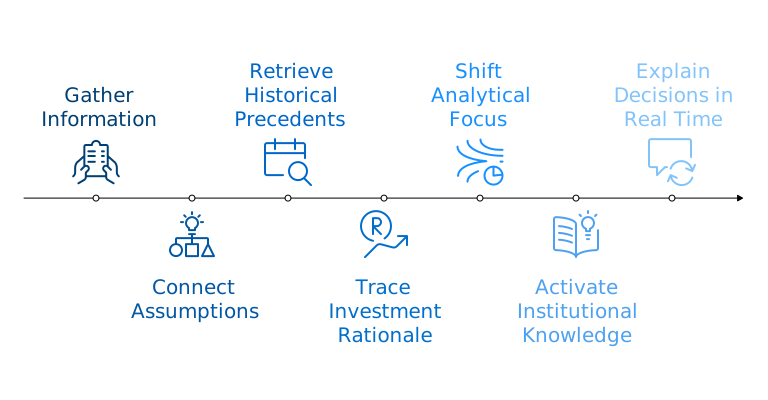
Before structured knowledge access, teams spend their energy asking a simple operational question: Where is the information?
Analysts search across systems, reconstruct past assumptions, and validate documents before they can even begin thinking about the investment itself.
After stabilization, the question changes. It becomes: what does this mean for our portfolio? Analytical capacity shifts from retrieval to interpretation.
Institutional knowledge is no longer passive documentation stored in separate repositories. It becomes active memory — accessible, connected, and ready to support judgment.
As a result, decision-making grows more consistent. Investment narratives become clearer and more defensible.
Governance strengthens because reasoning can be traced and explained.
KeyBusiness Insights of the Article
Beyond operational efficiency, the real impact is cognitive.
- When knowledge is fragmented, analytical energy is consumed by retrieval. Teams search, validate, and reconstruct before interpreting.
- When knowledge becomes structured and accessible, that burden disappears. The central question shifts from “Where is the information?” to “What does this mean for our portfolio?” Institutional knowledge turns from static documentation into active memory.
- Decisions become more consistent because their reasoning is visible. Investment narratives grow clearer because assumptions are connected.
- Governance strengthens because explanations are traceable.
This is not about automating judgment. It is about aligning it. And in volatile markets, alignment is more than an internal benefit. It is a strategic advantage.
A Final Word
If your investment organization is data-rich but explanation-poor, the issue is rarely performance. It is structured.
Ask yourself a simple question: could your team reconstruct the full reasoning behind a critical allocation decision in minutes — not days?
If the answer is uncertain, the opportunity is clear.
At Omnit, we help asset management leaders design AI Search frameworks that transform fragmented research, portfolio history, and governance documentation into decision-ready intelligence.
Not to replace judgment — but to strengthen it.
If you would like to assess how aligned and retrievable your institutional knowledge truly is, let’s start the conversation.

Lajos Fehér
Lajos Fehér is an IT expert with nearly 30 years of experience in database development, particularly Oracle-based systems, as well as in data migration projects and the design of systems requiring high availability and scalability. In recent years, his work has expanded to include AI-based solutions, with a focus on building systems that deliver measurable business value.
Related posts

Turning Organizational Knowledge into Confident Decisions

A Business Use Case of Visual Verification in Operational Monitoring

A Business Use Case of AI Search in Insurance Claims Management