
The State of OCR Technology
Accuracy, Architectures, and the Real-World Factors That Still Limit Performance
- AI Building Blocks
OCR — short for Optical Character Recognition, the technology that converts scanned or photographed text into a digital format that machines can read — has improved significantly in recent years. Thanks to transformer models and newer multimodal approaches, today’s leading systems can achieve nearly perfect accuracy on clean, well-formatted documents.
But in real-world situations, it’s not always flawless. Performance can vary quite a bit depending on factors such as document types, layout consistency, how well the files are prepared in advance, and even the specific domain or industry.
For organizations choosing the right OCR tools, it’s no longer just about the model itself. You need to consider the entire picture — benchmarks, pipelines, limitations, and how everything works together. This broader understanding is becoming increasingly important.
What This Article Is About
This article offers a strategic overview of the current OCR landscape, emphasizing key factors to consider when assessing today’s technologies. It discusses:
- How modern OCR models — such as CNNs (Convolutional Neural Networks), transformers, and newer multimodal LMMs (Large Multimodal Models) — perform on various document types
- What accuracy metrics like CER (Character Error Rate) and WER (Word Error Rate) actually indicate (and what they don’t)
- The influence of preprocessing and post-processing steps on real-world accuracy
- Why results in production often fall short compared to those in controlled lab environments
- And the ongoing challenges OCR still faces — particularly with handwriting, complex layouts, multiple languages, and noisy or low-quality inputs
The goal? To help decision-makers understand what today’s OCR systems can do, where they struggle, and what to focus on when choosing a solution that works well in real-world situations — not just on paper.
The figures, accuracy ranges, and performance estimates mentioned throughout this article are based on Omnit’s internal OCR research and evaluation processes. These insights demonstrate how transformer-based, CNN-based, and multimodal OCR systems perform on real-world documents — not just on benchmark datasets — and highlight the practical patterns observed when testing models in realistic operational conditions.
Understanding Today’s OCR Landscape
Rapid Progress, Persistent Variability
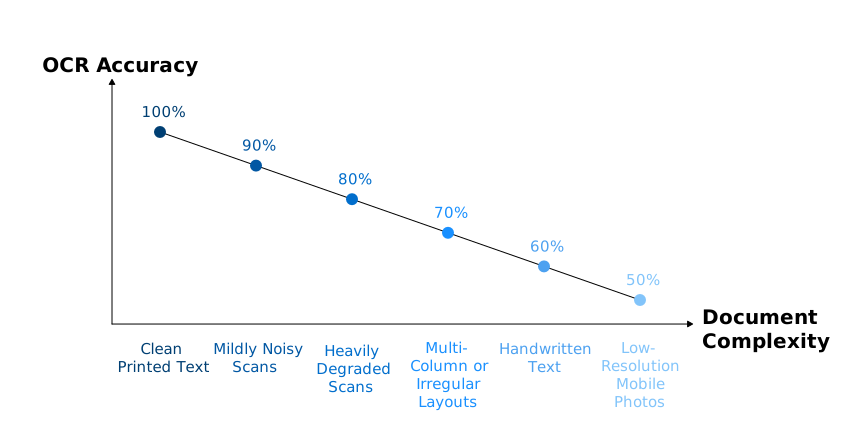
OCR technology has advanced significantly through improvements in computer vision, language models, and multimodal reasoning. Today’s systems excel at processing clean, printed text — and are also getting better at handling semi-structured layouts and multilingual content. However, in real-world applications, things get more complicated. Scanned documents often contain noise, blurriness, handwriting, unusual layouts, and various formatting inconsistencies. Even the most advanced models can struggle under these conditions.
That’s why choosing an OCR engine involves more than just evaluating its benchmark performance; it also requires understanding the real-world limitations influenced by how documents move through your workflows.
How Accuracy Is Measured in OCR
Benchmark Metrics: CER and WER — Important Metrics for Measuring OCR Performance
When assessing OCR system performance, two metrics are most commonly used: CER (Character Error Rate), which indicates the percentage of characters the system misidentifies, and WER (Word Error Rate), which reflects the percentage of words recognized incorrectly. Top systems today can achieve CER below 1% on clean, printed documents and WER below 2% in controlled test environments. However, keep in mind that these figures reflect ideal lab conditions, whereas real-world documents usually present a much more complex scenario.
The Technologies Behind Modern OCR
Transformer-Based OCR
Transformers — advanced deep learning models that understand long-range relationships — have quickly become the backbone of modern OCR, and what makes them unique is their ability to interpret complex document layouts, combine visual cues with text-based context, manage complex reading patterns like multi-column or non-linear formats, and adapt to a wide variety of document types. Taken together, these capabilities make transformers the top choice for enterprise-level OCR applications.
CNNs and Hybrid Models
CNNs (Convolutional Neural Networks) still have their place, especially when speed and efficiency are critical, and they work well for clean, high-quality scans, structured documents with predictable formats, mobile OCR apps, and hardware-limited setups. However, they face challenges with messy layouts or noisy images, which is why hybrid models — combining CNNs with sequence-based layers — seek to address these issues. Even so, pure transformer-based solutions are gradually replacing them.
Multimodal LMM-Driven OCR
One of the most significant recent changes is the merging of OCR with Large Multimodal Models (LMMs) — systems that combine vision and language understanding. These models do more than recognize text — they can:
- detect key entities and fields,
- understand the visual structure and hierarchy of documents,
- extract meaning from tables and forms,
- and even correct OCR errors using contextual language cues.
This advances OCR from basic text extraction to comprehensive document understanding.
Where OCR Is Headed
Looking at where the industry is headed, a few themes emerge, including tighter integration between visual and language models, end-to-end systems that reduce manual setup and tuning, and significantly improved handling of real-world, unpredictable documents. The future of OCR isn’t just pattern-matching anymore — it’s about intelligent, multimodal reasoning that can genuinely understand documents in context.
The OCR Pipeline: From Input to Output
Why Preprocessing Matters
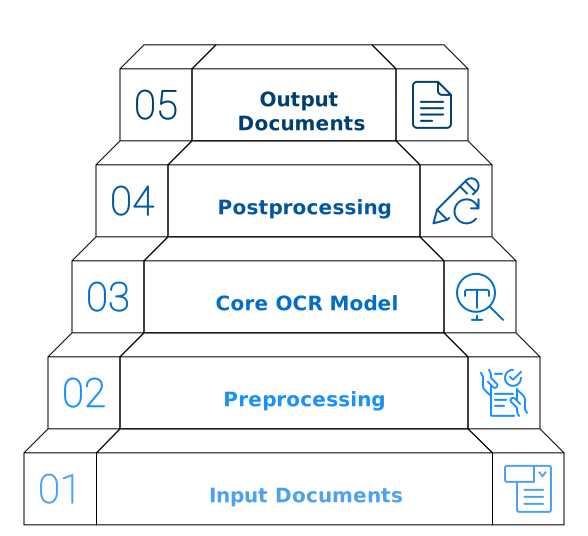
Even the best OCR models can struggle if the input quality isn’t high enough. That’s where preprocessing comes in — it can significantly improve the outcomes.
Key steps include:
- Deskewing: fixing tilted scans, often boosting accuracy by 5–15%.
- Denoising: removing background noise, stains, or artifacts.
- Contrast normalization: making text easier to see.
- Layout detection: identifying tables, images, and text areas so the model focuses on the right parts.
When done correctly, preprocessing helps the model concentrate on what truly matters.
The Role of Post-processing
After OCR captures the raw text, post-processing cleans and corrects the output using rules, context, and domain knowledge. This may involve running a language model to correct awkward or unlikely phrasing, checking formats (e.g., verifying dates or totals), matching words against dictionaries, and applying logic based on known business rules or field types. Taken together, these steps can often improve accuracy by an additional 4–5%, which adds up quickly when scaled.
Pipeline Impact on Real-World Accuracy
In production, the design of your entire OCR pipeline often has a greater impact than replacing a single model. Strong, well-tuned pipelines can deliver consistent accuracy across all input quality levels, handle low-quality scans without failing, reduce the need for manual corrections, and maintain high throughput while delivering reliable results. The bottom line is that OCR isn’t solely about choosing the best model — it’s about developing the right system from input to output.
Benchmarks and Their Limitations
Benchmarks help compare OCR systems in ideal, controlled environments. They show what’s possible, but it’s essential to see them as maximum limits, not guarantees of real-world results.
Most benchmarks are categorized into one of these groups:
- Printed text datasets: ideal for assessing performance on clean, straightforward scans.
- Handwriting datasets: demonstrate how much accuracy can differ across styles and quality.
- Document-structure datasets: evaluate how effectively systems extract tables, form fields, and interpret layout.
Each one shares a different part of the performance story.
As multimodal OCR systems grow, newer benchmarks are becoming more complex, including multi-column and irregular-layout documents, mixes of handwriting and printed text, content in multiple languages, and reading orders that don’t just go left-to-right, top-to-bottom. Altogether, these benchmarks more accurately reflect the challenges observed in real enterprise workflows. At the same time, advanced research benchmarks frequently demonstrate strong results on clean, structured inputs, steep drop-offs with noisy, low-quality scans, noticeable accuracy differences across languages and scripts, and clear benefits from using multimodal models. They’re helpful, but they don’t show the complete picture of operational reality.
In practice, day-to-day document processing involves all kinds of messiness, such as varying scan resolutions, old photocopy artifacts, handwritten notes scribbled in the margins, industry-specific terms or formatting, and inputs coming from scanners, phones, faxes — you name it. Because of this, organizations must test OCR tools with their own real documents, since benchmarks are a starting point, not the final solution.
Ongoing Challenges for OCR
OCR systems still face limitations when input quality decreases, and they struggle with low-resolution images, blur, shadows, and uneven lighting, folds, smudges, and old or stained paper, as well as noisy captures from mobile devices. That’s why solid preprocessing is essential for obtaining usable results. Handwriting is still unpredictable, and its accuracy relies on the writing style — since block lettering is easier than cursive — the cleanliness and uniformity of the page layout, whether annotations are mixed in, and how varying the strokes and spacing are. Even minor changes in handwriting can affect production results.
Beyond writing style, OCR models — including the latest transformers — can still struggle with documents that contain multiple columns, scientific formatting, receipts and irregular layouts, marketing brochures, or forms with handwritten notes mixed in. The more chaotic or unconventional the structure is, the more difficult it becomes to extract clean, accurate data. Accuracy also often declines when documents contain multiple languages, scripts like Latin mixed with Cyrillic or Arabic, or niche, domain-specific terms. Many OCR systems aren’t designed to manage that level of linguistic complexity without using specialized models.
Further complicating things, production documents tend to be disorganized, and you’ll frequently notice partially covered or obstructed text, low-light or tilted mobile photos, scans of other scans with degraded quality, and stamps, signatures, or overlapping marks. Most of these issues don’t appear in benchmark datasets, so their accuracy in real-world situations is often lower than expected.
Even with all the technological progress, human review remains essential — especially in high-risk or compliance-heavy environments. People are still needed to verify key fields, correct handwriting errors, make judgment calls on unclear characters, and ensure the final output complies with regulatory standards. Full automation sounds ideal, but in practice, it’s still rare when accuracy truly matters.
Key Takeaways for Decision-Makers
- Modern OCR systems can achieve near-perfect accuracy on clean, printed documents — yet in real-world situations, results can vary significantly.
- Handwriting remains a challenging area, with accuracy fluctuating depending on style, clarity, and consistency of the input.
- Transformers have become dominant because they manage complex layouts and mixed content types better than traditional CNN-based models.
- At the forefront, multimodal LMMs are beginning to revolutionize the field — introducing structural awareness and deeper semantic understanding that bring OCR closer to full document comprehension.
- However, model choice isn’t everything. Effective preprocessing and post-processing can boost accuracy by 10–20%, highlighting the importance of the entire pipeline’s quality as much as the OCR engine itself.
- Benchmarks are useful to gauge best-case performance, but they don’t tell the whole story. The only true way to assess how a system performs is by testing it with your own documents and workflows.
- Messy inputs — such as noise, complex layouts, or documents containing both printed and handwritten content — still present challenges across the board.
- In high-stakes situations like legal, financial, or medical documents, human review remains crucial. While automation has advanced greatly, when accuracy and compliance are critical, human oversight is still necessary.
A Final Word
OCR has never been more advanced — yet its actual value still depends on how well it performs outside controlled environments. Benchmarks can demonstrate what’s possible, but only your actual documents reveal what’s realistic. That’s why the real advantage today isn’t just selecting the “strongest” model. It’s about developing a pipeline that enables the model to succeed: solid preprocessing, context-aware post-processing, and clearly defining where automation ends and human judgment begins.
For decision-makers, one key lesson stands out: OCR becomes a business asset only when its capabilities are measured against your real-world workflows — not just against ideal test sets.
So it’s worth asking:
- What happens when your own documents — not sample data — are processed?
- Where can multimodal models add fundamental structure awareness, and where is a simpler architecture sufficient?
- And how much accuracy can be improved just by tuning the pipeline around the model?
To conclude this article, there is one last thing that is primordial for you to ask yourself:
- When choosing an OCR solution, are you evaluating the technology — or assessing how it performs in your real environment?
That difference determines whether OCR becomes a cost or a capability.

Lajos Fehér
Lajos Fehér is an IT expert with nearly 30 years of experience in database development, particularly Oracle-based systems, as well as in data migration projects and the design of systems requiring high availability and scalability. In recent years, his work has expanded to include AI-based solutions, with a focus on building systems that deliver measurable business value.
Related posts