The tool to tackle AI hallucinations
Retrieval-Augmented Generation (RAG)
- AI Building Blocks
One of the biggest challenges users face with AI tools is AI hallucinations. AI hallucinations are responses created by the AI to satisfy the user, even when they are not based on facts. These hallucinations often lead to false information or misleading answers. If undetected, these responses can cause a snowball effect, with issues spreading throughout the system due to the AI’s hallucinations.
One of the most effective methods to reduce AI hallucinations is Retrieval-Augmented Generation.
Unlike traditional models that rely on fixed, pre-trained data, RAG-based systems access trusted sources in real time, ensuring each response is grounded in current, verifiable facts.
We at Omnit have made this use of AI, one of our key specialties.
In this article, we will review the basics of RAG and its various versions, drawing on our experience developing and implementing them.
What You Will Learn
If You’re Reading This Article, You’ll Learn:
- What AI hallucinations are and why they pose a serious risk in real-world AI systems
- How Retrieval-Augmented Generation (RAG) reduces hallucinations by grounding responses in trusted, up-to-date sources
- How classic RAG works and where its limitations appear
- The key differences between Agentic RAG, GraphRAG, Reasoning RAG (RAG+), and LightRAG
- When to use each RAG variant— and when not to
- How advanced RAG systems improve accuracy, explainability, and trust in enterprise AI
- Why RAG is becoming a core building block for reliable document analysis and decision support
By the end of this article, you’ll understand how RAG turns AI from a confident guesser into a system that knows where its answers come from.
The goal isn’t to turn you into a RAG architect — or to make you memorize vector dimensions and graph schemas. And no, you won’t be debugging hallucinations at 3 a.m. with coffee and regret.
The goal is to give you just enough understanding to recognize why AI sometimes sounds convincing but wrong — and how RAG fixes that problem in a practical, enterprise-ready way.
Think of this article as your anti-hallucination guide: so you can build, buy, or evaluate AI systems that rely on facts instead of confidence — and sleep better knowing your AI isn’t making things up.
Classic RAG: The Foundation of Grounded Intelligence
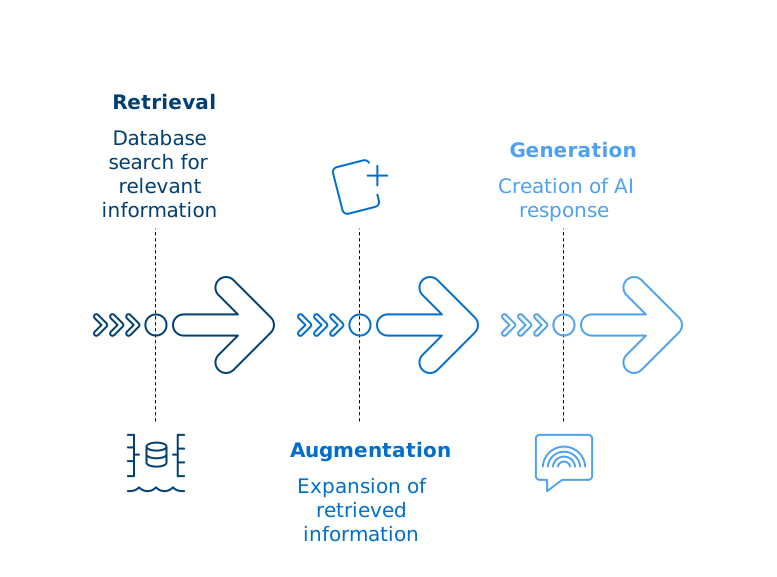
Technically, an RAG system works through a three-step process:
- Retrieval: The model converts the user’s query into a vector and searches an external knowledge base (such as documents, databases, or APIs) for the most relevant chunks based on their meaning.
- Augmentation: The retrieved text is integrated into the model’s context window — effectively expanding the model’s “memory” with factual, real-time information.
- Generation: The LLM then synthesizes this contextual data to create a coherent, evidence-based response.
This approach tackles one of the biggest challenges in AI: hallucination — when a model confidently produces fluent but entirely false outputs.
By grounding each response in a verifiable context, RAG significantly improves the accuracy, reliability, and accountability of AI-generated content, making it more appropriate for real-world decision-making.
While traditional RAG systems marked a significant advancement, their architecture remains fundamentally limited. Because they rely on static databases and fixed retrieval processes, they struggle to keep up with rapidly changing information or shifting contexts.
To overcome these limitations, modern RAG variants incorporate more adaptive mechanisms and specialized techniques that expand how information is collected, interpreted, and utilized.
In the following sections of the article, we will explore emerging innovations in the field of RAG that turn it from simply a tool for improved search into a dynamic, understandable framework for enterprise-level intelligence.
Agentic RAG: The Autonomous Information Seeker
Agentic RAG redefines AI as an active researcher. Instead of merely extracting data from a static source, Agentic RAG carefully plans its approach, breaks down complex questions, searches multiple data sources, and verifies the results before delivering a final answer.
This change shifts the AI’s role from that of an assistant to an analyst.
At the core of this system are AI agents — independent components or sub-models that perform specific reasoning or operational tasks within the larger framework. Each agent is goal-oriented, capable of making decisions, using tools, or working with other agents to reach a common goal. For example, one agent might focus on searching databases, another on verifying retrieved content, while a third concentrates on synthesizing insights into a straightforward narrative. Together, they form an integrated network that resembles a multidisciplinary research team, working in parallel or in sequence to ensure accuracy and depth.
By managing a team of specialized agents — each responsible for functions like retrieval, verification, summarization, or synthesis — Agentic RAG creates a layered, evidence-based understanding of any prompt. The result is more accurate and reliable output — especially in high-stakes or fast-changing environments such as financial services, scientific research, or enterprise support.
While this model adds complexity and requires more computational power, it also offers something that traditional RAG systems cannot: strategic reasoning. Agentic RAG doesn’t just retrieve what it’s instructed — it determines how to retrieve what truly matters.
Key Characteristics of Agentic RAG
- Multi-agent setup – Specialized agents manage tasks such as search, validation, and synthesis.
- Access to multiple data sources, including APIs, internal systems, the web, and databases.
- Real-time adaptability – Constantly updates context and strategy as new information appears.
- Reduced hallucination risk – Each output is checked against retrieved facts.
- Higher cost and latency – Demands more orchestration, computational resources, and infrastructure.
Agentic RAG marks a significant move toward explainable, autonomous AI — created not only to provide answers but to reason through them.
GraphRAG: Building Knowledge Through Relationships
GraphRAG advances retrieval-augmented AI by going beyond keyword or vector search.
Instead, it organizes knowledge as relationships — linking entities like people, organizations, events, or concepts into a dynamic, navigable graph.
The result? An AI that not only finds facts but also understands how they connect.
By building and utilizing knowledge graphs, GraphRAG allows systems to answer questions with more meaningful context and clarity. Instead of retrieving isolated text snippets, it can examine the connections between data points — highlighting patterns, dependencies, and cause-and-effect chains that would remain hidden in simple search results.
It combines graph traversal with vector search to find both semantically relevant and structurally important information. This two-layered approach not only boosts accuracy but also improves explainability — the model can illustrate its reasoning process, which is vital in sensitive or regulated fields like legal analysis, biotechnology, and financial research.
However, the power of GraphRAG comes with the trade-off of increased operational complexity. Since its graphs must remain accurate and up to date, updates often require reindexing and meticulous data integration. This makes it suitable for stable, high-value knowledge areas where maintaining detailed, structured context provides significant benefits.
Key Characteristics of GraphRAG
- Entity and relationship graphs – Create structured links between knowledge components.
- Graph traversal and vector retrieval – Combines semantic search with structured reasoning.
- Explainability – Allows transparent tracing of how answers were generated.
- Hybrid data integration – Combines structured databases with unstructured text sources.
- Higher maintenance cost – Demands reindexing and graph management when new data is added.
GraphRAG is ideal for enterprises where understanding why an answer is correct is as important as the answer itself — a move toward AI that reasons through relationships instead of just relevance.
Reasoning RAG (RAG+): When the Model Starts Thinking
Reasoning RAG, often called RAG+, presents an essential enhancement to retrieval-augmented AI: structured reasoning.
Instead of just finding relevant facts and rephrasing them, this model actively thinks through the problem — breaking it down, exploring possibilities, and building answers through deliberate logic.
By combining techniques like Chain-of-Thought (CoT) and Tree-of-Thought (ToT), Reasoning RAG handles multi-step problems, asks itself sub-questions, and revisits earlier steps when necessary.
It mimics how humans reason — not in a straight line, but through branching exploration, validation, and synthesis.
This layered approach is perfect for tasks that require more than just surface-level understanding. Whether it’s diagnosing complex technical issues, planning long-term business strategies, or making sense of ambiguous or conflicting data, Reasoning RAG performs well where traditional models reach their limits.
Of course, thinking requires time.
The deeper reasoning and iterative steps make Reasoning RAG slower and more computationally intensive than standard RAG approaches. But in exchange, you gain accuracy, transparency, and decisions grounded in real logic — not just statistical associations.
Key Characteristics of Reasoning RAG (RAG+)
- Chain-of-Thought & Tree-of-Thought reasoning – Supports multi-step and branching logic.
- Decomposes complex tasks – Breaks questions into smaller parts.
- Blends retrieval with inference – Uses retrieved data as raw input for reasoning.
- Exceptional accuracy – Ideal for diagnostics, forecasting, and strategic planning.
- Higher latency and cost – Reasoning workflows require more computation.
Reasoning RAG marks a move from pattern-matching AI to goal-oriented intelligence — where the aim isn’t just quick answers, but thoughtful ones.
LightRAG: Fast, Cost-Efficient, and Scalable
LightRAG adds a practical twist to advanced retrieval — focusing on speed, affordability, and scale without sacrificing quality.
Inspired by GraphRAG’s structured insights, it streamlines the architecture with lightweight graph structures and a dual-level querying system: one layer focuses on specific details, while the other provides a broader contextual understanding.
This design enables LightRAG to provide rich, context-aware answers while maintaining low resource use.
It’s particularly ideal for enterprises handling large, evolving datasets — from legal archives and healthcare records to internal documentation — where real-time responsiveness and cost-efficiency are essential.
Unlike heavier models, LightRAG doesn’t require a full reindex when data updates. Instead, it allows for incremental updates, making it flexible and easy to manage. With lower token usage and fewer API calls, it scales more smoothly across users and scenarios — providing enterprise-level intelligence without the high price.
Key Characteristics of LightRAG
- Hybrid retrieval – Combines graph-based context with precise vector search.
- Dual querying – Combines detailed local searches with broad summaries.
- Token-efficient – Designed for low overhead and quicker response times.
- Incremental updates – Prevents full reindexing when adding new data.
- Cost, speed, and accuracy balance – Designed for high performance at scale.
LightRAG proves that RAG can be both powerful and practical — delivering reliable, current intelligence in a lightweight, scalable package designed for real-world enterprise needs.
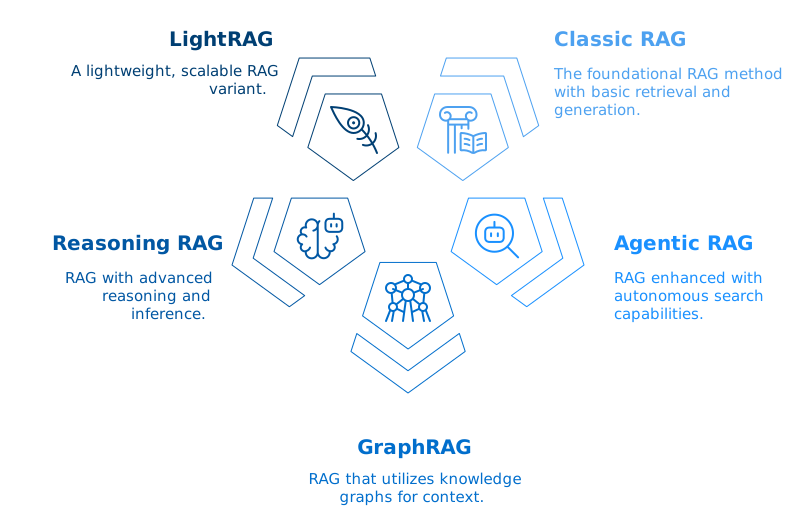
Key RAG Variants and Their Unique Features: A Summary of the Main Points
Classic RAG – The Foundation
- Retrieves relevant data from a static source.
- Generates grounded responses to reduce hallucination.
- Improves factual accuracy compared to standalone LLMs.
- Limitation: Lacks adaptability to new or changing information.
Agentic RAG – The Autonomous Information Seeker
- Employs multiple specialized AI agents to plan, search, and validate.
- Dynamically queries multiple data sources (APIs, documents, web).
- Offers the most flexibility and intelligence.
- Trade-off: High complexity and infrastructure cost.
GraphRAG – Context Through Connection
- Builds structured knowledge graphs connecting entities and ideas.
- Enables explainable and traceable answers via relationship mapping.
- Ideal for highly regulated or research-intensive fields (law, biotech, finance).
- Trade-off: High setup and ongoing maintenance due to reindexing.
Reasoning RAG (RAG+) – The Logic-Driven Decision-Maker
- Integrates Chain-of-Thought and Tree-of-Thought reasoning methods.
- Decomposes complex problems and infers multi-step conclusions.
- Great for diagnostics, planning, or forecasting.
- Trade-off: Slower response time and higher compute cost.
LightRAG – Efficient and Enterprise-Ready
- Lightweight version of GraphRAG with hybrid graph/vector retrieval.
- Dual-level querying: local (details) + global (context)
- Supports incremental updates without full reindexing.
- Strength: Best balance of speed, cost, and context for large-scale use.
Each of these RAG models serves a specific, strategic purpose; however, they are not competing tools — they are complementary layers within an evolving ecosystem. Together, they enable AI systems that not only locate knowledge but also reason through it, learn from it, and apply it accurately in real-world business scenarios.
The Final Word
RAG is becoming an essential part of AI document analysis and a key tool for staying competitive. As the business world accelerates due to the use of AI, the question isn’t whether you’ll use RAG, but when you’ll start using it if you want to remain competitive.
At Omnit, we develop and create customized RAG systems for organizations that want to speed up and optimize their processes while increasing the overall safety of their document management systems.
If you find this article interesting, please let us know. If you are interested in an RAG system for your enterprise or organization, or if you want to explore the subject of RAG further feel free to contact us below.

Lajos Fehér
Lajos Fehér is an IT expert with nearly 30 years of experience in database development, particularly Oracle-based systems, as well as in data migration projects and the design of systems requiring high availability and scalability. In recent years, his work has expanded to include AI-based solutions, with a focus on building systems that deliver measurable business value.