
Why Computers Process Numbers, Not Words
Natural Language Processing (NLP)
- AI Building Blocks
You are constantly exposed to text — emails, reports, contracts, chat messages, documentation, and presentations. Natural Language Processing (NLP) is a set of methods and tools designed to help you manage and understand all this text more efficiently.
While OCR helps computers “see” text, NLP helps them “read” it. It can assist you in classifying, summarizing, drafting, extracting data, translating, or simply organizing information that would otherwise take a lot of time and mental effort.
This overview explains what NLP is, how it works behind the scenes, what it is good at (and where it falls short), and how you can use it safely and effectively in your daily work.
What You Will Learn
If you keep reading, you’ll receive a clear breakdown of:
- The Core Transformation: How machines move from counting words to interpreting context
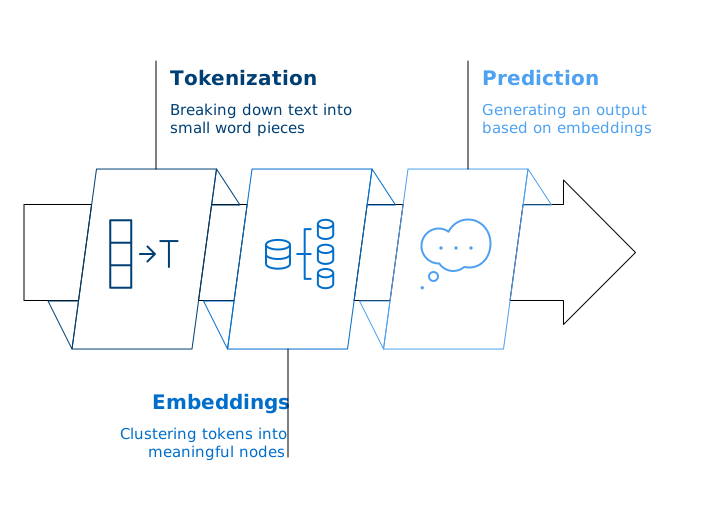
- The Pipeline: A look at the specific steps of tokenization, semantic vectorization, and prediction
- Capabilities & Limits: Why NLP is great at sorting but lacks a concept of “truth”
- Risk Awareness: The unique risks of bias and misleading outputs
- Best Practices: Habits that ensure your models stay grounded in reality
Our goal with this article is not to turn you into a data scientist, but to give you enough understanding so that you can use NLP confidently and critically.
From “Manual Reading” to Strategic Text Capability
To use NLP effectively in any setting, it helps to understand what it truly is and what it is not. At its core, NLP involves teaching computers to understand written human language.
From a business perspective, you can think of NLP as a reading and sorting engine for your organization. While a human might skim a handful of documents and tag them, an NLP system can quickly scan thousands of documents and:
- categorize them,
- highlight key fields,
- produce concise summaries,
- route them to the appropriate team.
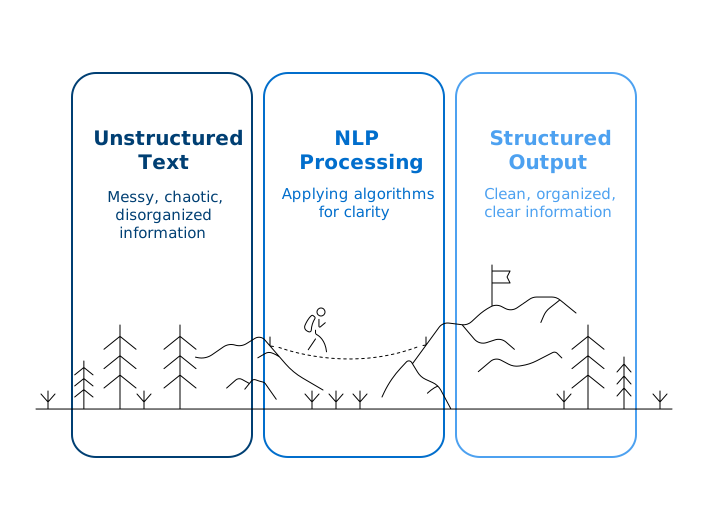
Crucially, NLP does not “understand” language the way humans do. It detects recurring patterns in text and uses them to make predictions. Its strength is the speed and consistency with which it applies these learned patterns across large amounts of text.
Inside the NLP Toolbox: From Words to Vectors
Text Normalization and Tokenization
Raw text is disorganized; it includes typos, formatting artifacts, signatures, headers, and many minor inconsistencies. Before any model can process it, the text must be normalized.
This involves “cleaning” the input: dividing text into sentences and words, removing or standardizing noisy characters, normalizing word forms to a standard base, and reducing the weight of frequent function words when necessary. Poor pre-processing undermines every subsequent step.
Semantic Vectorization (Contextual Embedding)
Computers process numbers, not words; NLP transforms text into numeric vectors that represent meaning and usage patterns.
Modern techniques place each word in a multi-dimensional space so that words appearing in similar contexts end up close to each other.
- In the past, computers just counted words.
- Today, Contextual Embeddings ensure that the word “Bank” in “river bank” does not resemble “bank account,” enabling precise distinction.
These vectors serve as the link between language and machine learning.
Pattern-Based Prediction Engines
Once text is converted into these “meaning vectors,” various models can be used.
- Transformers & Neural Networks: Advanced models, like Transformer-based ones, currently dominate because they capture long-range language relationships.
- Prediction: The key point is that NLP models recognize patterns in language. Their effectiveness relies on the data they are trained on and how well the model aligns with the business task.
What NLP Excels at Today
NLP works best when the task is repetitive, text-heavy, and follows clear patterns.
- Intelligent Routing: It can automatically classify incoming messages so they reach the right team.
- Data Extraction: It can extract structured fields — names, amounts, dates, and clauses — from documents such as invoices, contracts, and forms.
- Summarization: It can lessen reading burden by generating brief, factual summaries of lengthy texts.
- Semantic Search: Instead of just using keywords, it finds conceptually related content even when the wording differs.
Language
- Transformation: It assists with translation, rewriting, tone adjustments, and standardization.
The Structural Limitations You Must Not Ignore
NLP systems possess fundamental limitations because they lack an internal model of reality.
- No Concept of Truth: They don’t know whether a sentence is true or false; they only evaluate how well it matches patterns in the training data.
- Contextual Blindness: They might produce an incorrect value from a document if the formatting is unusual or misclassify an atypical message.
- Inherited Bias: If training data contains stereotypes, models will often reproduce them.
- Drift: Language, products, and processes evolve, and an NLP system that is never updated gradually diverges from reality.
The Risk Landscape: Practical Pitfalls
The “meaning-making” nature of NLP introduces unique risks compared to other technologies.
- Hallucination & Misleading Outputs: There is a risk of incorrect or misleading outputs — such as incorrect labels, missing information, or summaries that omit key details.
- Bias & Fairness: Bias can occur in how information is classified or prioritized.
- Privacy Leakage: Privacy and compliance concerns arise when sensitive data is processed without adequate safeguards.
- Brand Damage: Operational risks include brand damage when generated or rewritten text is off-tone or inaccurate.
Practical Tips for Using NLP Safely and Effectively
Success with NLP relies on habits, not just technology.
- Define Clear Goals: Specific goals — such as reducing triage time, improving findability, or extracting key fields — are easier to measure than vague intentions.
- Use Representative Data: You should ensure that models depend on representative data from your own environment.
- Keep Humans in the Loop: Human supervision is still crucial for high-impact results; NLP should support, not substitute, human decision-making.
- Monitor for Drift: Tracking error patterns, corrections, and user feedback helps identify when a model requires updating.
Key Takeaways of the Article
- The Function: NLP allows computers to process human language in text form.
- The Strength: It provides speed, scalability, and consistency across text-intensive workflows like classification, extraction, search, and summarization.
- The Weakness: Its limitations include sensitivity to input quality, inherited biases, a lack of fundamental understanding, and the need for ongoing maintenance.
- The Strategy: NLP provides the most value when it’s integrated into real workflows and humans retain responsibility for final decisions.
To Sum Things Up
NLP allows organizations to handle language at scale. Instead of employees manually reading and sorting every email, document, or ticket, NLP systems can categorize them, extract key information, enhance search capabilities, and generate helpful summaries.
However, they have some limitations: they don’t fully understand the meaning, may inherit biases from data, and their effectiveness relies heavily on input quality and ongoing maintenance. When used thoughtfully — with clear goals, representative data, appropriate safeguards, and ongoing monitoring — it can reliably support daily tasks, allowing people to focus on decision-making rather than routine reading and typing.

Lajos Fehér
Lajos Fehér is an IT expert with nearly 30 years of experience in database development, particularly Oracle-based systems, as well as in data migration projects and the design of systems requiring high availability and scalability. In recent years, his work has expanded to include AI-based solutions, with a focus on building systems that deliver measurable business value.
Related posts



Turning Ambition into Real, Scalable Results


Accuracy, Architectures, and the Real-World Factors That Still Limit Performance
