
The Secret Life of LLMs
How Large Language Models Actually Work
- AI Building Blocks
You’re constantly exposed to text — emails, reports, contracts, chat messages, documentation, and presentations. Large Language Models (LLMs) are tools created to help manage large amounts of text more easily. They can assist you in summarizing, drafting, rewriting, translating, or organizing information that would generally require a lot of time and mental effort.
This overview explains what LLMs are, how they work, what they excel at (and where they fall short), and how you can use them safely and effectively in your daily work.
What You Will Learn
If you keep reading, you’ll receive a clear breakdown of:
- What an LLM really is
- How it works behind the scenes — explained, no deep tech knowledge needed
- What it excels at and where it tends to fall short
- Which business use cases actually make sense right now
- What kinds of risks should you watch out for
- Which practical tips can help you achieve more reliable and valid results
The goal isn’t to turn you into a data scientist — it’s simply to give you enough understanding so you can use LLMs confidently and critically.
From “Autocomplete on Steroids” to Strategic Tool
To utilize LLMs effectively in any setting, it is helpful first to understand what they truly are and how they operate behind the scenes.
A Large Language Model (LLM) is a type of artificial intelligence that processes text. Its primary function is quite simple: it predicts the most likely next word in a sentence. By repeating this process, it can produce complete sentences, paragraphs, and even entire documents that seem natural and human-like.
LLMs are trained on vast amounts of text — including books, articles, websites, and documentation. As a result, they learn patterns such as which words tend to appear together, how sentences are generally structured, and how specific topics are usually discussed. However, they do not typically store facts, nor do they truly “understand” things like humans do. Ultimately, they operate as statistical pattern processors for language.
From a business standpoint, you can think of an LLM as a supercharged autocomplete. While your email might predict the following few words, an LLM can generate a complete response, summary, or draft based on your input.
Take a simple example. Consider the sentence: “Our customer wrote to support because…” A typical autocomplete might suggest the next word. But an LLM can continue the complete thought in a way that actually makes sense; for instance: “Our customer wrote to support because they could not access their monthly report, and they needed the data for an internal management meeting.” Now, the model doesn’t know your actual customer or whether there’s even a real report. It’s just generating a continuation that sounds likely — based on patterns it learned from tons of similar texts.
Although the technology behind LLMs is complex, the basic idea is quite simple. An LLM predicts the next word based on what you’ve already written. Its power comes from how it makes that decision.
Inside the Black Box: How LLMs Really Work
Beneath the surface, today’s LLMs depend on an architecture built specifically to monitor relationships in text.
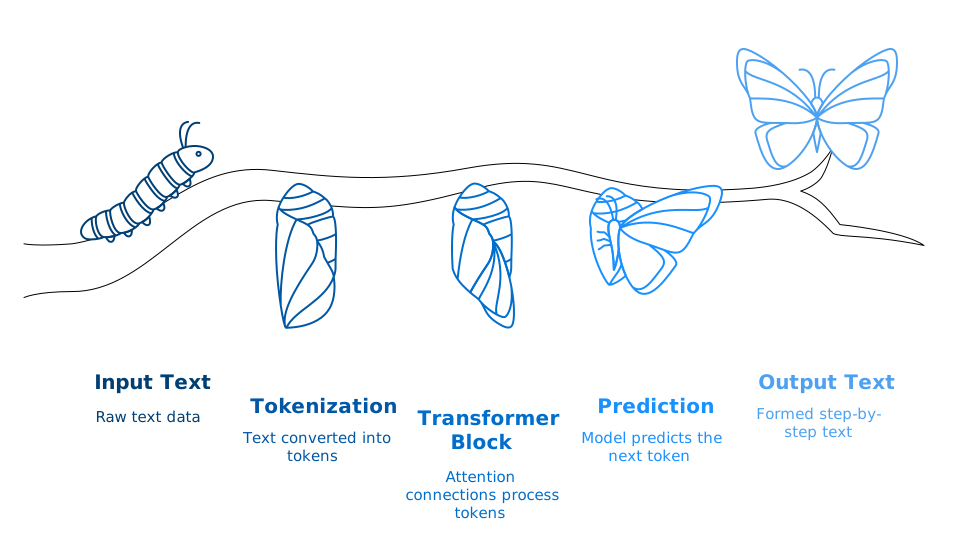
Self-Attention
LLMs employ a transformer architecture, with the core idea being self-attention.
Self-attention is like the model’s way of keeping track of everything at once. It doesn’t just move through words one by one — it’s always cross-referencing, checking how one word relates to another, even if they’re far apart. That’s how it keeps the context clear and doesn’t get lost halfway through a paragraph. Honestly, it’s why these models can tell if you’re being sarcastic, identify the subject of a sentence, or pick out what detail matters most in the bigger picture. Without it, everything would just fall apart into disconnected word salad.
In the sentence “The report that the manager approved was published yesterday,” the model understands that “report” is more closely connected to “was published” than to “approved” — even though those words are separated. This ability to track long-distance relationships helps the model follow your tone, maintain context, and ensure everything flows smoothly across multiple sentences.
Core Processing
When you input something, the model goes through four steps:
- It converts your words into numbers.
- It compares each word to every other word (self-attention).
- It predicts what word should come next.
- It keeps repeating that step, one word at a time, until it finishes the complete response.
It doesn’t perform deep reasoning or fact-checking — it just follows patterns, but does so incredibly quickly and on a large scale.
To make this more straightforward, imagine a colleague who has read millions of documents. If you say something like “We need to prepare the client presentation because…”, that person might finish your sentence by saying: “…the leadership team expects an update on the Q3 results, and they want a clear summary of the key risks.” They’re not recalling this from memory or deep understanding. They’re simply drawing from an extensive mental database of similar phrases they’ve seen before. It’s pattern-matching, not proper comprehension.
LLMs Don’t Do Fact-Check
LLMs excel at working with language — they can continue text, rewrite it, summarize it, and keep coherence across long passages by recognizing patterns in how words usually fit together. They can even mimic your writing style when given a strong example. However, despite how fluent and confident they may sound, they lack a built-in ability to verify if what they produce is actually true.
LLMs don’t fact-check or search for information; they simply predict the most likely wording. As a result, an output can seem polished and credible but still be inaccurate or entirely fabricated.
This is why human review remains crucial, especially when dealing with data, timelines, policies, or any information that needs to be correct before it’s shared or used in decision-making.
How LLMs Learn: From Raw Text to Business Tool
To understand the origins of these strengths and weaknesses, it helps to examine how LLMs are trained.
The process by which an LLM learns occurs in two main phases. First, it develops general language skills. Then, it is trained to behave in a more targeted and controlled manner.
Training
During pre-training, the model reads countless textbooks, articles, web pages, and documentation. The goal is simple: correctly predict the next word, again and again. By doing this millions of times, it begins to learn:
- grammar patterns,
- common sentence structures,
- how topics usually flow,
- which words tend to appear together.
LLMs don’t memorize facts during training; they learn patterns.
That’s why it can write smoothly but still produce incorrect details. When it sees “The quarterly report shows…”, it predicts something like “…revenue growth” just because that’s common phrasing — not because it knows your numbers.
Fine-Tuning
Once pre-training is complete, the model can write, summarize, and translate — but it’s not yet aligned to a specific tone or workflow. That’s where fine-tuning comes into play.
Fine-tuning is giving a model some extra training wheels — specifically for your environment. Instead of starting from scratch, you take a general model and provide it with examples that matter to you — such as your team’s tone, support chats, documents, or whatever standards you follow. It doesn’t make the model smarter in terms of facts, but it does make it much more likely to respond the way you want in real situations. Basically, it helps the model “get” your vibe and stay aligned with what’s acceptable or useful in your daily work.
Companies provide the model with smaller, curated datasets, such as:
- product manuals,
- customer service chats,
- internal guidelines,
- examples of preferred versus unacceptable answers.
This trains the model to behave in a manner more consistent with your organization’s requirements.
Most modern models also learn from human feedback, where people rate outputs based on clarity, safety, and usefulness. This helps reduce hallucinations and enhances consistency.
Because of all this:
- LLMs excel at language but struggle with facts.
- They can sound confident even when they are wrong.
- They can replicate your writing voice if you provide clear examples.
- They become more reliable when calibrated with internal data.
What LLMs Are Truly Skilled At
LLMs excel at tasks that involve lots of text and pattern recognition.
- They’re good at creating first drafts — emails, reports, explanations, or updates. A prompt like “Write a short, neutral update for the team about a delayed project milestone” provides a clear starting point that you can build upon.
- They’re also skilled at summarizing lengthy materials — meeting notes, research papers, documentation, or customer interactions. Summaries save time, although they still need a quick check for accuracy.
- LLMs can rephrase text for clarity or tone, simplify technical terms, or refine awkward phrasing, helping teams maintain clear and consistent communication.
- They can translate between languages while preserving tone — helpful for internal communication or when working with international teams.
- They can organize and categorize unorganized text, tagging content by topic, urgency, sentiment, or request type, or extracting names, dates, and details into clear formats.
- For questions, LLMs generate answers based on patterns in their training or the prompt; however, they don’t look up facts. They become much more reliable when combined with retrieval from your internal documentation.
- LLMs can handle basic reasoning when the logic is straightforward and self-contained. However, they have difficulty with multi-step or highly technical rationale.
- They can also assist with code — creating small snippets, clarifying code, or producing documentation — though outputs still need review.
The Structural Limitations You Can’t Ignore
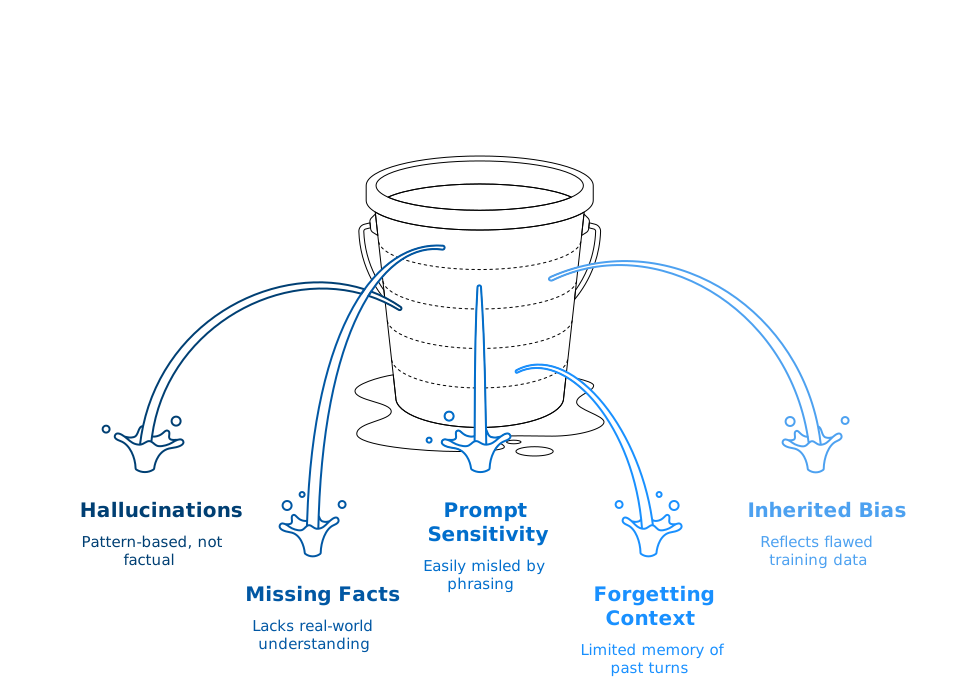
Despite their strengths, LLMs have fundamental limitations linked to their structure.
- Initially, they do not truly understand; they mimic patterns. They might invent numbers, events, or product details because those details appear plausible in the context.
- They are sensitive to how prompts are worded. Vague prompts produce vague or wrong results.
- They struggle to handle lengthy documents, often forgetting or misreading details from earlier sections.
- They inherit biases from their training data — such as gender assumptions, cultural biases, and regional phrases — which can subtly appear in responses.
- They can’t fact-check independently. If you want the truth, you need to provide the source.
- They require significant computing power, which impacts both speed and cost.
- And they struggle with deep or multi-step reasoning— advanced logic, complex workflows, or specialized domain tasks.
The Risk Landscape: Potential Pitfalls to Watch For
In practical workflows, these limitations become specific risk categories:
- incorrect or misleading answers,
- bias affecting summaries, recommendations, or tone,
- prompt injection or manipulation from external text,
- privacy and data protection issues,
- regulatory or compliance risks in automated content,
- over-reliance leading to decreased human oversight,
- operational and cost overruns,
- brand risk from off-tone or inaccurate outputs.
Where LLMs Generate Genuine Business Value
LLMs excel at tasks that are repetitive, text-heavy, or information-dense.
In customer support, they can generate responses in the appropriate style, speeding up agent workflows while keeping humans involved.
For writing tasks, they eliminate blank-page syndrome and provide consistent first drafts — saving time on emails, reports, announcements, and presentations.
They can summarize lengthy documents, thereby reducing the reading load for managers and knowledge workers.
When connected to internal documentation, they help employees find answers faster, highlighting policy details and guidelines without the hassle of navigation.
For unstructured text, they can extract and format data into tables, bullet points, or organized fields.
They support multilingual communication by translating content while maintaining tone.
Technical teams benefit from code explanations, snippets, and draft documentation.
For ideation or early decision support, they help brainstorm options, compare trade-offs, or organize initial ideas.
Operating Principles: Using LLMs Safely and Effectively
A few practical habits significantly improve results:
- use clear, precise prompts,
- verify facts, numbers, and claims,
- establish a consistent tone and include it in your prompts,
- avoid jargon; give straightforward instructions,
- use retrieval to ensure outputs rely on your verified documents,
- keep humans involved for sensitive or customer-facing tasks,
- monitor usage and cost patterns,
- do not send sensitive or regulated data,
- provide examples to guide the model’s output.
Key Takeaways of the Article
- LLMs are language tools, not decision-makers.
- They are excellent in speed and scalability for language-intensive tasks.
- They are not perfect — hallucinations and bias are built-in.
- Their value relies on workflow design, guardrails, and oversight.
- Clear prompts and structure significantly improve results.
- Human review remains essential for accuracy, compliance, and brand protection.
A Final Word
LLMs aren’t a simple push-button solution, but they are extremely useful — if you know how to use them properly. Think of them more as turbocharged language tools than decision-makers. They’re excellent for helping you produce drafts, summaries, translations, or brainstorming ideas — tasks that take up a lot of time — while you handle the real thinking, fact-checking, and judgment calls.
When you provide clear prompts, verify the facts, and keep a human involved, these models can significantly reduce the routine work. That doesn’t mean they replace your skills — it’s more like they enhance them. The real advantage comes when you set things up so the model takes care of the repetitive tasks, while you focus on the aspects that require a human: reading the room, evaluating trade-offs, and making the final decision.

Lajos Fehér
Lajos Fehér is an IT expert with nearly 30 years of experience in database development, particularly Oracle-based systems, as well as in data migration projects and the design of systems requiring high availability and scalability. In recent years, his work has expanded to include AI-based solutions, with a focus on building systems that deliver measurable business value.